Quick answer: Hamden L. Forkner developed the concept for FBLA in 1937 while at Teachers College, Columbia University. The first high-school chapter was chartered at Science Hill High School in Johnson City, Tennessee, on February 3, 1942.
The Three Questions Everyone Confuses
Three distinct questions often get collapsed into one: who had the idea, when was the organization founded, and where did the first chapter open. The official FBLA timeline separates these cleanly, but shorthand references often merge them. Below is a reference table built directly from FBLA’s official About page and the High School 101 Toolkit.
| Question | Answer | Official Evidence |
|---|---|---|
| Who founded FBLA? | Hamden L. Forkner | FBLA identifies Forkner as founder; he developed the concept in 1937 at Teachers College, Columbia University (About page) |
| When was FBLA founded? | 1937 (concept); 1942 (first high-school chapter) | 1937 concept development; first chapter chartered Feb 3, 1942 (About page; Toolkit) |
| Where was the first FBLA chapter chartered? | Science Hill High School, Johnson City, Tennessee | Feb 3, 1942; second chapter followed Feb 5 in St. Albans, West Virginia (About page) |
Why 1937 and 1942 Both Appear in Official Sources
The 1937 versus 1942 distinction is not a matter of one source being wrong. It is a matter of what question a source is answering. When FBLA’s official materials state the organization traces to 1937, they refer to Forkner’s original concept work. A bare “founded in 1942” answer is ambiguous because it does not distinguish between the concept date and the first operational high-school chapter.
However, for students preparing materials where precision matters—study notes, competitive event responses, or chapter history presentations—treating 1942 as the concept date would misrepresent Forkner’s five-year development period. The name “Future Business Leaders of America” was selected in 1940, which sits between the two dates and shows deliberate, paced growth rather than a single founding moment.
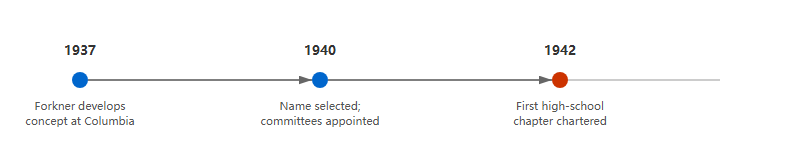
Selective Verified Timeline
Below are milestones drawn only from verified official sources. This is not a comprehensive institutional history; it is a checkpoint list for students who need confirmed dates.
- 1937: Hamden L. Forkner develops the FBLA concept at Teachers College, Columbia University.
- 1940: The National Council for Business Education sponsors the proposed organization; committees are appointed and the name “Future Business Leaders of America” is selected.
- 1942: First high-school chapter chartered at Science Hill High School, Johnson City, Tennessee, on February 3. A second chapter follows on February 5 in St. Albans, West Virginia.
- 1947: Iowa becomes the first FBLA state chapter.
- 1958: Formal postsecondary division created (now FBLA Collegiate).
- 1994: Middle School division formed.
- 2022: Association rebrands under the unified FBLA name.
If your course or event requires organization history, check its current blueprint. The objective-test study method guide covers targeted preparation strategies for competitive formats.
How to Verify a History Claim Before Using It
Students often copy dates from third-party flashcards or unofficial prep sites, which may compress or distort the timeline. You can verify any historical claim by checking it against primary sources. Here is a short verification workflow.
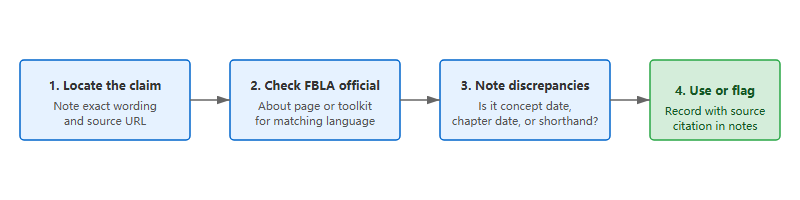
Step 1: Locate the claim. When you encounter a date like “FBLA was founded in 1942,” record the exact wording and where you found it. Shorthand phrasing is common and often harmless, but it is not the same as a primary source statement.
Step 2: Check official sources. The FBLA About page and the High School 101 Toolkit are the two most accessible authoritative documents for historical facts. The About page is preferred for current framing; the toolkit confirms stable historical details but carries a 2023 date, so verify against the About page if wording seems dated.
Step 3: Note discrepancies. Ask whether the source is referring to Forkner’s concept development (1937), the naming and sponsorship (1940), or the first operational high-school chapter (1942). Each is a valid historical marker, but they answer different questions.
Step 4: Use or flag. If you are building study notes for an event, record the date with its context and source citation. If you are writing a chapter history for a competitive event, use the precision that the event’s judging criteria require. The competitive-event format guide covers how different event types are structured.
Frequently Asked Questions
Was FBLA founded in 1937 or 1942?
Both dates appear in official materials for different reasons. Hamden L. Forkner developed the concept in 1937. The first high-school chapter was chartered in 1942. FBLA’s official About page uses 1937 for the founding concept and 1942 for the first chapter. Treat them as complementary, not conflicting.
Who was Hamden L. Forkner?
Forkner was on the faculty at Teachers College, Columbia University, when he developed the concept for an organization to prepare students for business leadership. FBLA identifies him as the founder. The name “Future Business Leaders of America” was selected in 1940.
Where was the first FBLA chapter chartered?
Science Hill High School in Johnson City, Tennessee, on February 3, 1942. A second chapter opened two days later in St. Albans, West Virginia. Iowa became the first state chapter in 1947.
Related Reading
For students preparing for FBLA competitive events, understanding organizational history is one piece of broader preparation. See the objective-test study method for targeted preparation strategies, the membership mechanics guide for eligibility and registration details, and the competitive-event format guide for how different event types are structured.