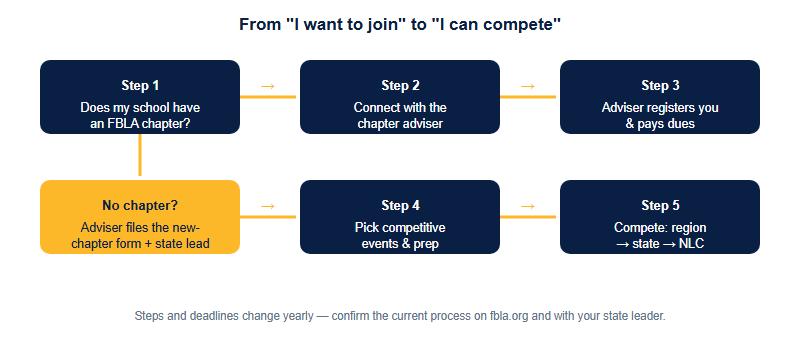
FBLA membership in a China international school works through your school chapter, not a personal online checkout. You join by connecting with your campus chapter adviser (a teacher, administrator, or faculty member), who registers members with FBLA and pays national and state dues. If your school has no chapter yet, an adviser starts one with a short form and your state leader. Get this in motion in the fall so you are eligible before competition season begins. Always confirm current steps on fbla.org.
You join through a chapter, not as a lone individual
This is the single most common misunderstanding among families new to FBLA. There is no “register myself and start competing tomorrow” path. FBLA is a Career and Technical Student Organization (CTSO) built around local chapters hosted inside a school. To become a member you have to be enrolled through a chapter that is on record with the National Center and has paid its dues.
For a student at an international school in Shanghai, Beijing, Shenzhen, or anywhere else in China, the practical sequence is simple: find out whether your school already runs an FBLA chapter, and if it does, ask the adviser how to be added to the roster. If you have arrived from the FBLA China program operated by Hanlin, your coordinator can point you to the chapter structure that applies to your campus. We cover the broader picture of eligibility and access in our guide to FBLA for international students.
Why does this matter so much? Because every downstream thing you care about — registering for competitive events, advancing through region and state rounds, and qualifying for the National Leadership Conference — flows from your membership being active and correctly recorded. Skip the chapter step and none of the rest is available to you.
What a chapter adviser actually does (and why you need a good one)
Every FBLA local chapter is required to have an adviser, and that person can be a school administrator, a teacher, or any faculty member. The adviser is not a figurehead. In practice they are the operational hub of your FBLA experience.
- Registration and dues: the adviser enrols members and ensures national and state dues are paid so the chapter is officially active.
- Event entry: competitive-event registration for region, state, and national rounds is coordinated at the chapter level, not by students acting alone.
- Deadlines and logistics: the adviser tracks the calendar, submits prejudged materials by deadline, and arranges travel for in-person conferences.
- Eligibility checks: some events are restricted by grade (more on this below), and the adviser helps make sure your entry is valid before you invest weeks of prep.
The takeaway for students: a responsive, organised adviser is worth more to your results than almost anything else. If your campus is just standing up its chapter, volunteering to help the adviser with logistics is one of the highest-leverage things you can do — it builds the leadership record that admissions readers actually notice, and it keeps your own entries from slipping through the cracks.
Dues, minimum members, and the deadline that catches people out
Here are the figures that families ask about most. National dues are $10 per member, and state dues vary by state. Many chapters also collect a small additional amount locally to cover things like a chapter t-shirt or a district/region competition. Treat any single all-in number you see online with caution; the real total depends on your state and what your chapter chooses to add, so confirm it with your adviser.
Two structural rules matter for a new or small chapter:
| Item | What the official rules say | What it means for you |
|---|---|---|
| National dues | $10 per member | Per-person, paid through the chapter |
| State dues | Vary by state | Ask your adviser/state leader for the exact figure |
| Minimum chapter size | At least 5 members | A new chapter needs a small founding group |
| Active-status deadline | Dues on record by March 1 of the program year | Don’t leave registration to the last minute |
| Local add-ons | Some chapters charge extra (t-shirt, region comp) | Your real cost can be higher than $10 + state |
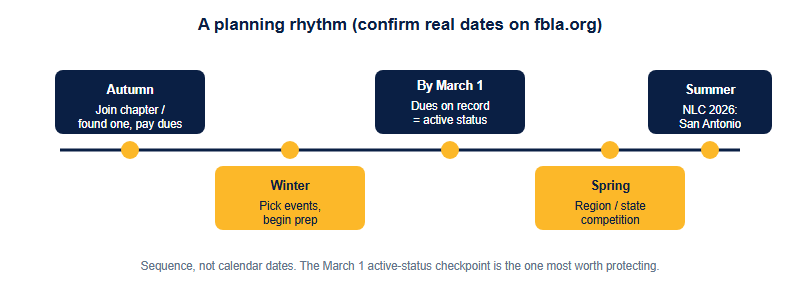
That March 1 active-status checkpoint is the one that quietly ends seasons. An active local chapter must be on record with the National Center as having paid dues by March 1 of the current program year. If your chapter forms late and misses that window, your competitive season can be over before it starts. This is exactly why we push China international-school students to handle the chapter and membership question in the autumn, not in February.
Starting a chapter from scratch on a China campus
Plenty of international schools in China do not yet have an FBLA chapter. That is not a dead end — it is an opportunity, and founding a chapter is itself a strong leadership story. The process, at a high level:
- Find an adviser. You need a willing teacher, administrator, or faculty member to serve as the chapter adviser. Business, economics, and CTE teachers are natural fits, but any faculty member qualifies.
- Gather a founding group. A chapter must have at least five members, so line up a small core of committed students before you file anything.
- File the new-or-reactivated chapter form. The adviser completes the official form and connects with your state leader and the membership team to establish or reactivate the chapter.
- Pay dues and get on record. Once registered and dues-paid, the chapter is active — and only then can members enter competitive events.
Because international schools sit in a range of FBLA structures, the exact state pathway and any region arrangements can differ. Do not assume the process matches a US public school you read about; confirm the current chapter-formation steps on fbla.org and with the membership team. If your campus runs through the FBLA China program operated by Hanlin, ask your coordinator which chapter framework your school uses before you start filling out forms.
A realistic fall-to-spring timeline
You cannot control FBLA’s official calendar, and exact dates change every year — so this is a planning rhythm, not a set of fixed dates. Use it to avoid the late-registration trap, and verify every real deadline against your state and fbla.org.
Five membership mistakes we see China students make
From working with international-school students, the same avoidable errors come up year after year. None of them are about talent — they are about logistics, and all of them are fixable in advance.
- Treating membership as a personal sign-up. Students hunt for an “apply now” button that does not exist, then lose weeks. Membership is chapter-based; start with your adviser.
- Leaving dues to the last minute. The active-status checkpoint (dues on record by March 1 of the program year) is firm. A chapter that registers late can forfeit the whole competitive season.
- Assuming a single all-in fee. National dues are $10 per member, but state dues vary and chapters may add local costs. Budget for the real total, not the headline number.
- Ignoring grade eligibility. A Grade 11 student who spends a month preparing a 9-10-only Introduction event has wasted that month. Check the eligibility line first.
- Founding a chapter without a founding group. A chapter needs at least five members. Recruit your core before filing the form, or the application stalls.
The through-line is simple: in FBLA, the paperwork is not a footnote — it is the gate. Students who handle membership early and correctly free themselves to spend the season on what actually matters, which is preparing for their competitive events and building a leadership record worth writing about.
Mind the grade rules before you fall in love with an event
One eligibility detail trips up younger students. A block of FBLA’s “Introduction” events is restricted to grades 9-10 only — for example Introduction to Business Communication, Introduction to Business Concepts, Introduction to Business Procedures, Introduction to FBLA, and Introduction to Business Presentation. Most other events are open to grades 9-12. If you are a Grade 9 or 10 student, the Introduction events are a gentle on-ramp; if you are in Grade 11 or 12, plan around the open events instead.
Grade tiers and entry limits are reviewed annually, so check the current eligibility line for any event before committing — and read our walkthrough of the full competitive events catalogue to find the right fit. When you are ready to map your route to nationals, our guide on how to qualify for NLC shows how region and state rounds feed into San Antonio.
Frequently asked questions
Can I join FBLA on my own without my school?
No. FBLA membership runs through a school chapter with an adviser. If your school has no chapter, an adviser can start one. Confirm the current process on fbla.org.
How much does FBLA membership cost?
National dues are $10 per member; state dues vary, and some chapters add a small local fee. Ask your adviser for the exact all-in figure for your state.
What is the deadline to be an active chapter?
An active local chapter must be on record with the National Center as having paid dues by March 1 of the program year. Verify the current date on fbla.org.
Does my international school in China need a minimum number of members?
Yes. A chapter must have at least five members. Line up a founding group before filing a new-chapter form.
Published by the FBLA editorial desk, operated by Hanlin Education for China-based international-school students. Official rules are set by the competition and change yearly — confirm current membership steps, dues, deadlines, and eligibility on fbla.org. Errors are corrected within 7 working days.