For students entering the FBLA Business Ethics event in the 2026-27 season, the main difficulty is not learning ethical vocabulary. It is keeping one argument consistent across three different formats: an individual objective test, a written report, and a presentation. According to the FBLA High School Competitive Events list checked on 26 October 2026, Business Ethics includes all three of those components. Many competitors treat them as separate tasks, so the written analysis ends up disagreeing with the spoken delivery. The fix is simple in principle and demanding in practice: choose one ethical decision lens early and apply it to every component.
This article sets out a teaching method — not an official scoring rule — for choosing that lens, building the written report around it, and carrying the same reasoning into the live presentation. It also includes a worked hypothetical decision memo and a short diagnostic you can run before you submit.
The Three-Part Challenge: Why Business Ethics Is Not Just a Written Event
The three components ask for genuinely different skills. The objective test rewards factual command of ethical frameworks, business law and professional conduct. The written report rewards structured argumentation and evidence synthesis. The presentation rewards clear, persuasive communication and the ability to defend a position in real time.
Because the skills differ, it is tempting to prepare them in isolation. A student memorises definitions for the test, writes a broad essay for the report, then improvises in the room. The result is a submission that reads as three unrelated pieces of work. If the report argues from a utilitarian standpoint while the presentation leans on duty-based language, the reader — and the audience — sees a student who has not settled on a position.
That is a coherence problem, not a knowledge problem. It is also the most fixable problem in the event, because it is solved before any drafting begins. One lens, chosen deliberately, gives you a single spine that runs through the test, the report and the talk.
Step 1: Choose One Ethical Decision Lens for All Three Components
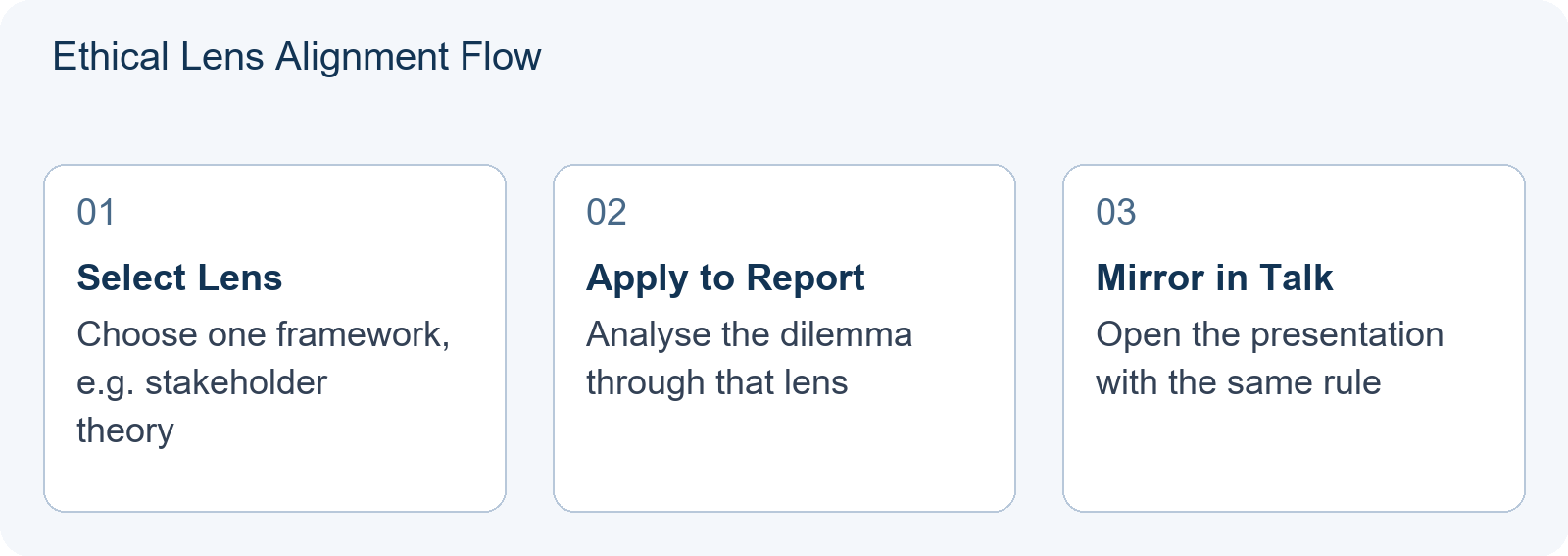
Before you draft anything, select one primary ethical framework to act as your lens. The common choices are utilitarianism (the decision that produces the greatest good for the greatest number), deontology (duty and rules that must be honoured regardless of outcome), virtue ethics (what a person of integrity would do) and stakeholder theory (how the interests of everyone affected are weighed).
Resist the urge to mix lenses. Swapping frameworks mid-submission is not sophistication; it usually signals that the analysis has not been narrowed enough. Once you commit to a lens, it shapes everything downstream:
- Objective test preparation: if you chose stakeholder theory, practise reading each scenario by asking who is affected and how their interests conflict.
- Written report: the lens determines which facts matter, which trade-offs are central, and what recommendation follows.
- Presentation: the lens becomes the single sentence you open with and the standard you return to when defending your recommendation.
This lens discipline is a coaching judgment, not an FBLA rule. If the current event guidelines take a different direction, the guidelines win. FBLA warns on its competitive events pages that guideline documents can change during the year and directs users to check the footer date of any document they download, so confirm the current version before you commit.
Step 2: Build the Written Report Around Evidence, Stakeholders and Trade-Offs
The written report is the anchor of your submission. It should demonstrate rigorous analysis rather than moral commentary. A reliable structure is to move through three elements in order: define the ethical dilemma precisely, map the stakeholders, then evaluate the trade-offs.
Use a hypothetical case to see how this works. Suppose the scenario involves a company weighing layoffs to protect its cash position. A weak report might simply state that layoffs are wrong. A stronger report using a stakeholder lens would do four things:
- State the dilemma as a genuine conflict, not a one-sided moral failure.
- Name the stakeholders: employees, shareholders, customers, suppliers and the local community.
- Set their competing interests against each other — short-term cost relief for shareholders against long-term reputational damage and morale loss among employees.
- Acknowledge the trade-off. There is rarely a clean solution, only a defensible balance, and saying so openly is stronger than pretending otherwise.
Anchor the argument in real business principles, contract law or professional codes where they are relevant, so the recommendation rests on evidence rather than preference. If you find yourself guessing at a fact to make the case fit, stop. Our separate note on FBLA Case Study Assumptions: Separating Evidence From a Convenient Guess walks through how to flag and replace assumptions before they harden into your conclusion.
Step 3: Convert the Report Into a Live Presentation Without Reading It Aloud
The presentation is not a recitation of the report. It is a distilled version of your core argument, delivered to an audience who has not read your page. The report can be thorough; the presentation must be rememberable.
To convert one into the other, extract the rule of thumb you established in Step 1. If your report concluded that long-term employee retention outweighs short-term cost savings, open the presentation with exactly that claim. Reuse the stakeholder map as a visual, but do not read the text — explain why you ranked certain stakeholders above others. Be explicit about the trade-off you accepted; naming it makes you sound decisive rather than evasive.
Then prepare for questions. The most productive rehearsal is not reading your script again but having someone attack your chosen lens. If you chose utilitarianism, be ready to defend how you handled minority interests. If you chose deontology, be ready to explain what happens when two duties collide. Every answer should stay inside the lens rather than switching frameworks under pressure. For a fuller method, see our guide on FBLA Presentation Questions: Answer an Objection Without Repeating Your Slides, which overlaps closely with how a Business Ethics defence should sound.
Worked Hypothetical: A Student Uses a Stakeholder-First Lens in the Memo and Opens the Presentation With the Same Rule
Consider a hypothetical competitor preparing for the 2026-27 season. This is a teaching illustration, not a real student case. She chooses a stakeholder-first lens.
In objective-test practice, she categorises each scenario by which stakeholder group is most affected, so the test becomes a drill in her chosen frame rather than a set of unrelated facts.
In the written report, she builds a table listing four stakeholders and their conflicting interests in a data breach scenario: customers who want transparency, regulators who want compliance, executives who want to limit liability, and employees who fear blame. She concludes that transparent disclosure to customers is the highest priority because it protects the trust the business depends on.
In the presentation, she does not summarise the report. She opens with the sentence: “My analysis shows that customer trust is the most valuable asset in this scenario.” She briefly relates the tension between legal compliance and public relations, then stops. When a question raises shareholder value, she answers inside her lens: “Shareholder value matters, but my stakeholder analysis indicates that losing customer trust causes greater long-term financial damage.” The answer is short, consistent and traceable back to the report.
The value of this hypothetical is not the specific conclusion. It is the shape of the reasoning: one lens, applied three times, visible in every answer.
Practical Diagnostic: Does Your Presentation Use the Same Ethical Reasoning as Your Report?
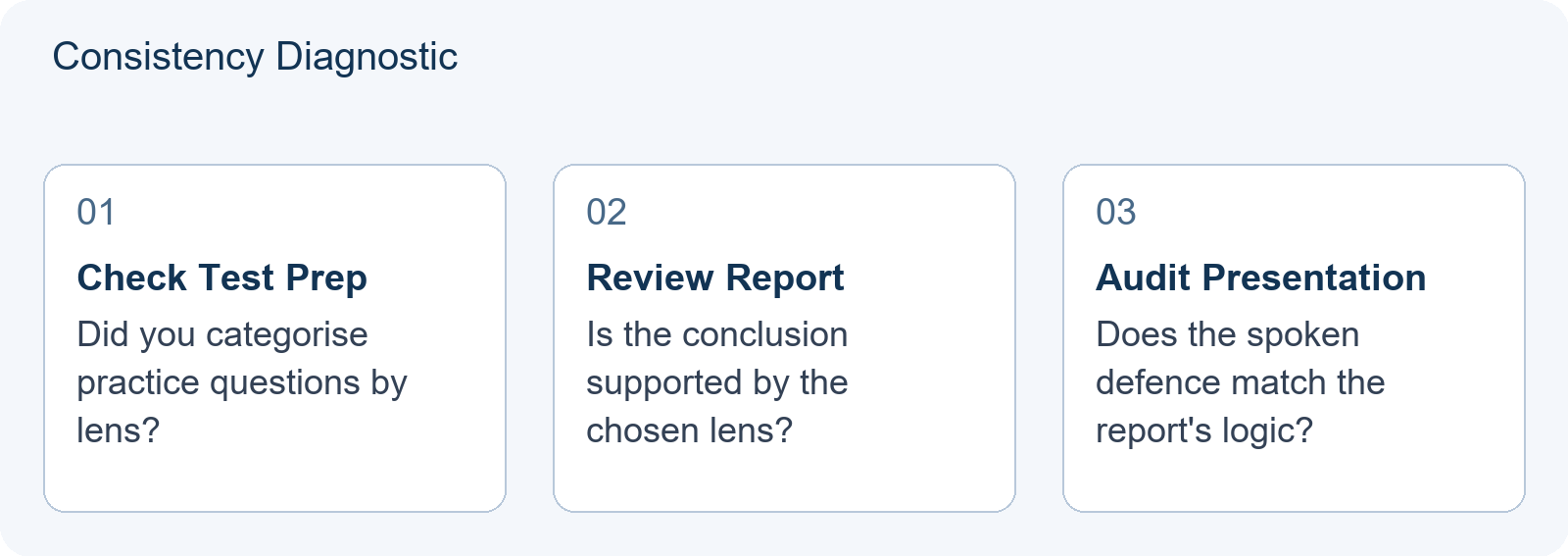
Run this check before you finalise, and be honest about the weak cell. When a check fails, revise the weaker component to match the stronger one — usually the report is the more detailed artefact, so the presentation is the one to adjust.
| Check | Question to ask | What a failure looks like |
|---|---|---|
| Lens consistency | Can you name the single ethical framework used in both the report and the presentation? | Your report analyses consequences but your talk appeals to duty. |
| Evidence alignment | Do the facts cited in the presentation match those analysed in the report? | You introduce a new number or claim in the room that never appeared in the report. |
| Conclusion match | Does the recommendation spoken aloud follow logically from the report’s analysis? | Your presentation recommends action A while the report supports action B. |
| Objection handling | Are your prepared answers framed inside your chosen lens? | Under pressure you switch to a different framework to escape a hard question. |
If you want to rehearse the question-and-answer part more systematically, our companion piece on Answering FBLA Judges: A 40-Question Drill Bank, Answer Frame and Scoring Log (2026-27) provides a repeatable structure for practising answers that stay on the same theme.
A 2026-27 Preparation Sequence Without Assuming Numeric Scoring Rules
FBLA’s public event pages do not expose the specific numeric scoring rules for this event in a form we can verify, so this sequence deliberately stays qualitative. Start by reading the current official guidelines for the event and checking the footer date, since FBLA itself warns that guideline documents can change during the year.
- Build the base. Study the objective test material first, filtering it through your chosen lens so the factual base and the analytical frame grow together.
- Draft the report. Write it so it stands alone: a reader who never sees your presentation should still understand the dilemma, the stakeholders and the recommendation.
- Design the talk from the report. Extract the thesis, not the text, and rehearse defending it against objections rather than memorising it.
This order matters because knowledge should support the writing, and the writing should support the speaking. Working backwards from the presentation tends to produce a shallow report; working from the report outward keeps the substance intact.
Course-Fit and Resource Request Preparation
If you plan to seek external coaching or review, come with specific questions rather than general ones. Ask a mentor to test your lens consistency using the diagnostic above. Ask whether your stakeholder analysis is too broad to be useful or too narrow to be fair. Ask for critique on the link between your written recommendation and your spoken defence — not for generic encouragement.
Targeted questions are how you turn feedback into edits. A request to “check my report” invites vague praise; a request to “tell me whether my presentation’s first sentence follows from my report’s conclusion” invites a decision you can act on the same evening.
General event background is available at Event background.
Frequently Asked Questions
Can I use different ethical theories for the report and presentation?
It is generally stronger to use one consistent ethical lens across all three components. As a coaching recommendation rather than an FBLA rule, we advise committing to a single framework, because switching theories between the report and the presentation makes the submission read as though no position was settled. If the current guidelines take a different direction, follow the guidelines.
How long should the written report be compared to the presentation?
We do not publish page or time limits because they are not verified here. As a working principle, treat the written report as the detailed anchor holding the full analysis and evidence, and treat the presentation as a distilled version of the core argument — short enough that a listener who has never read the report still follows the reasoning. Check the current official guidelines for any actual length requirements.
What if the FBLA guidelines change after I start preparing?
FBLA warns that guideline documents can change during the year and directs users to check the footer date, so re-check the current documents before you finalise. If requirements shift, adjust the format-level details, but keep the underlying skill of consistent ethical reasoning in place — that part survives most revisions.