For students at international schools in China, discovering FBLA often starts with excitement: competitive events in business, leadership, and entrepreneurship that look great on college applications. Then comes the roadblock—you cannot simply register as an individual. FBLA-PBL, Inc. requires every member to belong to a school-based chapter with an approved adviser. If no one on your campus knows what that role demands, you are stuck before you can even compete.
This article explains the adviser gate from the student perspective: what qualifications FBLA-PBL expects, the time and training load the role carries, and how to make your case to a reluctant teacher or administrator. It also offers a realistic framework for students whose schools lack business-education faculty.
§01 — The Adviser Gate: Why FBLA Will Not Let Students Join Solo
FBLA-PBL organizes its membership through chapters chartered to schools, not to individuals. According to the organization’s chapter framework, a recognized chapter must have a school-approved adviser who serves as the primary liaison between the school and FBLA-PBL national headquarters. This structure exists for liability, supervision, and program integrity reasons.
For students in China, this creates a specific bottleneck. Many international schools offer AP Economics or Business courses, yet no teacher has stepped forward to advise an FBLA chapter. Students often assume they can register through a regional partner or compete as independents. They cannot. The adviser requirement is non-negotiable.
Understanding this constraint early matters because it shapes your entire timeline. Adviser recruitment, training, and chapter chartering can take months. Students who discover FBLA in September and hope to compete in spring events often miss deadlines because they underestimated this first step.
§02 — FBLA-PBL’s Official Adviser Requirements: Credentials, Training, and Renewal
FBLA-PBL does not publish a rigid credential checklist comparable to state teaching licenses, but its chapter resources establish clear expectations. An adviser must be a full-time employee of the chartering school, typically in a teaching or administrative role. The organization emphasizes that advisers should understand FBLA’s mission of bringing business and education together in a student-focused environment.
Key responsibilities assigned to advisers include:
- Submitting annual chapter charter applications and membership rosters
- Ensuring students meet eligibility criteria (grade level, course enrollment where applicable)
- Supervising chapter activities and competitive event preparation
- Facilitating payment of national and state dues on behalf of members
- Attending adviser training or updates as required by state chapters
Training may be delivered through state-affiliated chapters or at the National Leadership Conference (NLC). New advisers should expect to spend time learning competitive event structures, deadlines, and chapter management tools. Renewal is annual and tied to the chapter charter cycle.
For context on how chapter operations fit into the broader FBLA calendar, see our overview of FBLA chapter officer roles and responsibilities.
§03 — The Time Commitment No One Tells Students: Class Hours, Travel, and Chapter Paperwork
Students pitching the adviser role to a teacher should understand what they are asking for. Based on typical chapter operations, an FBLA adviser commits to activities along these lines:
| Activity | Estimated Time |
|---|---|
| Initial chapter chartering and adviser orientation | 5–10 hours |
| Weekly or biweekly chapter meetings (supervision) | 1–2 hours per week |
| Competitive event preparation guidance | 2–4 hours per event |
| Regional/state conference attendance (if applicable) | 2–3 days |
| National Leadership Conference (optional but common) | 4–6 days plus travel |
| Annual paperwork, dues, and reporting | 10–15 hours per year |
For schools in China, travel to NLC in the United States adds significant cost and time. Some advisers delegate travel logistics to parent volunteers or partner with tour operators, but the adviser must still attend or provide approved substitutes. Students should acknowledge this burden honestly when recruiting.
§04 — No Business Teacher? Alternative Adviser Profiles That FBLA Accepts
A common student concern: “Our school has no business department. Who could possibly advise us?” FBLA-PBL’s adviser requirements do not mandate a business-teaching credential. While business, economics, or computer science teachers are natural fits, other profiles work:
- College counselors: Already invested in extracurricular strategy; understand competitive event alignment with admissions
- Dean of students or activities coordinator: Manages clubs as part of their role; may welcome a structured national program
- Math or science teachers with entrepreneurial interest: STEM backgrounds align with FBLA’s technology and data analysis events
- Administrators seeking student leadership programs: Principals or assistant principals may advise directly or delegate to a staff member
The key is finding someone with institutional standing, availability, and willingness to learn FBLA’s systems. A passionate teacher without business expertise often outperforms a disengaged business teacher.
For students exploring whether their school’s existing clubs culture supports competitive teams, our analysis of how FBLA competitive events work for international students offers useful context.
§05 — The Student’s Pitch Kit: How to Recruit and Retain a Willing Adviser
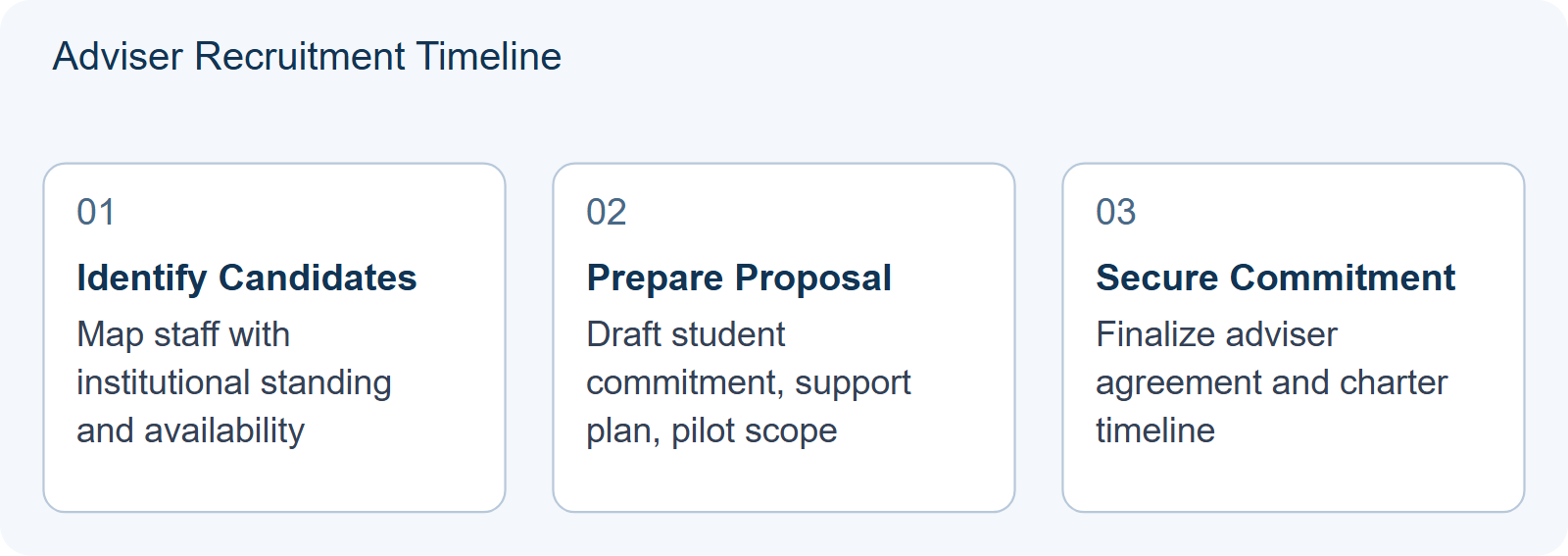
Recruiting an adviser requires more than enthusiasm. Students should prepare a structured proposal that addresses the teacher’s practical concerns:
Demonstrate student commitment. Gather signatures from 10–15 interested students. Show you have already done preliminary research on competitive events and can articulate why FBLA fits your school’s mission.
Clarify the support burden. Offer to form a student leadership committee that handles logistics, communication, and event research. The adviser should supervise and sign off, not manage spreadsheets.
Address training and knowledge gaps. Propose that student officers attend virtual orientations or review materials from FBLA-PBL’s public resources, then brief the adviser. Frame this as reducing, not adding to, the adviser’s workload.
Propose a pilot year. Suggest chartering with a small competitive event slate rather than committing to every category immediately. This lowers risk for both the adviser and the school.
Connect to existing priorities. If your school emphasizes college counseling, highlight FBLA’s recognition by admissions officers. If entrepreneurship is a strategic focus, emphasize the entrepreneurship and business plan events.
§06 — When Your School Says No: Evaluating Chapter Formation vs. Competing Independently
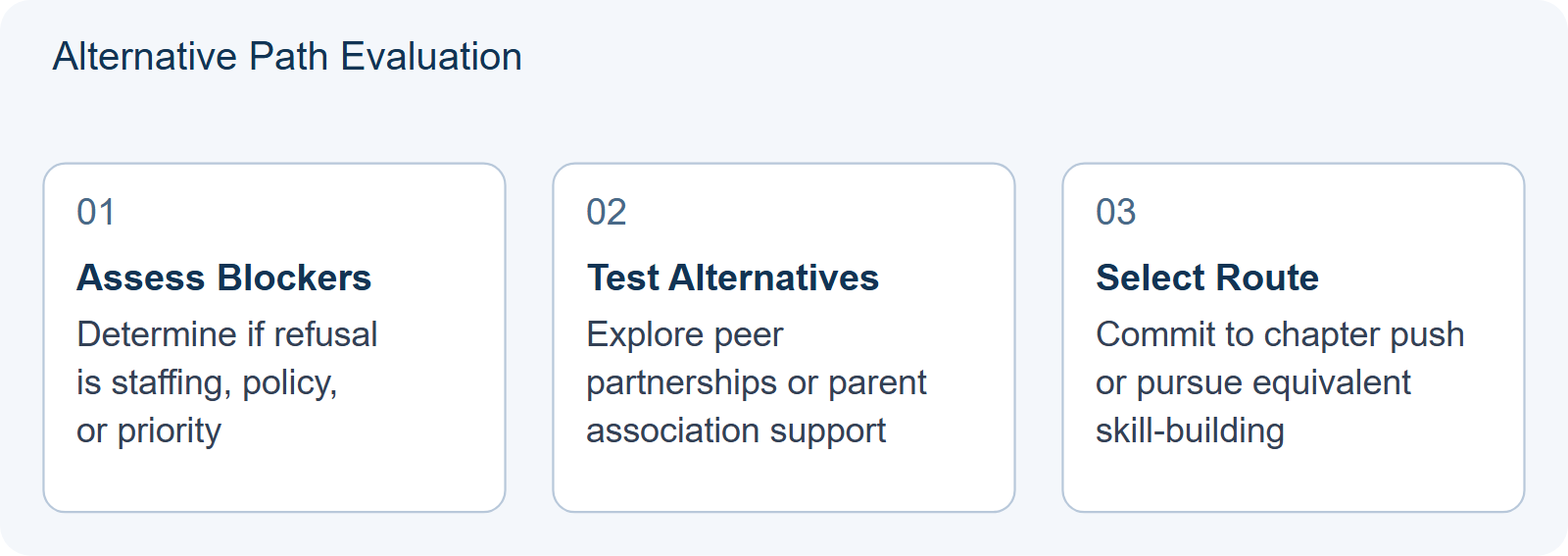
Sometimes the answer is no. The school may lack staff capacity, question FBLA’s relevance, or prioritize other activities. Students then face a decision: push for chapter formation or pursue alternatives.
Chapter formation remains viable if:
- You can identify even one staff member open to a conversation
- Parent association or alumni networks can provide logistical or financial support
- Peer schools in your city or region have chapters (creating informal pressure or partnership opportunities)
Alternatives worth considering:
- Transferring to a school with an established FBLA chapter (extreme, but relevant for families evaluating options)
- Focusing on independent business competitions or entrepreneurship programs with individual registration
- Building business skills through coursework and summer programs, then joining FBLA in university through PBL (the collegiate division)
There is no shame in choosing an alternative path. The skills FBLA develops—financial literacy, public speaking, business ethics—can be cultivated through other means. However, students should understand that FBLA’s structured competitive pathway, national recognition, and alumni network are difficult to replicate independently.
§07 — Adviser Onboarded: What Changes in Your Registration Timeline and Costs
Once an adviser commits, the operational timeline accelerates. Typical next steps include:
- Chapter charter application: Submitted through FBLA-PBL’s national office, often with state affiliate coordination. Processing takes 2–4 weeks.
- Membership enrollment: Students register and pay national dues through the chapter. The adviser manages the roster and coordinates payment.
- Competitive event selection: Advisers receive access to event guidelines, sample cases, and registration portals. Students should research events before registration opens.
- Regional/state qualification: Many competitive events require advancement through local or state rounds. The adviser ensures registration deadlines are met.
Costs extend beyond dues. Competitive events may require materials, travel to conferences, and preparation resources. Schools in China should budget for international travel to NLC if that is a goal, though regional alternatives exist.
Preparing for a Consultation: What to Bring
If you are considering reaching out for guidance on adviser recruitment or chapter formation, preparing in advance makes the conversation productive. Consider gathering:
- A list of potential adviser candidates at your school, with their roles and any expressed interest
- Your school’s club or activities policy, if publicly available
- A rough timeline of when you hope to compete and which events interest you
- Questions about how FBLA-PBL’s chapter requirements apply specifically to international schools
Having this information ready allows an advisor to assess your situation concretely rather than starting from generalities.
Note: FBLA-PBL, Inc. is the national organization governing FBLA. This article is prepared from an independent editorial perspective and does not represent official FBLA-PBL policy. For authoritative requirements, consult FBLA-PBL’s official resources.
Frequently Asked Questions
Can a part-time teacher or external coach serve as our FBLA adviser?
FBLA-PBL typically requires advisers to be full-time employees of the chartering school. External coaches may assist with event preparation, but the official adviser must be school-based to satisfy liability and supervision requirements.
How long does it take to charter a new FBLA chapter from scratch?
Realistically, expect 1–3 months from initial adviser conversation to chartered status. This includes adviser recruitment, application preparation, national office processing, and initial membership enrollment. Starting in spring for the following academic year is advisable.
What if our school already has DECA or other business clubs? Can we also have FBLA?
Many schools host multiple business-focused organizations. FBLA-PBL does not prohibit coexisting clubs, though individual schools may limit overlapping extracurriculars. The case for FBLA should emphasize its distinct competitive event structure and national recognition profile.