FBLA objective test events are timed, multiple-choice exams scored on a single test. Per the 2025-2026 FBLA competitive event guidelines on fbla.org, the events checked use a 100-question test in 50 minutes, no reference materials at the testing site, and a tie-breaker based on your answers to the last 10 questions. To score, you study a defined content domain, pace yourself, and answer every question — especially the final ten. Always confirm your specific event's guideline, because details change yearly.
What an FBLA objective test event actually is
FBLA runs 76+ competitive events across three categories. One of those categories is the objective test — a knowledge exam delivered as multiple-choice questions over a fixed content outline. There is no role-play, no report, and no panel of judges in a pure objective test event: your score is the number of questions you answer correctly, broken by a published tie-breaker. That makes these events the most measurable, most study-able route into FBLA — and the easiest to under-prepare for, because students assume “it's just a test.”
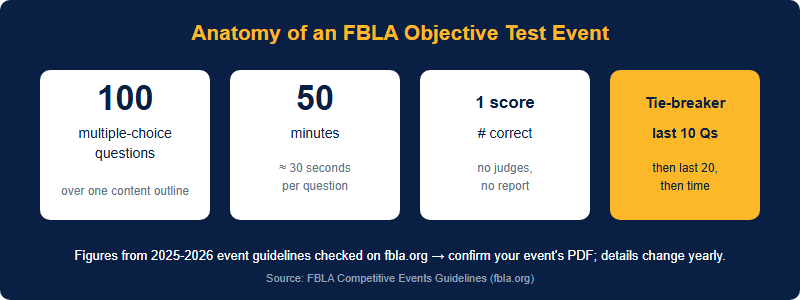
According to the 2025-2026 guidelines published on fbla.org and mirrored by state associations, the objective test events checked share a consistent format: 100 multiple-choice questions, 50 minutes, no reference or study materials brought to the testing site. Some events add specifics — for example, the Economics guideline states “No calculators may be brought into the testing site; calculators will be provided.” The exact item count, time limit, and any calculator rule live in each event's individual PDF, so treat the guideline for your event as the single source of truth.
A first-party note from our China program desk: international-school students who already cover IGCSE/A-Level Business, AP Microeconomics, or DSE BAFS often have 60-70% of an objective test's content domain “for free” — the gap is FBLA-specific U.S. terminology and the test's pace, not the underlying concepts. If you are weighing which category to enter, see our guide to the FBLA competitive events, and our overview of FBLA for international students.
Know the rules before you study (verify on fbla.org)
The scoring rules decide how you should study and how you should sit the test. Here is what the 2025-2026 guidelines state for the objective test events we verified, with the exact official tie-breaker wording. Where a value can vary by event, we say so — do not assume a number until you have opened your event's guideline.
| Rule | What the 2025-2026 guideline says | Why it changes your strategy |
|---|---|---|
| Format | 100 multiple-choice questions (events checked) | No partial credit — breadth beats depth on any single topic. |
| Time | 50 minutes (events checked; older cycles used 60) | ≈ 30 seconds per question. Skimming and flagging is mandatory, not optional. |
| Tie-breaker #1 | “Ties are broken by comparing the correct number of answers to the last 10 questions on the test.” | The final 10 questions are worth more than their face value. Never leave them blank. |
| Tie-breaker #2 | “If a tie remains, answers to the last 20 questions on the test will be reviewed.” | Reinforces: protect the back third of the test. |
| Tie-breaker #3 | “If a tie remains, the competitor who completed the test in a shorter amount of time will place higher.” | Speed only matters at an exact tie — accuracy first, speed last. |
| Materials | “No reference or study materials may be brought to the testing site.” Some events (e.g. Economics) provide calculators and ban personal ones. | You memorise; you cannot look anything up. Build recall, not a cheat sheet. |
| Administration | Objective tests are delivered as an online, proctored exam in connection with the conference. Confirm the exact testing window and platform for your event/year. | Practise on screen, not only on paper. |
One detail worth repeating because students miss it every year: the tie-breaker is about the last 10 questions, not the hardest 10 or your strongest 10. If you run out of time and leave questions 91-100 blank, you have not just lost those points — you have forfeited the tie-breaker if your raw score lands level with a rival. Two students can answer the same number correctly; the one who actually attempted the back ten wins. Treat the final stretch as protected territory.
How to study efficiently for the content domain
An objective test rewards coverage of a defined outline, not depth in your favourite chapter. The official guideline for each event lists the competencies the test draws from — that list is your syllabus. Study against it, not against a generic “business” textbook.
- Pull the competency list from your event's guideline first. Turn each competency into a checklist row. Anything not on the list is a low-yield use of your hours.
- Map your existing courses onto it. International-school students should mark which competencies IGCSE/A-Level Business, AP Micro/Macro, BTEC, or DSE BAFS already cover, then spend your time only on the gaps — usually FBLA-specific U.S. terminology, U.S. business law basics, and acronyms.
- Build active recall, not re-reading. Because no materials are allowed at the testing site, passive highlighting fails. Use spaced-repetition flashcards (Anki/Quizlet) for definitions, formulas, and the dozens of three-letter acronyms FBLA tests love.
- Drill released and practice questions on a timer. The skill being tested is “recognise the right answer in ~30 seconds,” which is different from “understand the concept.” Train the recognition speed, not just the understanding.
- Keep an error log. Every question you miss in practice goes into one document with the correct answer and the reason. Re-test only your error log in the final week — it is the highest-yield review you can do.
For team objective test events, each member typically tests individually and scores are combined — so divide the competency list among teammates for primary depth, but make sure everyone covers the full outline to a passing level. If your real goal is to convert a strong objective-test result into a national berth, read how qualification works in our guide to how to qualify for NLC; NLC 2026 is in San Antonio.
Test-day strategy: pace, flag, and protect the last ten
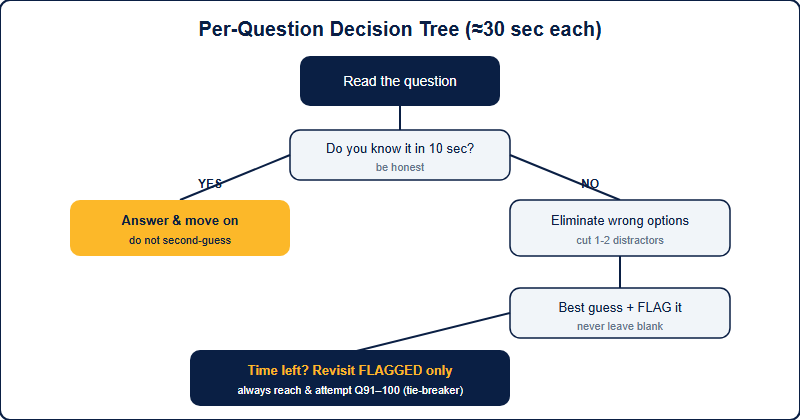
With roughly 30 seconds per question, the test is as much a pacing exam as a knowledge exam. The students who lose are rarely the ones who knew the least — they are the ones who spent four minutes on one stubborn question and never reached question 100. Run the test in passes:
- Pass 1 — the sweep. Go front to back. Answer everything you know inside ~10 seconds. The moment a question makes you hesitate, put your best guess, flag it, and move on. Your only job in Pass 1 is to reach the end with no blanks.
- Pass 2 — the flagged. Return to flagged questions with whatever time remains. Eliminate distractors and upgrade guesses. Because there is no penalty for guessing on a standard multiple-choice test, a flagged item should still carry your best answer from Pass 1 in case time runs out.
- Guard the back third. Budget your time so questions 91-100 get a genuine attempt — they are the first and second tie-breakers. If you must rush, rush the middle, not the end.
- Mind the clock, not the speed. Speed only helps at an exact score tie (tie-breaker #3). Do not sacrifice accuracy to finish early; accuracy is decided long before time is.
- Settle the logistics in advance. Confirm your event's testing window, the online platform, and the materials/calculator rule from the official guideline before test day — surprises cost minutes you do not have.
A quick honesty check on what FBLA objective tests can and cannot do for you: a strong objective-test result is a clean, verifiable signal of subject mastery and is a legitimate line on a résumé and an application. It is not a guaranteed pathway to any award or admission, and no one can promise you a placement. Study the outline, pace the test, protect the last ten — that is the entire game, and it is fully within your control.
A four-week prep plan you can actually run
| Week | Focus | Concrete output |
|---|---|---|
| Week 1 | Map the domain | Competency checklist built from your event's guideline; gaps vs. your courses marked. |
| Week 2 | Build recall | Flashcard deck for all definitions, formulas, and acronyms; daily spaced review. |
| Week 3 | Timed drills | 2-3 full 50-minute practice sets on screen; every miss logged with the reason. |
| Week 4 | Error-log review | Re-test only your error log; rehearse the two-pass + flag-and-return routine. |
This plan is deliberately boring and deliberately repeatable. Objective test events reward consistency over cramming: an hour a day of active recall and one weekly timed set will beat a single panicked all-nighter every time. Scale the weeks up or down to your timeline, but keep the sequence — domain, recall, timing, error log.
FAQ
How many questions are on an FBLA objective test and how long is it?
The 2025-2026 events we checked use 100 multiple-choice questions in 50 minutes (older cycles used 60). Confirm your event's guideline on fbla.org — it can differ.
How is a tie broken on an FBLA objective test?
By the number correct on the last 10 questions; if still tied, the last 20; if still tied, the shorter completion time places higher. Always reach Q91-100.
Can I bring notes or a calculator to the objective test?
No reference or study materials may be brought to the testing site. Some events (e.g. Economics) provide calculators and ban personal ones — check your guideline.
Where do I find the official content outline for my event?
In your event's individual competitive event guideline PDF on fbla.org. That competency list is your study syllabus; rules change yearly, so use the current one.
Published by the FBLA editorial desk, operated by Hanlin Education for China-based international-school students. Official rules are set by the competition and change yearly, so confirm current details — item counts, time limits, tie-breakers, and content outlines — on fbla.org. We are an independent China-program editorial desk and are not the national FBLA organisation. Confirmed errors are corrected within 7 working days.