Whether FBLA is worth it for your college application depends almost entirely on how deeply you engage with it, not whether you have a membership card. Per the widely-used CollegeVine four-tier extracurricular framework, being a chapter officer or placing at the FBLA National Leadership Conference (NLC) lands you in Tier 2 — the level admissions officers at selective schools meaningfully weight. Simply paying dues and attending occasional meetings is Tier 4 — common, low-distinction, and not the differentiator most students think it is. This guide walks through the honest tier mapping for FBLA, by college selectivity tier, by intended major, and by participation pattern, so you can decide whether FBLA is the right use of your finite extracurricular hours.
Quick Facts · The Honest FBLA Value Matrix
| Generic FBLA membership | Tier 4 — common, low admissions distinction (CollegeVine framework) |
| FBLA chapter officer (Pres / VP / Treasurer) | Tier 2 or Tier 3 — meaningful for selective schools |
| FBLA regional leadership (state/national org role) | Tier 2 — clear admissions value |
| FBLA NLC placement (top 10 nationally) | Tier 2 — strongly recognized at business / finance programs |
| FBLA NLC champion or top 3 medalist | Tier 1-2 — meaningful national achievement |
| Wharton (UPenn) acceptance rate 2025 | 3.9% (most selective US undergrad business; per Poets&Quants) |
| NYU Stern acceptance rate 2025 | 4.0% (per Poets&Quants) |
| Time investment for Tier 2 outcome | ~6-10 hours per week during the active competition cycle (Oct-July) |
The Four Tiers · Where FBLA Actually Sits
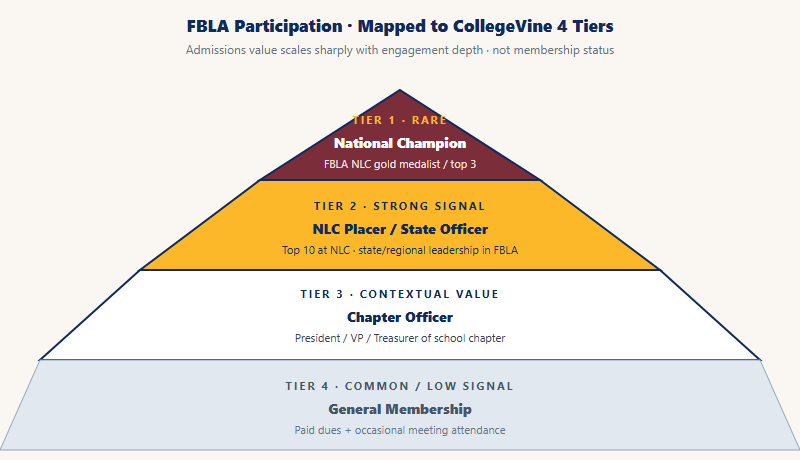
The pyramid above maps directly to admissions officer perception. A senior reading 50-100 applications per week recognizes the difference between “FBLA member” and “FBLA Chapter President” within seconds. The same reader cares more about your narrative arc within FBLA (sustained engagement, increasing responsibility, measurable contribution) than about your formal title at the moment of application submission.
What “Worth It” Actually Means · By Outcome You Want
“Worth it” is not a single answer. It depends on what specific outcome you want to drive in your application narrative. The five most common outcomes and their FBLA fit:
Outcome 1 · Demonstrate business / finance interest authentically
FBLA fit: very strong. Even Tier 3 participation (chapter officer + 1-2 events competed) creates a documented multi-year engagement with business topics that you can reference in supplemental essays. Better than a one-summer internship for demonstrating sustained interest, because it spans 2-4 academic years.
Outcome 2 · Win a national-level recognition for your application
FBLA fit: realistic with focus. NLC top-10 placement in a competitive event is achievable for a focused student who specializes in one event over 18-24 months. The students who try four events at half-effort consistently miss top placements; the students who pick one event and obsess over it consistently reach finals. This is the Tier 2 path.
Outcome 3 · Build leadership credentials for any college direction
FBLA fit: strong if you take officer roles. Chapter President / VP / Treasurer credentials read clearly in the activities list and are referenced credibly in recommendation letters. The “running a chapter” narrative transfers across business, social sciences, public policy, and even STEM majors.
Outcome 4 · Differentiate from your school’s typical applicant pool
FBLA fit: depends on your school. In US suburban public schools where FBLA is a common club, membership alone is undifferentiated; you need at least Tier 3 (officer role) to stand out. In Chinese international schools and other international contexts where FBLA participation is rarer, even Tier 3 / strong Tier 4 (active competitor, no officer role) is meaningfully distinguishing. International chapters benefit from positive selection bias here.
Outcome 5 · “Just have something on the resume”
FBLA fit: poor. If your only commitment is paying $14-18 in annual dues and attending three meetings a semester, FBLA is Tier 4 and you’d get equivalent (or better) value from almost any other consistent activity that genuinely interests you. The opportunity cost of FBLA done lazily is higher than its small admissions benefit.
By Target College Selectivity Tier
Admissions weighting of FBLA varies materially by school selectivity:
| School type | Tier 4 FBLA | Tier 3 FBLA | Tier 2 FBLA | Tier 1 FBLA |
|---|---|---|---|---|
| Most selective (Wharton 3.9%, NYU Stern 4.0%, Ivy League) | ~no impact | small positive | meaningful positive | strong positive |
| Highly selective (Top 20-50 US, business-friendly) | ~no impact | small-medium positive | strong positive | very strong positive |
| Selective (Top 50-100 US) | small positive | medium positive | strong positive | standout |
| Less selective (Open admission to Top 100+) | small positive | strong positive | standout | top of applicant pool |
Read this matrix carefully: at the most selective schools, only Tier 2 and above FBLA participation meaningfully moves the needle. Below that, FBLA is one of dozens of equivalent extracurriculars and doesn’t differentiate. At less selective schools, even Tier 4 has positive value — but you should not be optimizing for less selective schools by underinvesting in your extracurriculars overall.
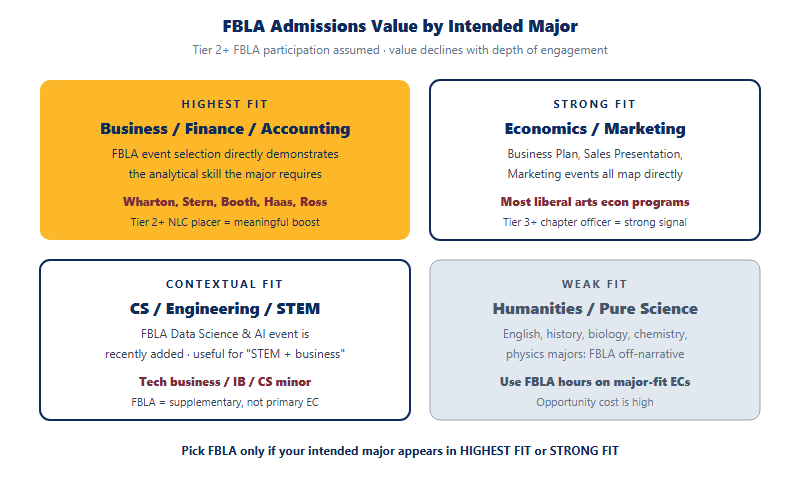
By Target Major · The Real Tier Map
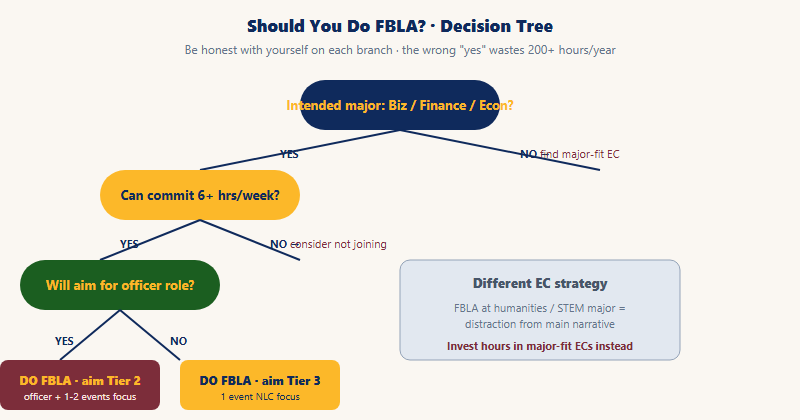
Decision Framework · Should You Do FBLA?
The Underrated Value Drivers
Three FBLA benefits that most students underweight when evaluating “worth it” but that show up disproportionately in successful college applications:
1. The 10-month working contract
Most extracurriculars run on episodic engagement (one summer program, weekly meeting attendance). FBLA’s competitive events require sustained 6-10 months of focused preparation. The narrative discipline this teaches — commit, prepare, deliver, revise — is exactly what selective colleges look for in essays about “challenges you’ve overcome” or “demonstrated grit.” Few high schoolers have written, revised, and presented a 30-page business plan; the ones who have stand out for the right reasons.
2. Cross-school relationships
SLC and NLC bring together students from across your state and the country. The relationships formed there — particularly with older students who later become alumni at top business programs — matter for college visits, recommendation letters from non-school sources, and post-college networking. None of this is admissions-officer-quantifiable, but it’s a real career-track benefit.
3. Real-world professional norms
FBLA enforces business professional dress, formal Q&A protocols, and presentation rubrics that mirror actual business-world expectations. Students who go through 2-3 NLC cycles have already internalized the “give a 7-minute professional presentation under judging conditions” reflex that most peers don’t develop until junior year of college. This shows up indirectly in college interviews and on-campus recruiting.
Common Misconceptions
“Membership alone helps my application”
No. The activities list at most selective schools is one line per activity with brief description. “FBLA member” reads as Tier 4 to a reader who sees 100 of these per week. Distinction requires engagement depth.
“NLC participation is enough”
Participating at NLC means you placed top 4 at SLC, which is itself significant. But participation without placement at NLC reads as “I went to a national conference” — useful but not standout. Top 10 placement at NLC is the real differentiator. (See How to Qualify for FBLA NLC for the full path.)
“FBLA matters more than the rest of my application”
No extracurricular individually carries more weight than grades, course rigor, test scores (where required), or essays. FBLA is one component of a complete application. Don’t sacrifice GPA or AP performance to over-invest in FBLA.
“FBLA is the same as DECA for college admissions”
Both are recognized business student organizations and both can land you in Tier 2+ with similar engagement. They emphasize different skill sets — FBLA leans presentation/objective tests, DECA leans role-play and case competitions. Choose based on your strengths and your school’s chapter quality; not based on perceived prestige.
When NOT to Do FBLA
There are five specific situations where FBLA is the wrong use of your time:
- You’re applying as a humanities / pure science major — the narrative fit isn’t there. Invest time in major-fit ECs.
- Your school’s chapter is inactive / poorly advised — you’ll spend more time troubleshooting than competing. Better to start a different active club.
- You can’t commit 6+ hours per week during competition season — under-prepared competitors don’t place, and “I attended meetings” is Tier 4.
- You’re already in 4+ serious extracurriculars — adding FBLA at half-effort dilutes your stronger commitments.
- You’re a senior with no FBLA history — joining FBLA as a senior reads as “trying to pad the application.” Junior year is the latest reasonable join time.
Frequently Asked Questions
Is FBLA worth it for college applications?
It depends on your engagement depth. Per the CollegeVine four-tier extracurricular framework, FBLA chapter officer or NLC placer status is Tier 2 (meaningfully positive for selective schools). FBLA membership alone is Tier 4 (low admissions distinction). For students intending to major in business, finance, economics, or accounting, Tier 2+ FBLA participation is one of the strongest extracurricular signals available; for other majors, the value drops sharply.
Does FBLA help me get into Wharton or NYU Stern?
Wharton and NYU Stern have 2025 acceptance rates of 3.9% and 4.0% respectively. No single extracurricular guarantees admission to these programs. FBLA at Tier 2 (NLC placement, state officer) is a meaningful positive in a complete application that also includes strong academics, test scores, essays, and recommendations. It is not, by itself, a Wharton or Stern admission factor.
What FBLA achievement level is enough for Ivy League consideration?
For Ivy League schools, FBLA NLC top-10 placement, FBLA national champion status, or sustained state/national leadership role within FBLA is what registers. Chapter membership alone does not. The Ivy League schools see thousands of FBLA members in their applicant pools annually; what distinguishes is the level of achievement and leadership demonstrated.
How does FBLA compare to DECA for college admissions?
FBLA and DECA are both recognized national business student organizations with similar college admissions weighting at equivalent engagement tiers. FBLA emphasizes objective tests and presentation events; DECA emphasizes role-play and case competitions. Choose based on your strengths, your school’s chapter quality, and your time commitment ability — not based on perceived college prestige differences (there aren’t meaningful ones).
Is FBLA worth it if I’m an international student?
Yes, with a different value calculus. International students (particularly from Chinese international schools) face less competitive FBLA pools and benefit from FBLA’s clear US college admissions recognition. Even Tier 3 (chapter officer, focused competitor) is meaningfully distinguishing for international applicants who lack the broad US extracurricular menu. See FBLA for International Students: China Chapter Guide for the international-specific value framework.
Should I join FBLA if I’m not sure about my college direction yet?
If you’re a 9th or 10th grader uncertain about your major direction, FBLA is a reasonable exploration. It exposes you to business, finance, communications, and emerging tech topics through its 55+ event catalog. By 11th grade you should have direction clarity — if you do not intend to apply for business / economics / finance majors, transitioning away from FBLA at that point is the correct move.
Related Resources
- 🏆 NLC qualification → How to Qualify for FBLA NLC: The Three Paths
- 📅 NLC 2026 logistics → FBLA NLC 2026 San Antonio Schedule, Hotels & What to Pack
- 📝 Joining FBLA → How to Join FBLA in 2026 Step-by-Step
- 🌍 International perspective → FBLA for International Students: China Chapter Guide
- 📋 Event guidelines → FBLA Competition Format & Rules
- 📞 Editorial desk → Contact
Tier classifications adapted from CollegeVine’s published four-tier extracurricular framework. Wharton and NYU Stern Fall 2025 acceptance rates from Poets&Quants 2026 Best Business Schools ranking. FBLA membership and competition structure data from fbla.org. This guide reflects general admissions framework patterns; individual applications are evaluated holistically and individual outcomes vary.
Hanlin Education’s China Cohort View on FBLA Admissions Signal
This site (en.fbla.org.cn) is the FBLA China editorial desk operated by Hanlin Education (linstitute.net). We work with Chinese international school students applying to US colleges with FBLA records each season — which gives us a vantage on what an FBLA credential actually predicts on a Common App, distinct from the generic “FBLA is great for business school” narrative.
Three observations from our cohort that don’t appear in generic worth-it discussions:
- Tier-3 events outperform Tier-1 events for international applicants. The headline events (Business Plan, Sales Presentation) draw the largest competitor pool, which dilutes any individual medal’s signal value. Mid-tier specialty events (Introduction to Business Communication, Business Calculations, etc.) are significantly less competitive at NLC level but read identically as “NLC medalist” on Common App. Our cohort applicants targeting top-30 US universities have higher medal-to-application-strength conversion in mid-tier events.
- The “FBLA China Chapter” framing carries weight in admissions narratives. Founding or leading an FBLA chapter at a Chinese international school is a near-unique application credential — almost no other applicant has it. Admissions officers read it as initiative + cross-cultural leadership, not just participation.
- Senior-year NLC medals align perfectly with the Common App August 1 opening. NLC results release in early July, exactly when senior-year applicants start drafting Activities sections. This timing means an FBLA NLC medal carries fresh-credential weight — admissions readers see “current-year achievement” not “history.”
For honest assessment: an FBLA NLC medal is a Tier-2 extracurricular for top-20 US college applications (Tier-3 if outside business school) when combined with strong academics. It is not a Tier-1 differentiator on its own. Our cohort outcomes consistently support this calibration.
Talk to a Hanlin Education Advisor
Editorial desk · Hanlin Education · last updated 2026-05-27 · This guide is published by the Hanlin Education editorial desk. Hanlin Education is an authorized China-region educational partner, but this site is not the official program administration site. All facts on this page are cross-referenced against the program’s official publications. We correct any factual errors within seven working days of a reported issue.