Does FBLA help you get into a top US university? Honestly: it can strengthen a business-minded application — not as a magic ticket, but as credible evidence of genuine interest, leadership and measurable achievement. Admissions officers do not award points for the acronym; they read what you did with it. This guide from the FBLA China desk explains what they actually value, what FBLA cannot do, and how to make it count.
What an FBLA record actually signals
A strong FBLA record speaks to four things admissions readers look for in any serious extracurricular. None of them is “won a competition” on its own:
| Signal | What it tells an admissions reader |
|---|---|
| Genuine interest | You chose business and stuck with it — coherence with a major or career direction. |
| Sustained commitment | Multiple years, not a one-time entry — depth beats a long list of one-offs. |
| Leadership & initiative | Chapter officer roles, starting projects, recruiting members — you build, not just attend. |
| Measurable achievement | State/national placement, a real business plan, a working product — evidence you can deliver. |
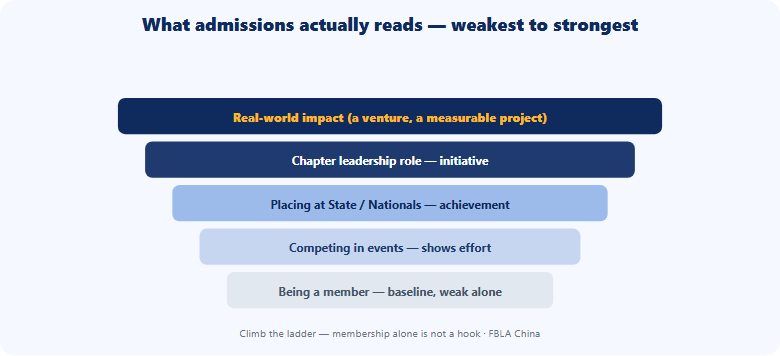
What FBLA cannot do (read this honestly)
It will not, by itself, get anyone into a top university. A single award is not a “hook,” and top schools see many FBLA competitors, so the acronym alone is not differentiating. Anyone promising that an FBLA placement guarantees admission is selling something. What FBLA can do is give a business-interested student a credible, US-legible arena to demonstrate the four signals above — which is valuable precisely because you turn it into something real, not because it appears on a list.
How to make FBLA count
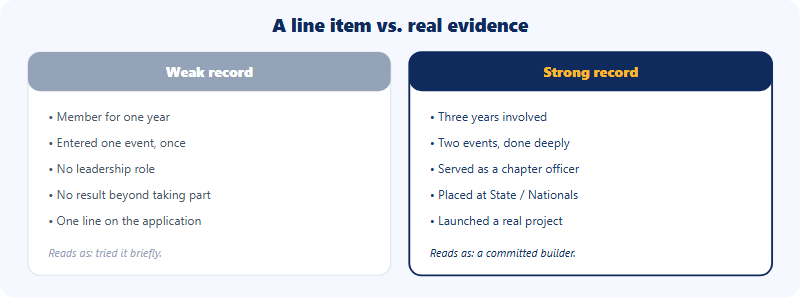
Four practical moves: go deep, not wide (two events mastered beats six dabbled in); take a leadership role and do something concrete with it; connect it to your narrative so FBLA supports a coherent academic story rather than sitting alone; and create real impact — a venture, a community project, a measurable chapter result — because impact beyond the contest is what reads as genuine.
For international students specifically
For a student applying from China, FBLA offers something useful: a US-legible business credential that admissions officers recognise, earned in English, against a national field. It pairs naturally with a quantitative or research signal and with your own initiatives. It is one credible component of a portfolio — strongest when it demonstrates the same drive your essays and recommendations describe. If your school has no chapter yet, that is the first step; see FBLA for international students and how to join FBLA, and choose events with our competitive events guide.
Frequently asked questions
Does FBLA help with college admissions?
It can strengthen a business-focused application by showing genuine interest, sustained commitment, leadership and measurable achievement. It does not guarantee admission, and membership alone carries little weight — what you build with it does.
Do top universities recognise FBLA?
Yes, FBLA is a well-known US student business organisation, so the context is understood. But recognition is not a hook; admissions readers look for depth, leadership and real impact, not the name itself.
Is a national placement enough to stand out?
It helps as evidence of achievement, but on its own it is rarely decisive. The strongest records combine a result with leadership and a real project that connects to the student’s wider story.
How should international students use FBLA in their application?
As one credible, US-legible component of a coherent portfolio — go deep in a couple of events, lead, create real impact, and make sure it reinforces the same narrative as the rest of the application.
This guide is published by the FBLA China editorial desk, operated by Hanlin Education for international-school students in China. It reflects general admissions principles, not a promise of any outcome — no extracurricular guarantees admission. For official FBLA programs and rules, see fbla.org. Confirmed errors are corrected within 7 working days.