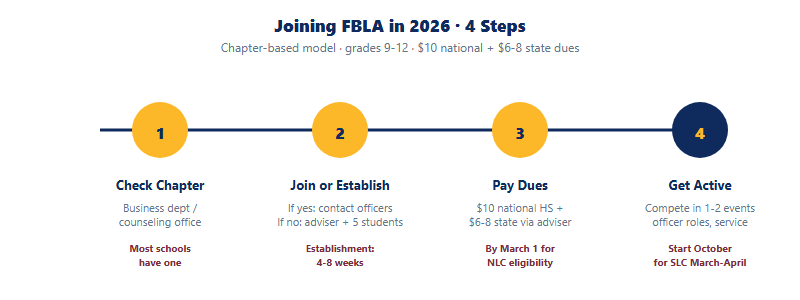
Joining FBLA in 2026 follows a chapter-based model — there is no individual-membership path. The standard process: (1) confirm your school has an active FBLA chapter (or establish one with a business teacher adviser and minimum 5 interested students), (2) join the chapter and pay $10 national dues + $6-$8 state dues by your state’s published deadline (typically by March 1 if you intend to compete at NLC), and (3) engage with chapter activities — competitive events, community service, leadership opportunities. International students follow the same structural path with FBLA China as the coordinating office. Below: a step-by-step walkthrough covering eligibility, both join paths, dues structure, and the first-year tactical roadmap.
Quick Facts
| Membership model | Chapter-based (no individual / online-only membership) |
| Grade eligibility | FBLA High School: grades 9-12 · FBLA Middle School: grades 5-9 |
| Academic prerequisite | Enrolled in a business or business-related course at your school |
| Chapter minimum | 5 active student members + 1 adviser (teacher, administrator, or relevant faculty) |
| National dues (HS) | $10 per member per year |
| State dues | Varies; typical $6-$8 (e.g., PA $6, MD $8); combined annual cost $14-$18 typical |
| Dues platform | FBLA Connect (national member portal), paid in bulk by chapter adviser |
| Deadline for NLC competition | March 1 of the school year |
| International coordination | Via FBLA China (authorized 2015) for chapters in China |
Step 1: Check If Your School Already Has a Chapter
The fastest path to FBLA membership is joining an existing chapter at your school. Most schools with established business or economics programs already have a chapter; reactivation rather than fresh establishment is the more common task for chapters that lapsed during the pandemic years.
Where to check
- Business department / business teacher’s office: The most direct path. If your school’s business teacher is also an FBLA adviser, they know the chapter status immediately.
- College counseling office: Counselors who track student extracurricular activities often maintain a chapter directory.
- Activities or student-organizations office: For schools with formal extracurricular registration systems.
- FBLA Connect chapter directory: For US schools, search by school name on the national FBLA Connect portal.
- FBLA China: For international schools in China, check directly with FBLA China for chapter status — the directory of active Chinese chapters is maintained at the FBLA China level, not at FBLA national.
If a chapter exists
Contact the current chapter officer team or adviser. The joining process is typically a brief application form or an interest-meeting attendance — chapters that are actively recruiting hold info sessions at the start of each semester. Your adviser will register you through FBLA Connect once dues are paid; no individual portal registration on your end.
Step 2 (Alternate Path): If No Chapter Exists, Establish One
If your school has no FBLA chapter, you can establish a new one. The requirements are deliberately accessible to support FBLA’s expansion:
The four prerequisites
- An adviser — a school administrator, business teacher, or any faculty member willing to serve as the chapter’s adult sponsor. The adviser does not need to be a finance or business specialist; many successful chapters are advised by general teachers with administrative interest in student extracurriculars.
- A minimum of 5 active student members — the floor below which a chapter cannot be officially recognized. Most successful first-year chapters launch with 8-15 founding members to absorb the inevitable early attrition.
- School administrative approval — new student organizations typically require sign-off from the principal or assistant principal. The FBLA national brand and its US-wide recognition usually make this approval straightforward.
- Charter application — the formal new-chapter establishment process, submitted through FBLA Connect (US schools) or through FBLA China (international schools).
Timeline expectation
From “we want to start a chapter” to “officially registered chapter able to compete at SLC”: typically 4-8 weeks, with the variance driven by school administrative approval timing more than the FBLA process itself. Plan backwards from your state’s SLC date: if SLC is in March/April and you want to compete in your first year, chapter establishment should be initiated by November of the prior fall.
Step 3: Pay Membership Dues
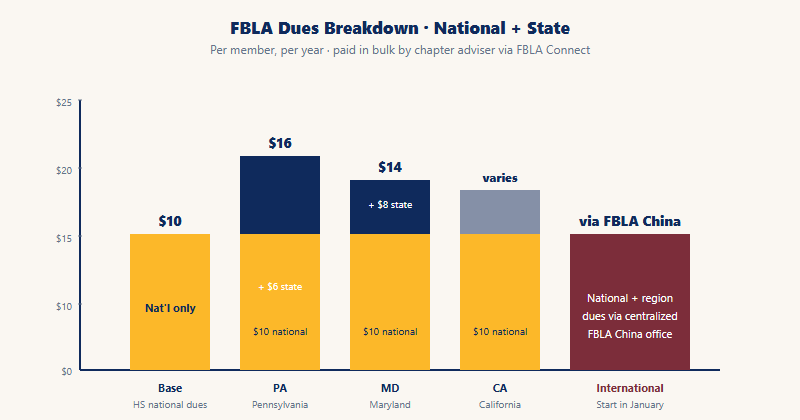
Dues are paid in bulk by the chapter adviser, not individually by each student. The two-tier dues structure:
National dues
- FBLA High School national: $10 per member per year
- FBLA Middle School national: published separately by FBLA national, slightly lower
- Paid through FBLA Connect (the national member portal)
State dues
State dues vary — published by each state FBLA office and updated annually. Sample 2025-2026 state dues for context:
- Pennsylvania: $6 (total $16 with national)
- Maryland: $8 (total $14 with national)
- California: published in the California FBLA Chapter Affiliation Guide
- Other states: check the state FBLA office website
Chapter-level dues (where applicable)
Some chapters charge additional chapter-level dues on top of national + state to cover regional competition entry fees, chapter T-shirts, or social events. These are set by each chapter’s executive team and typically range from $0-$30 per member per year, decided at the chapter level.
The March 1 deadline matters
If you want to compete at NLC, your national dues must be paid by March 1 of the school year. Chapters typically set internal deadlines to mid-February to absorb state-office processing delays. For international chapters, start the dues workflow in January to accommodate the additional FBLA China coordination layer.
Step 4: Get Active (The Year-One Roadmap)
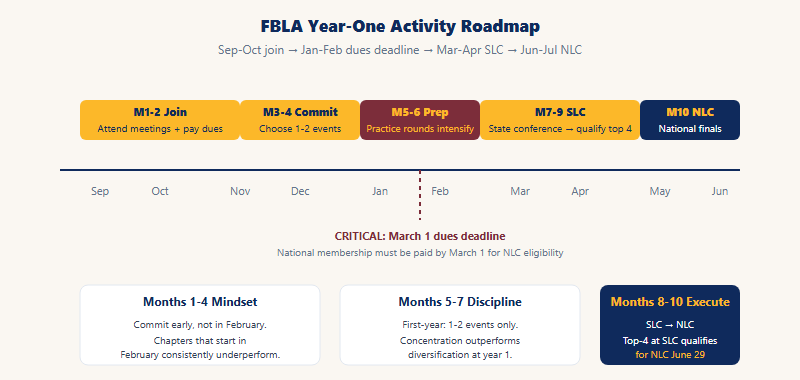
Paying dues makes you an FBLA member. Being active is what generates the experience that matters — for skill development, for college applications, and for chapter contribution. A typical first-year engagement pattern:
Months 1-2 (September – October)
- Attend the chapter’s first 2-3 meetings; introduce yourself; volunteer for at least one small task
- Browse the FBLA 55+ Competitive Events catalog and identify 1-2 events that match your academic interests and skill
- Talk with returning members who placed at the prior year’s SLC about which events to consider
- Make sure your dues are submitted to the adviser early in the term
Months 3-4 (November – December)
- Commit to 1-2 competitive events for the year
- If team events: identify and form your team. Strong teams typically lock by the December break
- Begin event preparation. For pre-judged events (Business Plan, etc.), start the written deliverable. For objective tests, begin a study plan
- Attend chapter community service opportunities
Months 5-6 (January – February)
- Intensify event preparation: practice rounds, peer review of materials, mentor feedback
- Verify your membership dues are submitted (chapter-level internal deadline)
- If applicable: regional competitions in February-March
Months 7-9 (March – May)
- State Leadership Conference — compete in your event(s)
- If you place top-4: begin NLC preparation immediately (do not wait for “official” qualification confirmation)
- If you don’t place: review judge feedback, plan year-two event strategy
Month 10 (June – July)
- If NLC-qualified: travel to NLC, compete, network, learn from observing other states’ approaches
- If not qualified: attend NLC as a non-competing observer if possible (many chapters fund chapter delegations)
Eligibility: Who Can Actually Join
Per FBLA national policy, membership in the FBLA High School division is open to students who meet all of:
- Grade 9-12 currently enrolled (FBLA Middle School handles grades 5-9 separately)
- Business or business-related course enrollment at your school — the specific course taxonomy is flexible (economics, business, finance, accounting, entrepreneurship, marketing all qualify; the adviser interprets edge cases)
- Acceptance of the FBLA purpose and creed at membership
- Willingness to contribute to chapter activities and community service
- Demonstrated qualities for professional employment — professional conduct, dependability, integrity
For international schools (including those in China), the “business or business-related course” criterion is interpreted by the chapter adviser in coordination with FBLA China. Most schools offering economics, business, finance, accounting, entrepreneurship, or marketing courses satisfy this requirement. If your school’s specific course offering is in question, the adviser should confirm with FBLA China before chapter dues are paid.
For International Students: The Additional Administrative Layer
Joining FBLA from an international high school (notably Chinese international schools) follows the same chapter-based structure with one structural difference: FBLA China is the coordinating office, not direct contact with FBLA national.
What this means in practice
- Chapter establishment runs through FBLA China rather than directly through FBLA Connect
- Dues are paid through FBLA China’s centralized workflow; the additional coordination layer adds 1-2 weeks of processing time relative to a US chapter
- The country-level qualifying competition (FBLA China’s annual final, analogous to a US state SLC) qualifies top finishers for the US NLC
- Visa documentation for NLC travel runs in parallel with chapter administrative tasks; the FBLA letter of invitation is requested through your adviser, who routes through FBLA China to FBLA national
For the full international-student walkthrough, see our companion article on FBLA for International Students: China Chapter Guide.
Common Mistakes First-Year Members Make
1. Waiting too long to commit to competitive events
First-year members who commit to events in February consistently underperform first-year members who committed in October. Event preparation is a 4-8 month undertaking for serious-contention events (Business Plan, Sales Presentation, written-deliverable events). Compress this into 6 weeks and your output is visibly thinner than the field’s.
2. Joining “for the resume” without engaging
FBLA membership in itself is a relatively common line on a college application. What distinguishes is competitive event placement, chapter officer roles, or measurable community contributions. A first-year member who pays dues and attends one meeting will have nothing meaningful to write about FBLA in a college essay; a first-year member who placed top-10 at SLC has a substantive narrative.
3. Choosing too many events
First-year members who compete in 3-4 events typically place in 0-1; first-year members who compete in 1-2 events typically place in 1-2. Concentration outperforms diversification at year 1. Use year 1 to specialize; expand to additional events in year 2 once the first event is at competition-ready quality.
4. Not engaging with returning members
The returning members at your chapter are the highest-leverage resource available — they have the practical knowledge of which events the chapter is strong in, which judges value which qualities, which competitive event formats reward what kind of preparation. Skipping their guidance and figuring it out from scratch is a common year-1 mistake.
5. Missing the March 1 dues deadline
The most preventable mistake. Set your personal calendar reminder for early February; chase your adviser if dues haven’t been processed by mid-February. A missed deadline disqualifies the entire chapter from NLC for the year, including any students who placed top-4 at SLC.
Frequently Asked Questions
Can I join FBLA as an individual without a chapter?
No. FBLA membership is chapter-based by design. If your school has no FBLA chapter, the path is to establish one (with a faculty adviser and minimum 5 interested students) rather than join as an individual.
How much does it cost to join FBLA?
FBLA High School national dues are $10 per member per year. State dues vary — typical state dues run $6-$8, bringing combined annual dues to $14-$18 per member. Some chapters also charge optional chapter-level dues ($0-$30) for regional competition fees and chapter activities.
What are the FBLA membership requirements?
FBLA High School membership requires: (1) being in grades 9-12, (2) enrolled in a business or business-related course at your school, (3) accepting the FBLA purpose and creed, (4) willingness to contribute to chapter activities, and (5) demonstrating qualities for professional employment.
When is the deadline to join FBLA?
Chapters typically accept new members year-round, but national dues must be paid by March 1 to be eligible to compete at NLC that same school year. To compete at your state’s SLC (March/April), confirm with your chapter adviser about earlier state-level deadlines.
Can international students join FBLA?
Yes. International students at schools with FBLA chapters can join via the same chapter-based path. For international chapters — including the active chapters in China, Canada, Europe, and Latin America — coordination runs through the regional office (FBLA China for chapters in China, authorized since 2015).
How do I start an FBLA chapter at a school that doesn’t have one?
Recruit a faculty adviser (school administrator, business teacher, or any willing faculty), gather a minimum of 5 interested student members, obtain school administrative approval, and submit a charter application through FBLA Connect (US schools) or through FBLA China (international schools). Total timeline from initiative to officially-registered chapter: typically 4-8 weeks.
Related Resources
- 🌍 International students → FBLA for International Students: China Chapter Guide
- 🏆 NLC qualification → How to Qualify for FBLA NLC: The Three Paths
- 📅 NLC 2026 logistics → FBLA NLC 2026 San Antonio: Schedule, Hotels & What to Pack
- 📋 Competition format → FBLA Competition Format & Rules
- ✍️ Registration page → FBLA Registration
- 📞 Contact our editorial desk → Contact
Membership dues, eligibility criteria, and chapter establishment process sourced from fbla.org and state FBLA organization publications (PA FBLA, Maryland FBLA, California FBLA, Florida FBLA, Virginia FBLA, New York State FBLA) for the 2025-2026 school year.