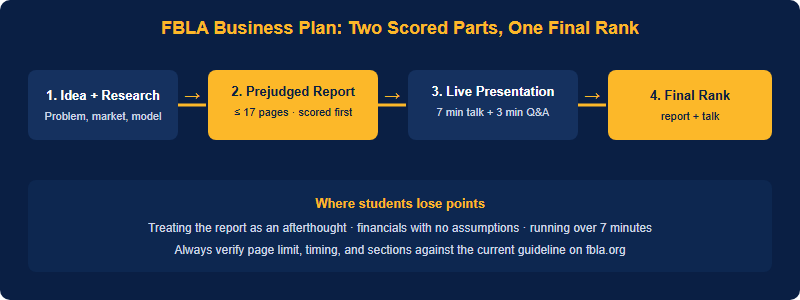
The FBLA Business Plan event is a two-part Presentation Event: a prejudged written report of no more than 17 pages and a live presentation at the National Leadership Conference (NLC). You enter as an individual or a team of up to three from the same chapter, and your final rank combines the report score and the presentation score. This guide shows international-school students how to build a strong entry end to end — always confirm current rules on fbla.org.
What the Business Plan event actually is (and how it is scored)
Among FBLA’s 76+ competitive events across three categories, the Business Plan event sits in the Presentation Events group. Per the 2025–2026 Competitive Events Guidelines on fbla.org, it has two distinct components that are scored separately and then combined:
- A prejudged written report — submitted ahead of the conference and read by judges before any presentation. The report is capped at 17 pages on 8½″ × 11″ paper, must open with a cover page and a table of contents, and must be page-numbered.
- A live presentation — delivered to a panel of judges at the NLC, followed by a question-and-answer period.
This split matters for how you spend your time. A common mistake is to pour weeks into slides and rehearsal while treating the report as an afterthought. In reality the report is judged first and often determines whether you even reach the room — so the document has to stand on its own without you there to explain it.
Eligibility is straightforward but easy to get wrong. The event is open to an individual or a team of up to three members, and all team members must belong to the same chapter. Chapters are limited in how many entries they may send, so internal selection often happens before the regional or state level. If you compete through FBLA’s China program, the entry, deadline, and submission mechanics are handled through your chapter and the conference platform — do not assume a generic “register and get an ID” flow; confirm the exact process on fbla.org and with your chapter adviser.
The 17-page report: what every required section must do
The report is built to follow the rating-sheet sequence, so the smartest move is to write each section to answer the exact question a judge is scoring. The 2025–2026 guidelines list these core sections (with an optional appendix). Use this as your build checklist:
| Section | The question the judge is really asking | What a strong entry shows |
|---|---|---|
| Executive Summary | In one page, why is this business sound and likely to work? | A crisp synopsis of the concept, the opportunity, and the ask — written last, read first. |
| Company Profile | What exactly is this business? | Legal form, mission, location, governance, and immediate development goals. |
| Industry Analysis | Do you understand the market you are entering? | Industry size, growth rate, competitive nature, and the trend you are riding. |
| Target Market | Who is the customer, specifically? | A defined segment with size, behaviour, and why they buy — not “everyone.” |
| Competitive Analysis | Why won't an existing player crush you? | Honest comparison plus a defensible edge (cost, niche, distribution, IP). |
| Marketing Plan & Sales Strategy | How do customers find you and buy? | Positioning, channels, pricing logic, and a realistic path to first revenue. |
| Operations | How does the business actually run day to day? | Supply, production or service delivery, key processes and partners. |
| Management & Organization | Can this team execute? | Roles, relevant skills, and how gaps will be filled. |
| Long-Term Development | Where does this go in 3–5 years? | Growth milestones, risks, and an exit or scale path. |
| Financials | Do the numbers hold up? | Stated accounting method, explicit assumptions, and conservative projections. |
| Appendix (optional) | What backs up your claims? | Letters of intent, licences, certifications, supporting documents. |
Two of these decide most reports. Financials is where guidelines explicitly ask you to indicate your accounting methodology, discuss the assumptions behind your projections, and present numbers “honestly and conservatively.” Judges have seen thousands of hockey-stick revenue curves with no logic underneath; a modest forecast with a clear assumption (“we convert 2% of 5,000 monthly visitors at an average order of $18”) reads as far more credible than a $1M Year-One fantasy. The Executive Summary is the other lever: it is read first and frames everything after it, so write it last, once you actually know your own story.
For international-school students, the report is also where you can build a genuine edge. A plan rooted in a real problem you can observe — a service gap on your campus, a cross-border product, a bilingual market most US teams cannot see — gives you primary insight that a generic “coffee shop” plan never will. That is the kind of original angle judges remember. (For how international students fit the FBLA structure overall, see our guide to FBLA for International Students.)
The presentation: 5 minutes setup, 7 to present, 3 for questions
If your report advances you to the live round at the NLC, the format is tightly timed. Per the current guidelines:
- Setup & teardown: a maximum of 5 minutes total to set up and remove your equipment and materials.
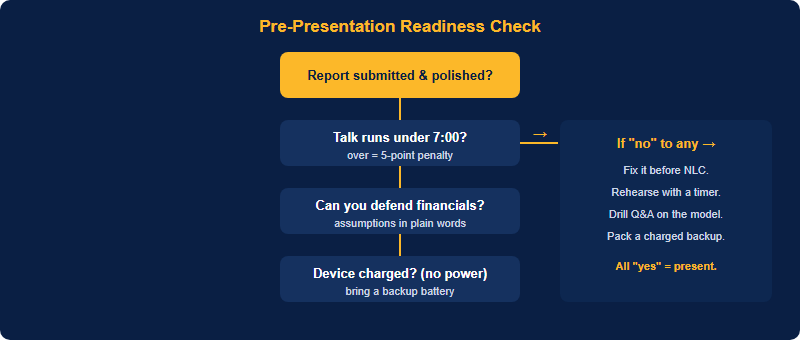
- Presentation: up to 7 minutes. Going over the limit carries a documented 5-point penalty, so finishing at 6:45 is safer than racing to 7:10.
- Q&A: a 3-minute question-and-answer period with the judges immediately after you present.
- Logistics: a wireless slide advancer is permitted, but electricity is not provided in the room — bring a fully charged device, and the preliminary round is typically closed to the audience.
The “no electricity” rule trips up well-prepared teams every year. Charge everything the night before, carry a backup battery, and rehearse a version that survives if a projector fails — your story should land even on a laptop screen. Because the judges read your report beforehand, do not waste your 7 minutes re-reading it aloud. Spend the time on the three things slides do better than paper: the problem made vivid, the business model made obvious, and the financial logic made believable. Then save energy for the Q&A, where rank is often won or lost — judges probe assumptions, so the team member who built the financial model should be ready to defend it in plain language.
A realistic build timeline from idea to entry
The teams that place rarely start the week before a deadline. Because the report is prejudged, you need it finished early enough to revise. Here is a sequence that works, scaled to whatever runway you have:
- Weeks 1–2 — Idea & validation. Pick a problem you can actually observe, then pressure-test demand. Talk to 5–10 potential customers before you commit. A validated narrow idea beats an exciting unvalidated one.
- Weeks 3–5 — Research the market. Build the Industry Analysis, Target Market, and Competitive Analysis on real numbers. Cite credible, documented sources — vague claims lose points.
- Weeks 6–7 — Model the business & money. Define operations, then build financials with explicit assumptions. This is the hardest section, so give it the most time.
- Week 8 — Draft the full report. Write every section to the rating-sheet sequence, then write the Executive Summary last. Keep it inside 17 pages with a cover and table of contents.
- Week 9 — Revise & format. Cut filler, check the page count, number every page, proofread. Have an adviser or peer who has not seen it read it cold.
- Weeks 10+ — Build & rehearse the talk. Slides that add to the report, not repeat it. Rehearse with a timer to land under 7 minutes, and run mock Q&A on your weakest assumptions.
Qualifying typically happens at the regional or state level before any national round, and only top entries advance — so treat each level as a checkpoint to strengthen the plan, not a finish line. For the broader event landscape and how this fits the FBLA program, see our Competitive Events guide and our walkthrough on how to qualify for the NLC. NLC 2026 is hosted in San Antonio; always confirm conference dates and event-specific deadlines on fbla.org rather than relying on prior years.
Common point-losers (and the fix)
Across rating sheets, the same avoidable mistakes recur. Fixing them is often worth more than any single clever idea:
- Over the page limit or missing structure. Penalty points apply when the report ignores the guidelines. Keep it to 17 pages, with a cover page, a table of contents, and numbered pages.
- Financials with no stated assumptions. Numbers without logic read as guesses. State your accounting method and the assumptions behind every projection.
- A vague target market. “Everyone who likes coffee” is not a market. Name a segment, size it, and explain why it buys.
- Re-reading the report aloud. Judges already read it. Use the presentation to add clarity and energy, not to repeat paragraphs.
- Running long. A 5-point penalty for exceeding 7 minutes is entirely self-inflicted. Rehearse to a timer.
- Guessing at the rules. Page limits, timing, sections, and submission steps can change year to year. Confirm every procedural detail on fbla.org before you submit.
Frequently asked questions
Is the FBLA Business Plan an individual or team event?
Either. You may enter as an individual or as a team of up to three members from the same chapter. Confirm current entry limits on fbla.org.
How long can the report be?
No more than 17 pages on 8½″ × 11″ paper, with a cover page, a table of contents, and numbered pages, following the rating-sheet sequence.
How long is the presentation?
Up to 7 minutes to present (a 5-point penalty applies if you go over), plus a 3-minute Q&A, with up to 5 minutes to set up and remove materials.
Do I need to register or get a candidate ID?
Entry runs through your chapter and the conference platform. Do not assume a generic flow — confirm the exact registration and submission steps on fbla.org.
Published by the FBLA editorial desk, operated by Hanlin Education for China-based international-school students. Official rules are set by the competition and change yearly, so confirm current details — page limits, timing, required sections, deadlines, and submission steps — on fbla.org. Confirmed errors are corrected within 7 working days.