When a judge asks a question during an FBLA presentation, the instinct is often to restate information from your slides. This response usually misses the mark. Judges have already seen the slides; they are typically asking because they want to understand your reasoning, test your depth of knowledge, or challenge an assumption. The goal of the Q&A session is not to repeat what you presented, but to demonstrate that you can think on your feet and defend your business case with logic and evidence.
The Core Mechanism: Addressing the Intent Behind the Question
Based on common competitive presentation formats, judges typically ask questions for three purposes: clarification, challenge, or exploration. Clarification questions occur when a point was ambiguous. Challenge questions occur when a judge disagrees with a premise or sees a flaw in the logic. Exploration questions occur when a judge wants to see if you can extend your thinking beyond the prepared material. In all cases, repeating slide text usually fails because it does not address the specific intent. A stronger answer acknowledges the question’s type and responds to the underlying concern.
For example, if a judge asks, “Why did you choose this pricing model?” and you respond by reading your slide titled “Pricing Strategy,” you have ignored the word “why.” The judge is asking for justification, not description. You must explain the trade-offs considered, the data supporting the choice, and why alternatives were rejected. This demonstrates analytical depth, which competitive presentation scoring typically rewards.
Worked Teaching Illustration: Handling a Cost Objection
Note: The following figures are explicit fictional assumptions for teaching purposes, not actual evidence or official contest data.
Imagine a student team presenting a subscription-based tutoring service. Their slide shows a monthly fee of $50. A judge asks, “Your competitor charges $30. Why would customers pay $50?”
A weak response repeats the slide: “Our price is $50 per month.” This ignores the comparison and the value proposition.
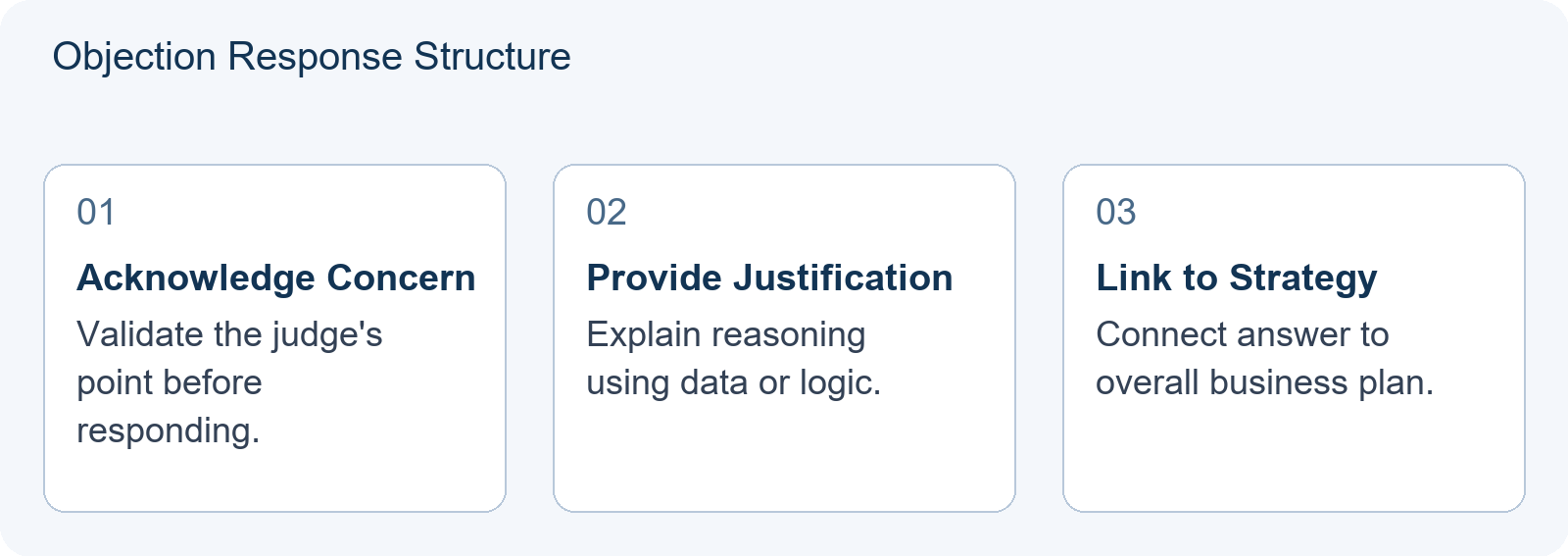
A stronger response follows this structure:
- Acknowledge the gap: “You’re right that our price is higher than the basic tier of competitors.”
- Justify with differentiation: “However, our $50 includes personalized AI-driven progress tracking and weekly human mentor check-ins, which competitors charge separately as add-ons totaling $70.”
- Cite evidence with explicit limitation: “In our pilot survey of 50 students, 80% indicated preference for integrated support rather than fragmented services. Preference data shows direction but does not prove willingness to pay or retention; we would next test actual conversion at this price point.”
- Conclude with strategic fit: “Therefore, we position ourselves as a premium all-in-one solution, targeting parents who value convenience over lowest cost.”
This answer addresses the objection (price difference) without repeating the slide. It uses comparative data and logical positioning to defend the decision, while honestly stating the gap between stated preference and proven purchasing behavior.
Contrasting Case: When Repetition Seems Necessary but Isn’t
Sometimes, students feel compelled to repeat slides because they fear forgetting details. Consider a judge asking, “What is your break-even point?” If the slide clearly states “Break-even at 120 units,” a student might say, “As shown on slide 4, the break-even point is 120 units.” This is technically accurate but wastes time and signals lack of confidence.
A better approach integrates the number into a broader explanation: “We break even at 120 units.” This is an appropriate concise answer to the exact question asked. If the judge wants additional context, they will follow up. Volunteering unsupported forecasts—such as claiming to reach 120 units by month six based on a customer acquisition cost of $10 per user—requires explicit assumptions to be valid. Note: The following figures are explicit fictional assumptions for teaching purposes. For instance, that forecast would assume approximately 20 net new customers per month with no retention loss, and “units” would need clear definition as customers rather than subscriptions or revenue. Without these assumptions stated, the forecast is unverifiable and should be omitted.
In another scenario, a judge asks, “How did you validate your market size?” If the slide lists “TAM: $1B, SAM: $100M, SOM: $10M,” repeating these numbers adds no value. Instead, explain the methodology: “We derived TAM from national education spending reports, narrowed SAM to urban high school students using census data, and estimated SOM based on our pilot conversion rates.” This shows process, not just output.
Diagnostic Application: Identifying Weak Answers
Suggested teaching framework for practice sessions:
- Repetition Check: Did the answer use phrases identical to the slide? If yes, rewrite to focus on reasoning.
- Evidence Check: Did the answer cite data, surveys, or logical principles not explicitly detailed on the slide? If no, strengthen the argument.
- Intent Check: Did the answer address the judge’s likely concern (cost, feasibility, risk)? If not, pivot to acknowledge the concern first.
For instance, if a judge asks, “What happens if your supplier raises prices?” and the team answers, “We have a contract with them,” this is weak. It doesn’t address the risk. A stronger answer would acknowledge uncertainty and verification needs: “We do not have actual checked cost margins for supplier escalation scenarios. To verify, we would model our break-even at various input cost increases and confirm buffer in our current pricing.”
Suggested Framework: The PREP Method for Objections
Note: The following is an optional teaching tool, not official FBLA guidance.
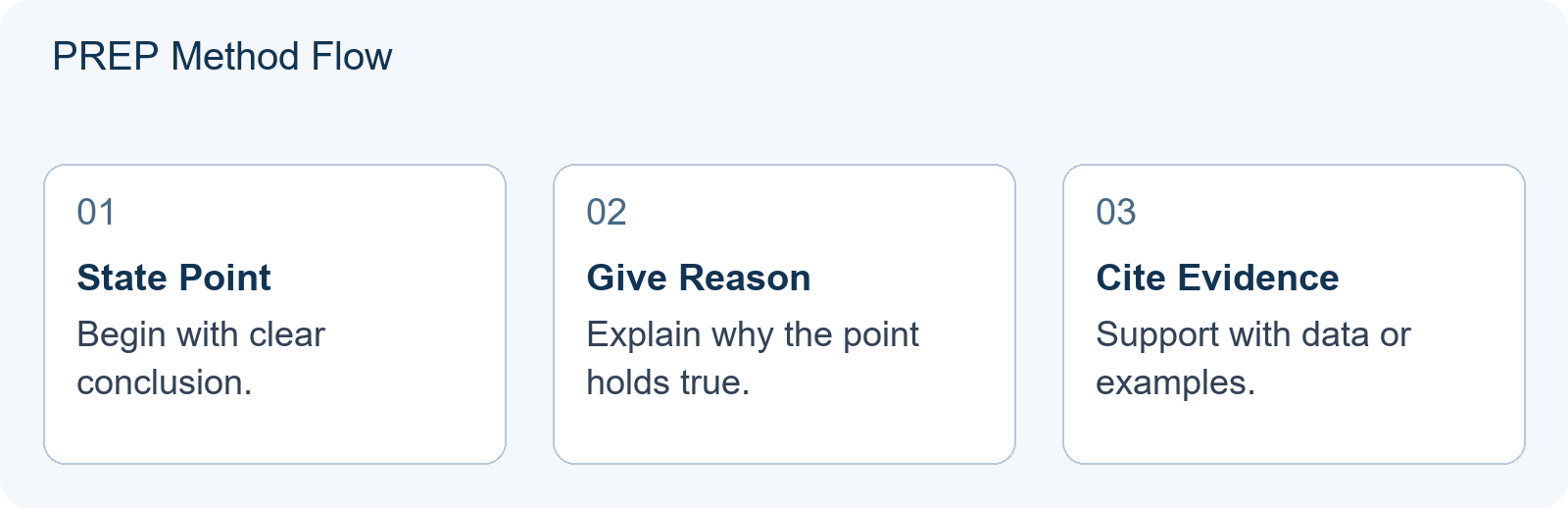
Teams may find it useful to practice with the PREP method to structure spontaneous answers:
- P – Point: State your main conclusion directly. (“We believe our pricing is justified.”)
- R – Reason: Explain why. (“Because it reflects superior service integration.”)
- E – Evidence: Provide data or examples. (“Our pilot showed strong retention signals versus industry benchmarks.”)
- P – Point: Restate the conclusion briefly. (“Thus, the premium price drives long-term value.”)
This structure prevents rambling and ensures each part of the answer serves a purpose. It may also help non-native English speakers maintain clarity under pressure. Referring to slides can help when complex visuals are essential to understanding, but verbal explanations generally demonstrate deeper engagement.
Course-Fit and Resource Preparation
Preparing for FBLA presentation questions requires more than memorizing facts. It demands critical thinking and adaptability. Students should assess whether their current preparation style focuses too much on slide design and too little on defense scenarios. If your team struggles with unexpected questions, consider seeking coaching that emphasizes mock Q&A sessions with varied judge personas.
Useful feedback should highlight gaps in logical consistency, not just delivery polish. Ask mentors to challenge your assumptions aggressively. For example, if you claim low customer acquisition costs, be ready to defend against questions about scalability limits or competitive saturation.
Additionally, review existing resources on FBLA Presentation Coaching: Choosing Feedback on Delivery, Slides and Questions to understand how to balance visual aids with verbal defense. Also, explore FBLA Case Study Assumptions: Separating Evidence From a Convenient Guess to learn how to separate evidence from guesses, a key skill in answering objections. Finally, consult Answering FBLA Judges: A 40-Question Drill Bank, Answer Frame and Scoring Log (2026-27) for a drill bank of common questions and scoring logs to track improvement.
Conclusion: Confidence Through Preparation
Answering objections without repeating slides is a sign of mastery. It shows that you understand your business case deeply enough to explain it flexibly. By focusing on intent, using structured methods like PREP, and practicing with realistic challenges, teams can turn Q&A sessions into opportunities to score higher. Remember, judges are typically trying to see if you truly own your project. Prepare to defend, not just present.
Deepening the Teaching Illustration: From Preference to Proven Value
The earlier teaching illustration used a fictional pilot survey where 80% of students preferred integrated support over fragmented services. While this data point supports a value proposition, it does not prove willingness to pay or long-term retention. A common error in FBLA presentations is treating stated preference as definitive market validation. Judges often probe this gap by asking, “How do you know these preferences translate into actual sales?” Repeating the slide statistic fails here because it ignores the distinction between intent and action.
Diagnostic Check: The Intent-Action Gap
To address this objection without repeating slides, teams must explicitly acknowledge the limitation of their current evidence and propose a verification method. This demonstrates analytical rigor rather than defensive repetition. Consider this response structure:
- Acknowledge the specific gap: “Our pilot survey shows strong preference for integrated features, but we recognize that stated preference does not guarantee purchase behavior.”
- Explain the logical bridge: “We are using this preference data to justify our feature set, not to forecast revenue. The $50 price point reflects the combined cost of AI tracking and human mentorship, which competitors charge separately.”
- Propose concrete verification: “To validate willingness to pay, we plan to run a limited pre-order campaign with a deposit requirement. This will convert stated preference into measurable commitment before full-scale launch.”
Why This Works
This answer avoids restating the slide’s “80% preference” figure. Instead, it contextualizes the data within a broader business logic framework. It admits uncertainty (a strength in competitive judging) and outlines a next step that directly tests the assumption. By separating product justification (features) from financial validation (conversion), the team shows they understand the different types of evidence required for each claim.
Practice Task: Reframe Your Evidence
Teams should audit their own presentation materials for similar gaps. Identify any statistic presented as proof of demand. Ask: Does this data show what customers want, or what they will buy? If it only shows desire, prepare an answer that explains how you will test purchasing behavior. For example, if your slide cites social media engagement rates, be ready to explain how you will track click-throughs to a landing page or sign-ups for a waitlist. This shifts the focus from passive metrics to active conversion evidence, addressing the judge’s likely concern about scalability and real-world viability.
Frequently Asked Questions
Should I apologize if I don’t know the answer?
No. Instead, state what you do know and offer to follow up. Say, ‘I don’t have that exact figure now, but based on our pilot data, we estimate…’ This shows honesty and analytical ability.
How long should my answer be?
Keep answers concise, ideally 30-60 seconds. Long answers risk losing focus. Use the PREP method to stay structured and avoid rambling.
Can I refer back to my slides during Q&A?
Referring to slides can help when complex visuals are essential to understanding, but verbal explanations generally demonstrate deeper engagement. Use slides as a reference when the visual directly supports your point, not as a substitute for reasoning.