Published FBLA high school rating sheets carry a row for how well you handle judges, and its top level rewards a competitor who “interacted with the judges in the process of completely answering questions.” Most students rehearse the presentation and improvise that row. This page does the opposite: a 40-question drill bank sorted by type, a four-part answer frame, and a log you score yourself against every week.
The one row you cannot rehearse by rehearsing your speech
FBLA’s most recent published high school list ran to 76 competitive events across five formats — objective tests, presentation events, role play events, chapter events and production events; the 2026-27 lineup goes live in early September, so confirm it on fbla.org. Three of those formats put you in a room with judges, and in those rooms scoring is row-by-row, not holistic. Published rating sheets mark each criterion at one of four levels — “Not Demonstrated,” “Below Expectations,” “Meets Expectations,” “Exceeds Expectations” — record the number in a Points Earned column, and take penalties off the bottom.
Among the delivery criteria on those published sheets sits a row phrased as “Demonstrates the ability to effectively answer questions.” Its bottom level describes a competitor unable to answer; its top level is the interaction sentence quoted above. Read those two poles carefully, because together they tell you exactly what the row is buying:
- Completeness, not brilliance. The top band says completely answering. A dazzling half-answer scores below a plain full one.
- Interaction, not survival. The word is interacted. A competitor who absorbs a question, answers it and freezes is not doing the thing the top band describes.
That is a row you can train directly, and almost nobody does. Everything below is built to train it. One caution first: criteria, wording and point values are set event by event and rewritten each cycle, and FBLA has stated that the 2026-2027 Competitive Events Guidelines, including topics, go live at the beginning of September. Pull your own event’s sheet from fbla.org rather than trusting the shape described here, and check the date in the footer of whatever you download — FBLA notes these documents may see small changes through the year.
Seven question types, and what each one is really testing
Judges are not generating questions at random. In practice they probe a small number of predictable weak points, and once you can name the type inside the first three seconds you have already bought yourself a structure. Use this table as the classifier.
| Type | What the judge is really testing | The tell that you are losing the row | Your default opening clause |
|---|---|---|---|
| 1. Scope | Whether you can state the problem tightly, and know what you excluded | You restate the whole project instead of narrowing | “The problem is specifically…” |
| 2. Numbers | Whether your figures are yours, sourced and understood | “I think it was around…” with no period or source | “That figure is from… and it covers…” |
| 3. Alternatives | Whether you chose, or merely arrived | You defend your option without naming a rejected one | “We considered X and rejected it because…” |
| 4. Risk | Whether you have imagined this failing | Optimism: “we do not expect problems” | “The likeliest failure is… and the early signal is…” |
| 5. Implementation | Whether the plan survives contact with a calendar and a budget | Verbs with no owner, cost or date attached | “In the first 30 days, [owner] would…” |
| 6. Ethics and stakeholders | Whether you can see who bears the cost | Treating the question as an attack | “The group most affected is… and we would…” |
| 7. Personal and process | Whether the work is actually yours | Vague team language: “we all worked on everything” | “I personally handled… my teammate handled…” |
Type 7 deserves a note for anyone preparing from a China campus. Expect judges who do not know your school to lean harder on process questions — not because they doubt you, but because they have no reference for what a project at your school normally involves. Treat it as an invitation to be specific rather than defensive, and see our guide for international students competing in FBLA for the wider context problem.
The four-part answer frame
Every answer should have the same skeleton. Not because judges want a formula, but because under pressure a formula is the only thing that reliably produces a complete answer — which is the word the top band uses.
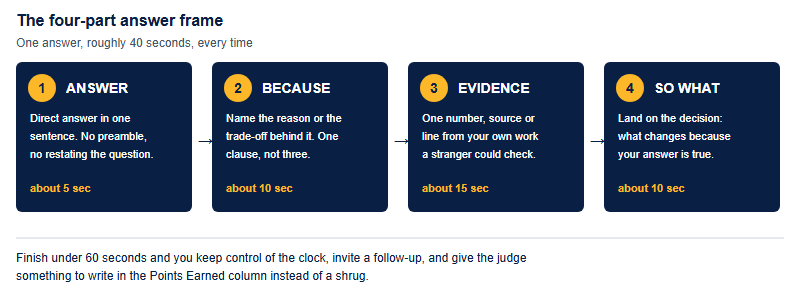
Two failure modes this frame is designed to kill. The first is the preamble — “That is a really good question, so if we look back at slide four…” — which burns your best seconds before you have said anything scorable. The second is the trail-off, where an answer is technically correct but dies in a mumble, leaving the judge unsure whether you finished. Part 4 is your full stop. Say it, stop talking, look up.
The drill bank: 40 questions to rehearse against
Print these. Have a teammate, a parent or a classmate draw them at random — the randomness is the whole point, because the skill you are building is classification speed, not memorised answers. This bank is ours, compiled from the questions that most reliably expose an under-prepared entry. It is not an official FBLA list, and your event’s real questions will follow your own topic and case.
Type 1 — Scope (6)
- In one sentence, what problem are you actually solving?
- Who is the customer, specifically?
- What is deliberately out of scope here?
- Define that term the way you are using it.
- How is this different from what already exists?
- If you had one sentence for a board, what would it be?
Type 2 — Numbers (7)
- Where did that figure come from?
- What period does that number cover?
- What happens if that number is half what you assumed?
- Which currency is that, and what rate did you convert at?
- What is your single most important assumption?
- What does that percentage mean in absolute terms?
- How would you verify that claim if you had one week?
Type 3 — Alternatives (6)
- What did you consider and reject?
- Why this option rather than the cheaper one?
- What is the strongest argument against your recommendation?
- If the budget were cut by 40 percent, what stays?
- What would a competitor do in response?
- Is there a version of this that needs no new spending?
Type 4 — Risk (5)
- What is most likely to go wrong first?
- How would you know early that this is failing?
- What is your fallback if the main channel does not work?
- Who could block this, and why?
- What rule or regulation could stop you?
Type 5 — Implementation (6)
- What happens in the first 30 days?
- Who owns this, and what is their role?
- What does it cost, and over what period?
- What do you need that you do not currently have?
- How would you measure success in six months?
- What is the first thing you would do on Monday?
Type 6 — Ethics and stakeholders (4)
- Who is worse off if this works?
- What data are you collecting, and who agreed to that?
- How would you handle the people whose roles change?
- Is there anything here you would not want published?
Type 7 — Personal and process (6)
- What part of this did you personally do?
- What surprised you during the research?
- What would you change if you started again?
- What did you not have time to investigate?
- How did your team divide the work?
- Where did the idea come from?
Score yourself, then run the six-week ladder
Drilling without scoring produces confidence, not points. After each answer, mark yourself against the same four-level shape the published sheets use — on observable behaviour, not on how it felt.
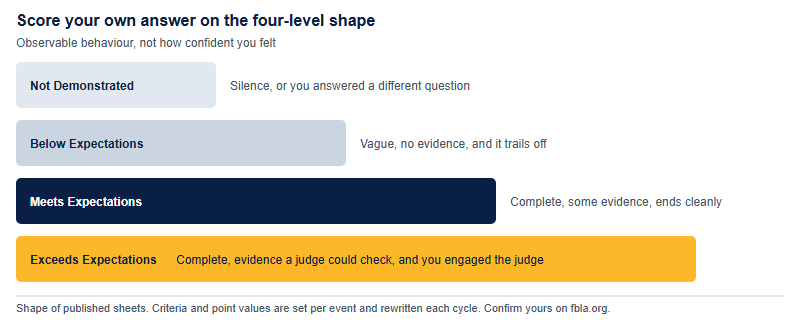
Now run the ladder: twenty minutes, twice a week, for six weeks. Draw questions blind, answer aloud and standing, and log the score before you discuss the answer.
| Week | Draw from | Constraint added | You have passed the week when |
|---|---|---|---|
| 1 | Types 1 and 2 | None — just complete all four parts | Every answer contains a visible Part 4 |
| 2 | Types 3 and 4 | 60-second cap, timed out loud | No answer runs over and none ends in a trail-off |
| 3 | Types 5 and 6 | Every answer must carry one number | You never say “around” without naming a source |
| 4 | All seven, random | Name the type aloud before answering | You classify correctly 8 times out of 10 |
| 5 | All seven, random | Drawer adds one hostile follow-up | You hold or concede cleanly, without collapsing |
| 6 | All seven, random | A stranger drawing — a teacher who does not know the project | You self-score at the third band or better on 8 of 10 |
Two notes on the final weeks. The hostile follow-up in week 5 trains the most valuable reflex in the room — telling apart a question you should concede from one you should hold. Conceding well (“You are right that the second-year figure is soft; the decision does not depend on it, because…”) tends to read better than defending badly. And week 6 needs a genuine stranger, because a teammate cannot un-know your project, which is exactly the condition every judge is in.
Where this sits in the season: choose your event first, since question style differs sharply between a defended report and a role play case. Our guide to the competitive events covers the formats, and if you are working back from a national target, how to qualify for NLC sets out the levels you would pass through.
Questions students ask about the judge Q and A
How long should an answer to an FBLA judge be?
Aim for 30 to 60 seconds — long enough for answer, reason, evidence and consequence, short enough to invite another question.
What do I do if I genuinely do not know?
Say what you do know, name the gap plainly, then say how you would find out. Silence scores lowest; a bounded honest answer does not.
Does every FBLA event include judge questions?
No. Question time is defined event by event, and some published guidelines set a timed question period. Confirm your own event on fbla.org.
When do the 2026-27 guidelines and topics appear?
FBLA has stated they go live at the beginning of September. Check the date in each document footer, as files can change during the year.
Published by the FBLA editorial desk, operated by Hanlin Education for China-based international-school students. Official rules are set by the competition and change yearly — confirm current details on fbla.org. Any error here is corrected within 7 working days.