Many students preparing for the FBLA objective test fall into a frustrating cycle: they take a practice set, score poorly, review the correct answers, nod in agreement, and then repeat the same mistakes on the next set. The problem is rarely a lack of effort or even a lack of knowledge. It is usually a lack of analysis. Without understanding why a specific question was missed, studying becomes random rather than strategic. This article provides a concrete method for fixing fbla objective test mistakes by turning every missed question into data that shapes your next week of preparation.
Why Another Topic List Is Not the Fix
If you have already reviewed our guide on FBLA 2026-27 Test Blueprints: Where the 100 Questions Come From in Every Objective Test, With a Study-Hour Allocator, you know where the 100 questions come from. You likely also worked through the The FBLA Business-Term Command Test: 60 Terms You Must Use, Not Just Recognise (2026-27). Yet knowing the topic distribution and having a term list does not explain why you chose answer C instead of B on a specific accounting question. General study plans allocate hours by subject; they do not account for the cognitive errors that produce wrong answers. When you miss a question, it is not only a gap in content — it is a signal about how you are processing information. Treating every miss as “I need to study more finance” is inefficient because you might actually be struggling with reading discipline under time pressure or with confusing similar-sounding terms. To fix this, move from passive review to active error classification.
The Three Core Miss Types
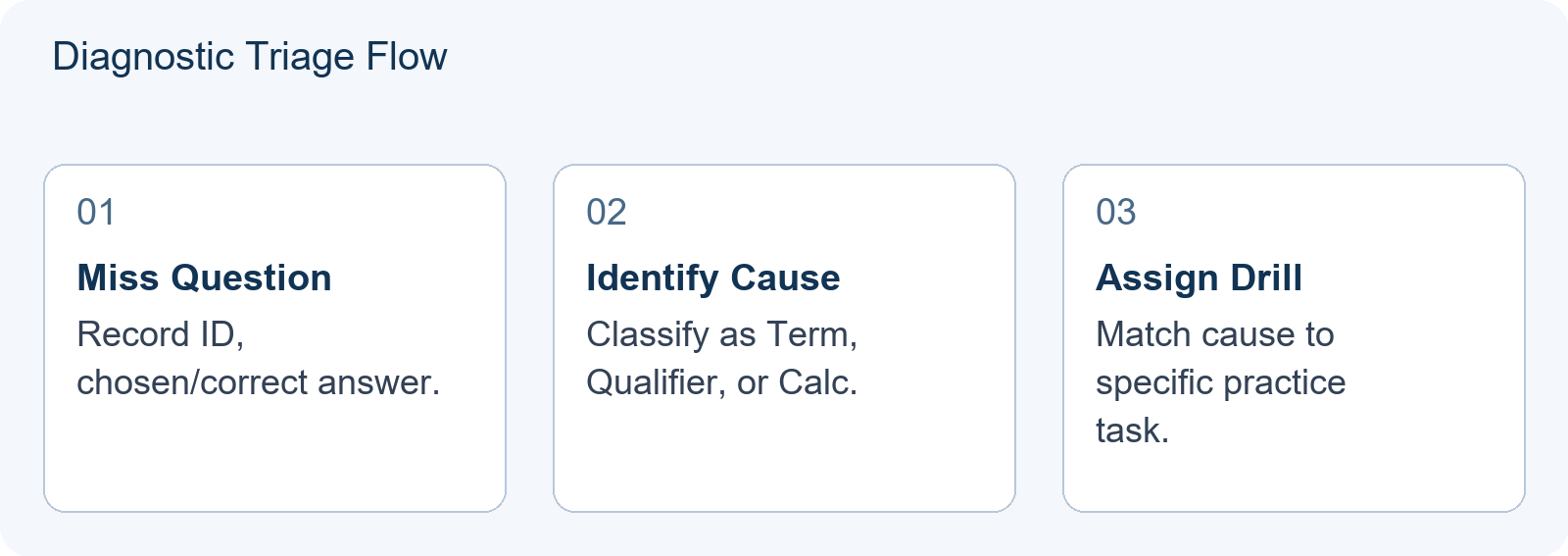
To diagnose your performance effectively, categorize every missed question into one of three distinct types. This triage system prevents vague self-criticism and directs specific remedial actions.
1. Term Confusion
This occurs when you recognize the vocabulary but cannot distinguish between closely related concepts. Examples include confusing “gross profit” with “net income,” or “fixed cost” with “variable cost.” These errors suggest that your mental model of the definitions is fuzzy. You may have memorized the words without internalizing their functional differences in a business scenario. The fix is not more reading but contrastive practice: forcing your brain to hold two related terms side by side and explain the boundary between them.
2. Qualifier Misread
Testing prose can use negative or superlative qualifiers — EXCEPT, NOT, LEAST, BEST — and a qualifier misread happens when you understand the concept perfectly but fail to notice that the question asks for the exception rather than the rule. This is an attentional error, not a knowledge gap. If you consistently miss these, the underlying weakness is speed-reading discipline under timed conditions, not business acumen. Because qualifier traps can appear in multiple-choice formats, treating them as a defensive reading habit — not merely a content problem — can pay off over time.
3. Calculation Setup Error
In events involving finance or marketing metrics, you might know the formula but apply it incorrectly due to unit mismatches or order-of-operations slips. For example, computing a break-even quantity with total revenue in the numerator instead of contribution margin per unit produces a nonsensical answer even though the formula was “correctly remembered.” These errors indicate a weakness in procedural fluency — the ability to translate a word problem into a mathematical structure accurately before any arithmetic is done.
Building Your Missed-Question Log
You need a simple, consistent tool to track these errors. Do not rely on memory. Create a spreadsheet or a physical notebook with five columns. Every time you miss a question during practice, fill out this row immediately, while the reasoning is still fresh.
| Column | What to Record | Example Entry |
|---|---|---|
| Q ID | Question number from the practice set | Set 4, Q12 |
| Chosen Answer | What you picked | C |
| Correct Answer | What the key says | B |
| Reason Code | One of the three types above | Qualifier Misread |
| Next Drill | Specific action to prevent recurrence | Practice five EXCEPT questions daily |
The “Reason Code” is the most critical column, and it is also the easiest to fake. Be honest. If you guessed and got it wrong, mark it as “Term Confusion” when you didn’t know the definition, or “Qualifier Misread” when you knew the definition but missed the “NOT.” Resist the temptation to record every miss as “I did not know it,” because that collapses three very different problems into a single label and destroys the diagnostic value of the log. Over a week, the reason codes will tell you exactly which drill to run next.
Keep the entries short. Each row should take under thirty seconds to write. The point is not documentation for its own sake but a pattern you can tally at the end of the week. If a full practice set produces twenty misses and each row takes two minutes to write, the log becomes a burden you will abandon. Force yourself to compress each miss into one terse line, and let the tallies — not the prose — carry the insight.
Teaching Illustration: From Data to Drill Plan
Note: The following is a hypothetical teaching illustration, not a real student record or official scoring guidance.
Imagine a student completes a 100-question practice set and misses 12 questions. They fill out their log. After reviewing the 12 rows, they tally the Reason Codes:
- 7 Term Confusions: Mostly related to accounting principles (for example, accrual versus cash basis).
- 3 Qualifier Misreads: All involved “EXCEPT” questions in a marketing-ethics block.
- 2 Calculation Setup Errors: Both involved break-even analysis units.
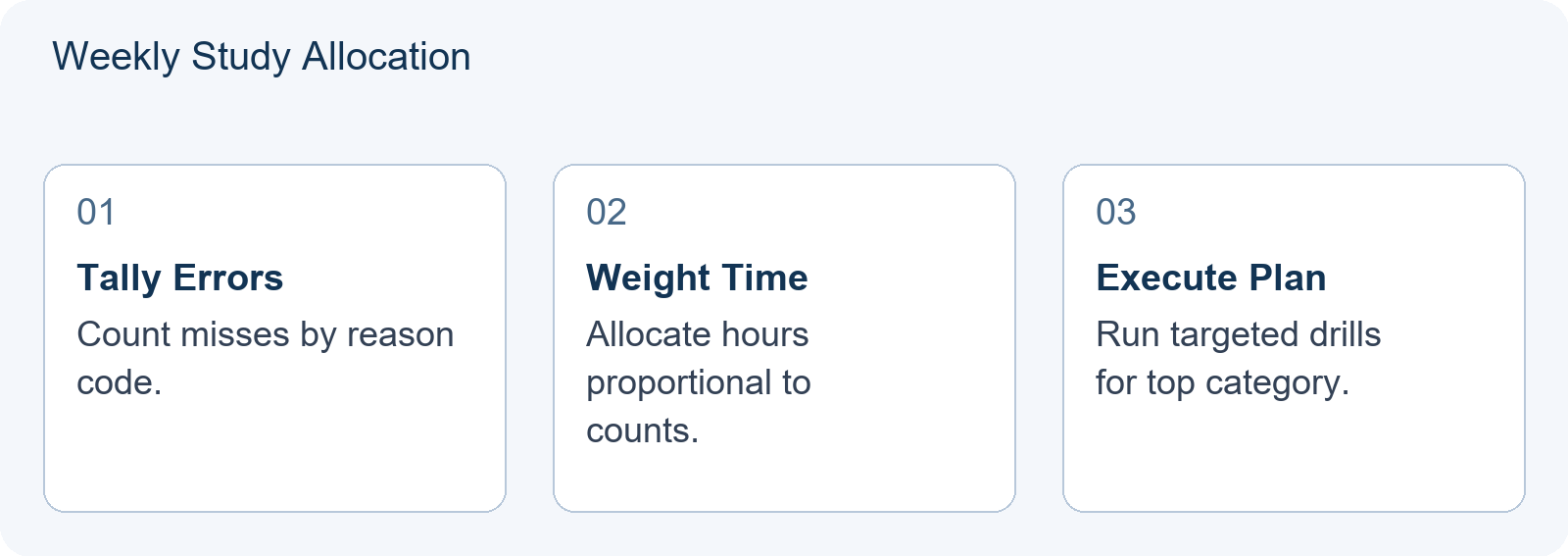
A generic response would be “study harder.” A diagnostic response allocates the next week’s practice time based on this distribution. Since Term Confusion is the dominant error type — 7 of 12 misses, roughly 58% — the student dedicates about 60% of their study minutes to flashcard and definition-contrast exercises. Because Qualifier Misreads are frequent enough to warrant attention, the student adds a quick ten-minute daily routine of scanning question stems for negative words before answering. Calculation errors are rare here, so they receive minimal dedicated time — perhaps just reviewing two sample break-even problems with units written down first. This allocation ensures effort matches the actual bottleneck instead of the student’s intuition about what feels hardest.
The arithmetic matters. A student whose dominant category hits 60% of misses should not spend 60% of study time on everything else. Mirror the proportions. If next week’s set produces a different distribution — say, term confusions drop but qualifier misreads jump — the plan updates automatically because it is derived from the log, not from a fixed curriculum.
Choosing Drills Based on Your Log
Once you have identified your primary error type, select drills that target that specific cognitive skill.
For Term Confusion: Contrastive Flashcards
Do not just define terms. Create cards that force comparison. On one side, write “Gross Profit.” On the other, write “Net Income.” In the middle, list the exact steps that separate them — subtracting operating expenses, interest, and taxes from gross profit gets you to net income. Practice explaining the difference aloud. If you can articulate why one is not the other, you have resolved the confusion. Our The FBLA Business-Term Command Test: 60 Terms You Must Use, Not Just Recognise (2026-27) offers a starting point for the definitions themselves, but your log will tell you which pairs are actually problematic for you.
For Qualifier Misread: The Circle-and-Pause Method
This is a mechanical drill. Take a set of twenty practice questions. Before looking at the options, circle any word like NOT, EXCEPT, LEAST, or BEST. Pause for two seconds. Re-read the stem end to end. This breaks the habit of autopilot reading. Track how many times you catch yourself almost missing a qualifier. Over two weeks of daily practice, the catch rate should rise while the miss rate falls, and you will have converted an attentional weakness into a reflex.
For Calculation Setup: Unit-First Writing
When practicing math-heavy questions, write down the units first. If a question gives costs in dollars per month and sales in units per year, convert everything to a common timeframe before plugging numbers into formulas. Draw a small box around each variable in the problem statement and label it with its unit. This visual anchoring prevents setup errors caused by mismatched scales. For break-even specifically, always write the contribution margin per unit — price minus variable cost per unit — before dividing fixed costs by it. If the numerator and denominator have mismatched units, the setup is wrong regardless of the arithmetic.
Weekly Review Cadence
Diagnosis is not a one-time event. Set a weekly rhythm: one practice set, one logging session, one tally, one planning session. At the end of each week, review the Missed-Question Log. Look for patterns. Did the number of Term Confusions decrease? If yes, shift some time to another area. If no, intensify the contrastive flashcard drills. If new error types emerge, adjust the plan. This iterative process keeps your preparation responsive to actual performance rather than static assumptions.
Schedule the review for the same slot each week — a Sunday evening, for example — and cap it at thirty minutes. A review that drags becomes a review you skip, and a skipped review is how a diagnostic habit dies. The output of each review is a single sentence in a new column of your spreadsheet: “This week, X% of minutes to term contrast, Y% to qualifier drill, Z% to calculation routine.” The next week executes that sentence.
Additionally, consider how your school curriculum aligns with these gaps. If you find many economics-related term confusions, check whether your IB or AP course covers those specific nuances. The The Syllabus-to-Event Map (2026-27): What Your IB, AP or A-Level Course Already Covers for FBLA can help you identify whether a gap is curricular or personal-study in nature, which in turn tells you whether the correct fix is classroom attention or an extra drill block.
What the Log Cannot Tell You
While powerful, this diagnostic method has limitations. It relies on accurate self-reporting. Students may rationalize lucky guesses as knowledge. If you guessed correctly, you did not log a miss, but you still had a knowledge gap. To mitigate this, occasionally re-test questions you answered quickly or felt uncertain about, even if you got them right. Mark these as “False Positives” in a separate section of your log. This helps uncover hidden weaknesses that standard missed-question tracking will miss.
Furthermore, this log addresses individual performance. It does not replace understanding the broader competition context. Ensure you are also reviewing the structural aspects of the test — time management, question format familiarity, and the pattern of which sections you rush through — because a mistake made under time pressure can look identical in the log to a mistake made from lack of knowledge. Distinguishing them requires noting the number of seconds spent on each missed question, an optional sixth column worth adding once the basic habit is stable.
Conclusion
Improving your score on the FBLA objective test requires more than volume; it requires precision. By classifying your errors into term confusion, qualifier misreads, and calculation setups, you transform practice misses into a roadmap for improvement. Start logging today. Identify your dominant error type. Allocate your next week’s study time proportionally to that type. Review the distribution at the end of the week and let it update the plan. This disciplined approach turns frustration into progress, ensuring that every hour spent preparing yields measurable gains in accuracy and confidence.
Frequently Asked Questions
How many questions should I analyze per session?
Analyze all missed questions from a full practice set. Consistency matters more than volume; ensure every miss is logged with a reason code to build reliable data across weeks.
Can I use this log for judged events too?
This log is designed for multiple-choice objective tests. Judged events require different feedback mechanisms, such as the rating-sheet self-check approach covered in our judges and scoring guides.
What if I don’t know why I missed a question?
If the cause is unclear, re-read the question stem slowly. If you still cannot determine if it was a term, qualifier, or calculation issue, mark it as ‘Unclear’ and review it again after completing the rest of the log. Often, the pattern emerges over several sessions.