Many FBLA events can be entered individually or as a team of two or three, and the choice changes everything: how much control you have over your score, how you schedule prep, how reliable your partner has to be, and what the activity signals on an application. Individual events reward self-reliance and a clean personal result; team events reward collaboration and let you split the workload. There is no universally “better” option — only the better fit for you. Team-size rules vary by event, so always confirm the current eligibility for your specific event on fbla.org.
The core trade-off in one sentence
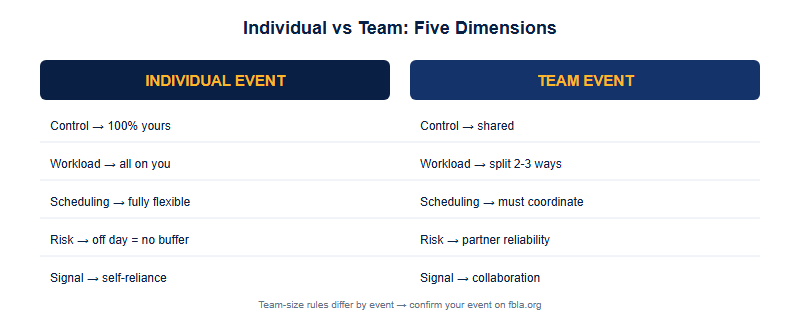
An individual event puts 100% of the outcome in your hands and 100% of the workload on your shoulders; a team event shares both. Everything else — scheduling, accountability, the story you can tell — flows from that single trade-off. Before you pick, it helps to know that FBLA’s catalogue of 76+ competitive events groups events into formats such as Objective Tests, production/written events, and presentation events, which our Competitive Events guide breaks down in full. Many of the production and presentation events offer both individual and team versions.
What individual events are good for
Choose an individual event when you want full ownership and a result that is unambiguously yours.
- Total control. Your preparation, your performance, your score. Nobody else can lower your ceiling — or raise it.
- Flexible scheduling. You rehearse when it suits you. For a busy China international-school student juggling IB or AP deadlines, not having to coordinate calendars is a real advantage.
- A clean personal signal. An individual placement is easy to describe truthfully on an application: it was your work.
- Objective Tests are inherently solo. If you love speed and frameworks, the timed Objective Test events are individual by nature — see our China chapter guide for how international students approach them.
The cost is exposure: if you have an off day, there is no teammate to absorb it, and the full prep load is yours alone.
What team events are good for
Choose a team event when collaboration is a strength and a larger deliverable benefits from more than one brain.
- Shared workload. A big production or a multi-part presentation is more manageable across two or three people.
- Complementary skills. One partner anchors the research and slides; another is calmer answering judges’ questions live. Together you cover more of the rubric.
- Real teamwork to talk about. Collaboration, delegation, and resolving disagreement are leadership signals in their own right.
- Less solo pressure. On presentation day, you are not alone in the room.
The cost is dependency: your result is now tied to your teammates’ reliability, and you must coordinate schedules — harder when members sit different exam timetables.
A simple decision framework
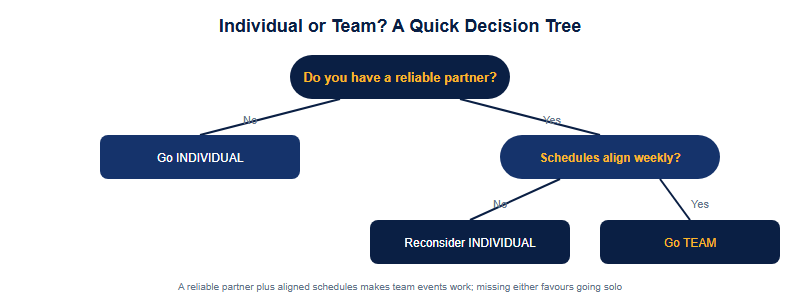
Run your situation through four questions. Answer honestly — the goal is the right fit, not the impressive-sounding one.
| Question | Lean individual if… | Lean team if… |
|---|---|---|
| Do you have a reliable partner? | You do not — or partners have flaked before | You have one or two committed, dependable people |
| How do your schedules line up? | Everyone’s timetable is different and crowded | Your group shares free blocks each week |
| Where do you perform best? | You think most clearly working alone | You sharpen ideas by bouncing them off others |
| What do you want to show? | A clean, self-driven personal result | Evidence of leadership and teamwork |
If your answers split evenly, default to the format that matches your strengths under pressure, not your preference on a calm day. Competition day is stressful; pick the setup where stress helps you rather than hurts you.
A worked example: same student, two valid paths
Frameworks are easier to trust with a concrete case. Take a Grade 11 student at a China international school who is a confident writer, a careful analyst, and a slightly nervous public speaker, and who has one classmate keen to compete with her.
The individual path. She enters a production or written event on her own. She controls the entire deliverable, rehearses any presentation component until the nerves settle, and ends with a result that is unambiguously hers. The risk she accepts: the full workload is on her, and if presentation day rattles her, there is no teammate to steady the room.
The team path. She pairs with her classmate, who happens to be the calmer speaker. She anchors the research, analysis, and written deliverable; her partner leads the live Q&A. Between them they cover more of the rubric than either could alone. The risk she accepts: her result now depends on her partner showing up and pulling weight, and they must find shared prep time across two crowded timetables.
Both paths are legitimate. The deciding factor is not which sounds more impressive — it is whether that one classmate is genuinely reliable and whether their schedules actually overlap. If yes, the team path turns her weakness (speaking) into a covered base. If there is any doubt about reliability, the individual path protects her from a risk she cannot control. This is exactly the kind of deliberate, evidence-based choice our guide to what admissions officers value rewards — a student who chose a path on purpose, not by accident.
The international-student angle: coordination is the hidden variable
For students inside the United States, forming a team mostly means finding willing classmates. For a China international-school cohort, there is an extra layer that quietly decides whether team events work: calendar coordination under a heavy, often non-US academic schedule.
- Competing deadlines. IB internal assessments, AP exams, and mock-exam weeks can land precisely when your FBLA prep should peak. If two or three teammates each have their own such crunch at different times, finding shared focus blocks is genuinely hard.
- Conference logistics. Reaching a State Leadership Conference or the National Leadership Conference — in San Antonio in 2026 — involves travel planning that is heavier from China. A team has to align not just on prep but on whether every member can actually attend. Confirm conference and eligibility details on fbla.org.
- Communication rhythm. Teams that agree on a fixed weekly check-in stay on track; teams that “message when free” tend to drift until the deadline panic. Set the rhythm before you commit.
None of this argues against team events — well-run teams are excellent, and the collaboration is real evidence for an application. It simply means that for a China-based student, coordination capacity belongs in the decision alongside talent and preference. If your group can hold a steady weekly block together, a team event is a strong choice; if calendars are hopelessly fragmented, an individual event removes a variable you cannot fix. Our China chapter guide covers more of these logistics for international members.
If you go team, choose and run your partnership well
A team event lives or dies on the partnership. Three rules from coaching China cohorts make the difference between a smooth entry and a stressful one:
- Pick reliability over talent. A slightly less polished partner who always shows up beats a brilliant one who disappears two weeks before the deadline.
- Divide by the rubric, not by friendship. Read the official scoring criteria together and assign sections to whoever is strongest at each. This way both names map to real contributions.
- Agree on a fallback plan. Decide early what happens if someone has to drop — whether the entry continues with fewer members or converts. Rules on minimum team size are set per event, so check fbla.org before assuming.
Whichever way you go, remember the result matters less than the fit. A well-chosen individual entry you fully control, or a well-run team entry with a dependable partner, both build the kind of credible record our guide to qualifying for NLC describes — and that, not the label “individual” or “team,” is what carries you toward the State and National Leadership Conferences.
Frequently asked questions
Can the same FBLA event be entered individually and as a team?
Many production and presentation events offer both an individual and a team version, while Objective Tests are individual. Team-size rules vary by event — confirm your specific event on fbla.org.
Do team events score higher than individual events?
No format is scored more generously by default. Each event is judged against its own published rubric. Pick the format that fits your strengths, not one you assume scores higher.
What if my teammate drops out before the conference?
Minimum team-size and substitution rules are set per event and can change yearly. Agree on a fallback early and confirm the current policy on fbla.org.
Which looks better for college applications?
Neither is inherently better. An individual result signals self-reliance; a team result signals collaboration. Describe honestly what you actually did.
Published by the FBLA editorial desk, operated by Hanlin Education for China-based international-school students. Official rules are set by the competition and change yearly — confirm current details on fbla.org. Any errors will be corrected within 7 working days.