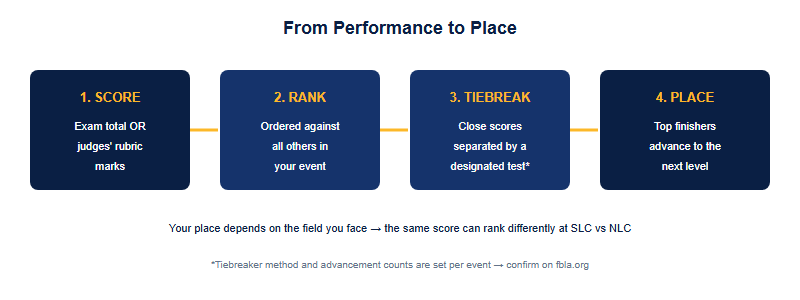
FBLA results come down to one idea: at each level, competitors in an event are ranked against each other, and only the top finishers advance. Objective Test events are scored on your exam total; production and presentation events are scored by judges against a published rubric; and many events use a separate tiebreaker — often a designated test — to separate near-identical scores. Knowing how the ranking is built tells you exactly where to spend your prep. Exact scoring weights, advancement counts, and tiebreaker policy are set per event and change yearly — always confirm on fbla.org.
Ranking, not a passing grade
The first thing to internalise: FBLA does not give you a pass/fail grade. Within each event, your performance is placed in order against everyone else competing in that event at that level, and a set number of top finishers move on — from chapter to a State Leadership Conference (SLC), and from SLC to the National Leadership Conference (NLC). Our guide to the three paths to NLC walks through that progression in detail.
This is why a score that would be an “A” in class might not advance, and a more modest raw score might place well — it depends entirely on the field you are competing against. You are not chasing a number; you are chasing a rank within your event.
The two ways events are scored
FBLA’s 76+ events, catalogued in our Competitive Events guide, score in two broad ways depending on format.
| Format | How the score is built | Where your prep should go |
|---|---|---|
| Objective Test events | Your total on a timed multiple-choice exam (commonly 100 questions) | Coverage and speed: question banks, every wrong answer reviewed |
| Production / written events | Judges score your deliverable against published rubric criteria | Hit every rubric line; revise drafts to the criteria, not to taste |
| Presentation / roleplay events | Judges score your live performance — often plus a Q&A — against a rubric | Rehearse out loud; practise answering judges’ questions calmly |
The practical lesson: find the rubric or test specification for your event and let it drive your preparation. Judges and graders score against the published criteria, so aligning your effort to those criteria is the single highest-return move you can make. Confirm the current specification for your event on fbla.org.
The tiebreaker: why it matters more than students expect
In competitive fields, several students can land on very close scores. To separate them and produce a clean ranking, many FBLA events designate a tiebreaker — frequently a specific test whose result is used to rank otherwise-tied competitors. The exact method differs by event and can change, so treat this as a structural principle and confirm the policy for your event on fbla.org.
For you, the strategic takeaway is concrete: do not treat any required test as a formality. If your presentation event uses an objective test as the tiebreaker, that test can decide whether you advance when the top of the field is tight. A student who polishes the presentation but skims the test has left a real advancement lever untouched. Prepare every scored component of your event — including the one that only matters “if it’s close,” because at SLC and NLC it often is.
Three myths about FBLA results, corrected
Because the ranking system is unfamiliar, students arrive with assumptions carried over from classroom grading. Three of them quietly lead to bad decisions.
- “A high percentage means I did well.” Not necessarily. Advancement is by rank within your event, so a high raw score in a strong field can still finish outside the advancing positions, and a moderate score in a thin field can place near the top. Judge yourself against the field, not against an imaginary 90%.
- “The tiebreaker only matters in rare cases.” At higher levels the top of the field bunches together, so “close” is the norm, not the exception. The component you dismissed as a formality is often the one separating advancers from non-advancers.
- “Not advancing means the event is wrong for me.” Sometimes — but often you were simply close, and a targeted improvement closes the gap. Read the margin before you abandon an event you have already invested in.
The healthier mental model is the one used in sport: you are not graded, you are seeded against a field, and your job each cycle is to move up the seeding by attacking the specific things that cost you places. That reframing alone changes how usefully you read what comes back.
Reading your score report like a coach
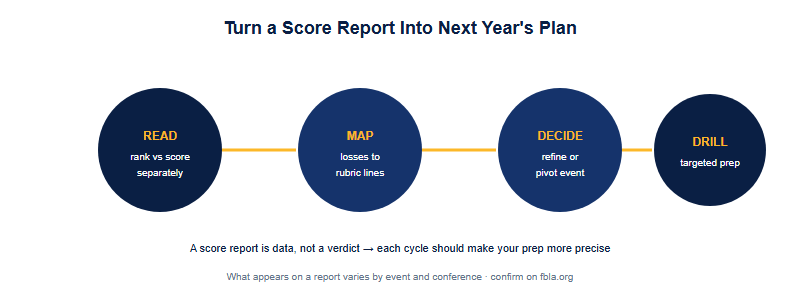
When results come back, most students glance at the placement and stop. The students who improve fastest read the report as a diagnostic. Here is the coaching read:
- Separate rank from raw score. Did you score well but face a stronger field, or was the score itself the gap? The fix is different for each.
- Map weak areas to rubric lines or test sections. If feedback or a breakdown is available, tie each lost point to a specific criterion so next year’s prep is targeted, not vague.
- Note the margin. Just missed advancing? A small, well-aimed improvement may be enough next time. Far off? You may need a different event or a deeper prep cycle — the kind our China chapter guide outlines for international students building toward nationals.
- Decide deliberately. Stay in the event and refine, or pivot to one that better fits your strengths. Either is fine — just choose on evidence, not emotion.
Exactly what appears on your report — raw scores, rank, judge comments — varies by event and conference. Check what your conference provides and confirm details on fbla.org.
A worked scenario: two students, the same score, different next moves
To see why “read rank and raw score separately” is more than a slogan, follow two students who walk out of an Objective Test event with almost identical exam totals.
Student A sat the event at a smaller conference with a thinner field. Her score placed her near the top, and she advanced. The correct read is not “I have mastered this event.” It is “my score was good enough for this field — the next field will be stronger.” Her smart next move is to raise her raw score before the next level, because the same total may rank very differently against tougher competition.
Student B sat the same event at a deeper conference. The identical score placed him just outside the advancing positions. The wrong read is “I failed.” The right read is “I was close, in a strong field, and a small targeted gain may be enough next time.” His smart next move is to find the specific topics or sections that cost him a handful of marks and drill exactly those.
Same number on the page; two completely different diagnoses and two different plans. A student who only looks at “did I advance?” learns nothing transferable. A student who asks “was the gap my score or my field, and by what margin?” walks away with a precise instruction for the next cycle. That habit — treating every result as data about where to improve — is what compounds over a multi-year FBLA record into steadily better placements.
What this means for your prep, in three lines
- Optimise for rank, not a grade. Know the field you face at each level and aim to finish above it, not just to score “well.”
- Let the rubric or test spec own your study plan. Every hour aimed at a published criterion is an hour that can move your rank.
- Prepare every scored component — including the tiebreaker. When the top of the field is close, the component you ignored is the one that decides it.
None of this guarantees a result — nothing in competition does. But understanding how the ranking is built turns FBLA from a black box into a system you can prepare for deliberately, which is exactly the mindset that carries strong competitors from a chapter event toward the State and National Leadership Conferences.
Frequently asked questions
Does FBLA give a pass/fail grade?
No. Within each event, competitors are ranked against each other and a set number of top finishers advance. You are competing for a place, not a passing mark. Confirm advancement counts on fbla.org.
What is the FBLA tiebreaker test?
Many events designate a tiebreaker — often a specific test — to separate very close scores into a clean ranking. The exact method varies by event and year, so confirm your event’s policy on fbla.org.
Why did a high score not advance?
Because advancement is by rank within your event, not by an absolute number. A strong field can mean a good score still places outside the advancing positions.
How are presentation events scored?
Judges score your live performance, often including a Q&A, against the event’s published rubric. Aligning your prep to that rubric is the highest-return move. Confirm criteria on fbla.org.
Published by the FBLA editorial desk, operated by Hanlin Education for China-based international-school students. Official rules are set by the competition and change yearly — confirm current details on fbla.org. Any errors will be corrected within 7 working days.