A strong FBLA record is not one big year — it is a four-year arc. In Grade 9 you join a chapter and try events; in Grade 10 you specialise and reach a State Leadership Conference (SLC); in Grade 11 you aim for the National Leadership Conference (NLC) and start leading; in Grade 12 you convert that experience into officer roles, mentoring, and college-application evidence. This roadmap maps each year for a China international-school student. Exact dates and rules change yearly — confirm current details on fbla.org.
Why think in four years instead of one
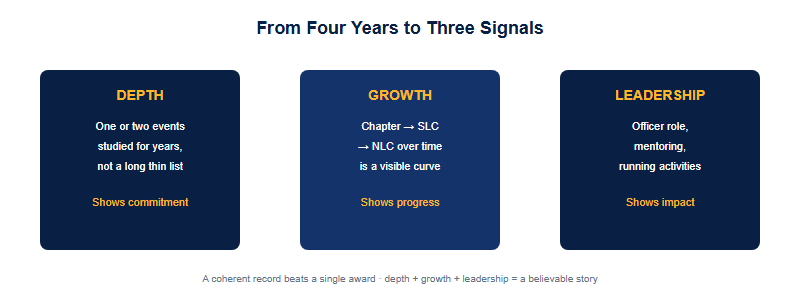
Admissions readers and FBLA judges both reward trajectory. A student who placed once at a single conference looks different from one who joined as a freshman, narrowed to two events, reached nationals as a junior, and led a chapter as a senior. The second story shows commitment, growth, and leadership — the qualities our piece on what US admissions officers actually value describes.
For students at a China international school, the four-year view also solves a practical problem: your chapter, advisers, and the fall sign-up window operate on a US academic calendar that may not match your school’s. Planning early means you never miss the membership deadline that gates everything else. FBLA’s High School division serves roughly Grades 9–12; verify your school’s specific chapter setup with your adviser and on fbla.org.
Grade 9 — Join, explore, and find your format
Freshman year is for breadth, not medals. Your three goals: become a paid FBLA member through your school chapter, attend meetings, and sample events across the three formats so you discover where you fit.
- Lock in membership early. Membership opens in the fall and is the prerequisite for competing. Our complete China chapter guide walks through the sign-up window step by step.
- Try one event from each family. Sit an Objective Test (a 100-question exam), attempt a small production task, and watch — or try — a presentation event. The point is to learn which format energises you.
- Build the boring base. Read the official Competitive Events Guidelines once so you understand the vocabulary. Start a habit of timed reading in English if you are a non-native speaker.
A realistic Grade 9 win is simply: “I am a member, I competed in one event at the chapter or regional level, and I know whether I prefer tests, production, or presentation.”
Grade 10 — Specialise and reach an SLC
Sophomore year is where you narrow. Pick one or two events and go deep. The target is to qualify for and perform at a State (or regional) Leadership Conference, the gateway level described in our guide to qualifying for NLC.
How to choose your event depends on your strengths:
| If you are strong at… | Lean toward… | What Grade 10 practice looks like |
|---|---|---|
| Memorising frameworks & speed | Objective Test events | Weekly timed question banks; review every wrong answer |
| Building documents & analysis | Production / written events | Draft, get feedback, revise to the rubric |
| Speaking & thinking on your feet | Presentation / roleplay events | Rehearse out loud weekly; record and rewatch |
Whatever you choose, study the official rubric for that event. Judges score against published criteria, so “knowing the rubric” is a real competitive edge — not a generic study tip. A realistic Grade 10 win: reaching an SLC in your chosen event and finishing the year with a clear specialism.
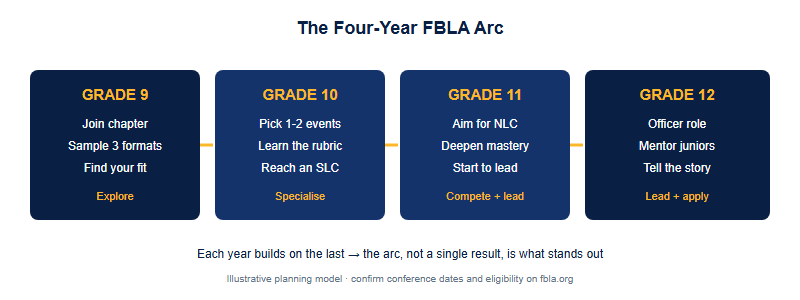
Grade 11 — Aim for nationals and begin leading
Junior year is the high-leverage year. Two things happen at once: you push for your best competitive result, and you step into early leadership.
- Go for NLC. By now you know your event and your rubric. Junior year is when a focused student is most likely to advance from SLC to the National Leadership Conference — in 2026, held in San Antonio. Treat the SLC→NLC gap as a training block, not a holiday.
- Take a small leadership task. Run a study group for your event, help onboard Grade 9 members, or coordinate one chapter activity. You do not need to be president yet; you need evidence that you contribute beyond your own scoresheet.
- Mind the calendar overlap. Junior year often collides with standardised tests and the start of college research. Block your FBLA prep into your weekly schedule in advance so neither side gets crowded out.
A realistic Grade 11 win: a strong showing at — or qualification for — NLC, plus one concrete leadership contribution you can name.
Grade 12 — Convert experience into leadership and a story
Senior year is about leverage and legacy. Your competitive ceiling is mostly set, so the marginal value now comes from leading others and articulating what you did.
- Run for or serve in a chapter office if the opportunity exists. Leadership that lasts a year carries more weight than a one-off task.
- Mentor the Grade 9 and 10 members in your event. Teaching what you know is both genuinely useful and a strong leadership signal.
- Write the story honestly. Your essays and activity list should show the arc — not claim guaranteed outcomes. As our Competitive Events guide stresses, the credible version is specific and modest, not inflated.
If you joined FBLA later than Grade 9, the arc still works — just compress it. A student starting in Grade 11 can explore and specialise in one semester, then aim for an SLC or NLC and a leadership role in senior year. The principle is the same: depth, growth, leadership.
A realistic weekly time budget by year
One reason FBLA records fall apart is that students treat it as a sprint each spring instead of a steady habit. For a China international-school student carrying IB or AP coursework, the sustainable version is a small, protected weekly block that grows as the stakes rise. The hours below are a planning guide, not a rule — adjust to your own course load.
| Year | Typical weekly FBLA time | What that time is spent on | Peak-season add-on |
|---|---|---|---|
| Grade 9 | 1–2 hours | Meetings, sampling events, reading the guidelines once | Light — you are exploring, not peaking |
| Grade 10 | 2–3 hours | Drilling your one or two chosen events to the rubric | Before SLC: add focused practice rounds |
| Grade 11 | 3–4 hours | Deep event mastery plus one leadership task | SLC→NLC gap: treat as an intensive training block |
| Grade 12 | 2–3 hours | Leading, mentoring, and writing your story | Front-loaded — application season competes for time |
Notice the curve is not flat. Junior year carries the heaviest load because it is when competitive results and emerging leadership overlap; senior year tapers on competition because your energy shifts to officer duties and applications. Blocking these hours into your calendar in advance — rather than reacting when a deadline appears — is the single most reliable way to keep a four-year arc intact alongside a demanding curriculum.
Four mistakes that break the arc
Across China cohorts, the records that underperform tend to fail in the same predictable ways. Avoiding these four is worth more than any single clever tactic.
- Spreading too thin. Entering five different events every year produces a long, shallow list and no real mastery. Depth in one or two events almost always reads better — to judges and to admissions readers.
- Joining late and pretending otherwise. If you start in Grade 11, own it and compress the arc honestly. Inventing earlier involvement is both unnecessary and a compliance risk; a genuine two-year story is perfectly strong.
- Chasing the medal instead of the rubric. Students who study “to win” in the abstract drift; students who study the published criteria for their event improve measurably. Let the rubric drive the plan.
- Treating senior year as a victory lap. Grade 12 is where leadership and mentoring create the most marginal value. Coasting wastes the year that best demonstrates impact.
The throughline is consistency over intensity. A student who does a little every week for four years — explore, specialise, compete, lead — ends up with a record that is both more competitive and easier to describe truthfully than one built from a single frantic season. That coherence, not any one result, is what FBLA can give a China international-school applicant.
Frequently asked questions
What grades can join FBLA High School?
FBLA’s High School division generally serves Grades 9–12. Your school’s chapter setup and any local specifics should be confirmed with your adviser and on fbla.org.
Is it too late to start FBLA in Grade 11?
No. You compress the arc: explore and specialise quickly, then target an SLC or NLC and a leadership role in senior year. Trajectory still matters more than a single result.
How many events should I do each year?
Breadth in Grade 9, then narrow to one or two events you can master. Depth in a small number of events reads more credibly than a long, thin list.
Do I have to reach NLC for FBLA to matter?
No. NLC is a strong goal, but a coherent four-year record of depth, growth, and leadership stands on its own. Confirm advancement rules on fbla.org.
Published by the FBLA editorial desk, operated by Hanlin Education for China-based international-school students. Official rules are set by the competition and change yearly — confirm current details on fbla.org. Any errors will be corrected within 7 working days.