Late October is not the start of the FBLA season, but it is often the first point where practice data becomes more useful than initial enthusiasm. Students who chose events in August or September now have several weeks of evidence: drafts, quiz scores, team attendance, and the honest feeling of whether a format energizes or drains them. This is where reviewing your fbla event choices matters. The goal is not to predict a win or guess at official policy. It is to decide whether to keep, switch, or drop an event before the rest of the year compresses your schedule.
If your chapter still permits changes, late October is a practical time to make them. If it does not, you can still adjust your preparation priorities without changing the formal entry. Either way, the diagnostic habit is the same: look for evidence, separate format problems from content problems, and protect the events that still have a credible path to a strong submission or performance.
Why Late October Is the First Honest Checkpoint
In August and September, almost every event feels possible. You have not yet hit the first dense week of schoolwork, the first failed practice run, or the first team meeting where two people do all the talking. By late October, those signals have appeared. That does not mean a slow start is fatal. It means you now have enough information to stop guessing.
The first honest checkpoint also comes before the academic year becomes crowded. November and December often bring internal assessments, project deadlines, and exam preparation. If you wait until then to admit that one event is consuming disproportionate time, you will make the decision under pressure. A late-October diagnosis is calmer: you can compare events, talk to your adviser, and rebuild your practice plan while there is still room to change the weekly rhythm.
This article does not tell you what your chapter’s official entry window is. That varies by school, chapter, and year. It gives you a decision framework you can apply within whatever rules your chapter actually has. The framework is designed for students, parents, and chapter advisers who want a practical conversation rather than another vague pep talk.
Five Signals for Effective Event Diagnosis
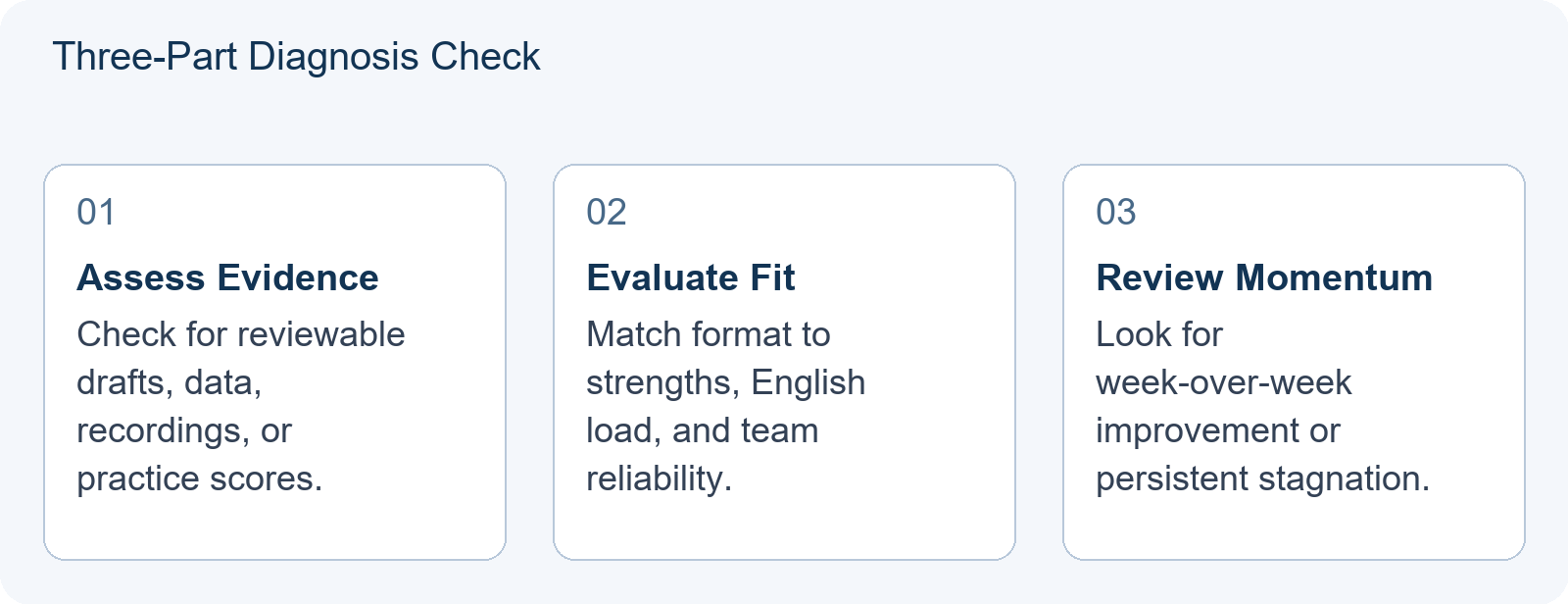
To move beyond gut feelings, evaluate each event against five signals. These are teaching criteria, not official scoring rules. Their value is that they force you to name the real bottleneck.
1. Evidence readiness. Can you produce tangible artifacts? For a judged event, do you have a draft slide deck, a survey instrument, a financial model, a video script, or a practice recording? For an objective test, do you have a log of practice scores? Evidence readiness is not about being finished. It is about whether the work exists in a form someone else can review. If three weeks of practice has produced no reviewable artifact, the problem may be method, not event fit.
2. Format fit. Does the delivery method match how you actually perform? A student who thinks clearly in writing may freeze in an impromptu speaking format. A visually creative student may struggle with a dense, text-heavy case analysis. Format fit is often confused with difficulty. They are different. Hard content in a comfortable format is usually fixable. Comfortable content in a format you dread can become a weekly source of avoidance.
3. English load. For international students, this signal deserves explicit attention. Are you spending most of your preparation time translating vocabulary, or are you refining business logic? High English load can mask real competence. If you understand the concept in your first language but cannot explain it smoothly in English, the issue may be language support rather than event mismatch. If you understand neither the concept nor the format, switching may be the cleaner solution.
4. Team reliability. In team events, consistency is a structural signal. Do all members attend practice? Is there a clear division of labor? Are drafts arriving when promised? Unreliable teammates are not just an annoyance; they change the amount of work you must personally complete. If the team cannot produce a coherent entry, the event may be draining time from individual events where you have more control.
5. Practice momentum. Are you improving week over week? Momentum does not require dramatic gains. It can be a faster outline, a clearer answer to judges’ questions, or a slightly higher quiz score. Stagnation despite consistent effort suggests a mismatch between your current skills and the event’s demands. Before dropping, however, check whether your practice method is actually targeted. Re-reading notes is not the same as timed practice, and editing slides is not the same as rehearsing a live answer.
Keep Criteria: When Weak Early Work Is Still Worth Continuing
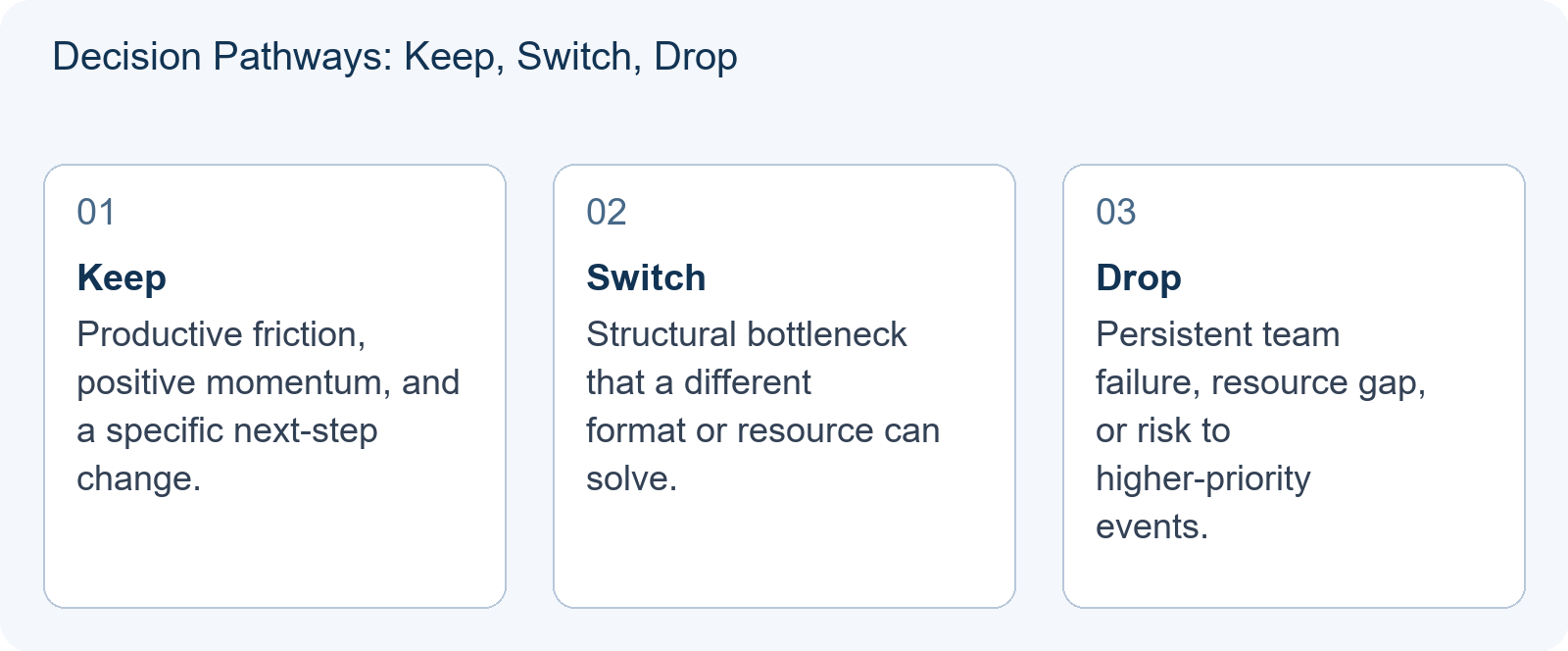
Not every slow start requires a change. Some events have a steep learning curve where early confusion is normal. You should consider keeping an event when you see productive friction. Productive friction means the difficulty comes from mastering content, not from fighting the format itself.
In a teaching illustration, a student new to financial analysis may spend the first two weeks learning how cash flow, profit, and working capital interact. If by week three that student can explain why a profitable business might still run out of cash, the event is beginning to click. The work is still hard, but the direction is positive. That is different from a student who understands cash flow conceptually but cannot produce a coherent written analysis because the format feels unnatural.
Other keep signals include alignment with a longer-term goal and a credible recovery plan. If the event connects to a major, a portfolio, or a skill you genuinely want, short-term discomfort may be worth tolerating. But alignment alone is not enough. You need a specific change for the next two weeks: a new practice routine, a review session with an adviser, a narrower scope, or a different preparation partner. Keep should be an active decision, not passive inertia.
Switch Criteria: When Another Event Solves the Real Bottleneck
Switching makes sense when the bottleneck is structural rather than skill-based. Suppose you chose a written case event because you enjoy discussing business dilemmas, but you keep losing time to the rigid structure of timed written analysis. If you are stronger in oral argumentation and can think quickly on your feet, a presentation-based event may solve the real problem. The goal is not to find an easy event. It is to move from a format that highlights your weakness to one that lets your strengths become visible.
Before switching, verify three things. First, check whether your chapter can still accommodate the change. Second, confirm that the new event’s format actually addresses the bottleneck. Third, estimate whether you have enough preparation time to learn the new event’s expectations. A switch that creates a second unfinished event is worse than a difficult keep. If you are rethinking the whole shortlist, the The FBLA Event Matcher (2026-27): Build a 3-Event Shortlist From Your Profile, Not Your Major can help you compare formats without simply chasing prestige.
Switching is also appropriate when the original event’s resource demands cannot be met. A team event with no reliable teammates, or a technical event that requires tools you cannot access, may be a poor use of the remaining season. In that case, the switch is not about escaping difficulty. It is about choosing an event where your effort can actually accumulate into a stronger entry.
Drop Criteria: When Quitting Protects the Rest of the Season
Dropping an event is a strategic decision, not a failure. You should consider dropping when an event threatens the quality of your other preparations. If a team event is plagued by non-responsive members, continuing to invest time may produce a fragmented project and high stress. If an individual event requires repeated work you cannot complete because of missing data, software, or access, the gap may be too large to close by the time your chapter finalizes entries.
Dropping frees mental bandwidth for events where you can still produce polished work. Depth and polish usually give you more control over quality than spreading yourself across too many half-finished entries. A well-prepared single event often gives a student a clearer story, a stronger practice loop, and a more confident performance than three events that never reach a reviewable draft.
That said, drop is not the first answer to frustration. If the problem is a weak practice method, a missing checklist, or a temporary schedule crunch, a keep or switch may be better. Drop is most defensible when the structural problem is persistent and outside your control. After dropping, communicate professionally with teammates or advisers. Protect the relationship even if the event did not work out.
Rebuilding Your Entry Plan Without Deadline Excuses
Once you have diagnosed your events, rebuild your schedule immediately. Do not rely on last-minute extensions or hope that circumstances will improve. Update your calendar to reflect only the events you are keeping or switching to. Allocate specific blocks for evidence creation: drafting slides, writing a script, running timed objective practice, recording a rehearsal, or collecting feedback.
Your rebuilt plan should include a weekly checkpoint. At the end of each week, write down one sentence: what moved forward, and what is still blocked? This prevents the same event from quietly consuming time without producing evidence. If you dropped a team event, use the freed block for the event with the clearest path. If you switched, spend the first two weeks learning the new event’s expected structure before trying to polish content.
For a China-side planning aid, you can use the The 2026-27 FBLA Deadline Planner: Every Official Date, Back-Planned for a China Timetable as a checklist, then confirm every relevant date with your chapter adviser. Do not treat any online planner as a substitute for your chapter’s actual instructions. The point of rebuilding is not to find a loophole. It is to make your remaining preparation honest, visible, and reviewable.
Teaching Illustration: A Hypothetical Three-Event Diagnostic
The following example is a teaching illustration, not a real student case. It shows how the five signals can turn vague anxiety into a decision.
Consider “Alex,” a Grade 11 student who initially selected three events: a technical objective event, a team decision event, and a video production event. By late October, Alex reports the following.
- Technical objective event: Alex enjoys the subject but practice scores are stagnant. After three weeks of timed questions, Alex still cannot finish the set and repeatedly misses the same category. Diagnosis: Low momentum plus a possible method problem. Action: Switch only if another technical event matches the same subject interest with a more manageable practice loop; otherwise keep for one more two-week cycle with a different study method.
- Team decision event: Two teammates miss half the practices. Alex is doing most of the work alone and the team has no coherent draft. Diagnosis: Structural failure in team reliability. Action: Drop unless the team commits to a new cadence immediately. For team repair, see How to Run an FBLA Team That Does Not Fall Apart: Roles, Cadence and the One-Voice Problem (2026-27).
- Video production event: Alex loves editing and has produced a strong visual draft. The scriptwriting feels forced and lacks business context, but Alex can explain the video’s core message without notes. Diagnosis: Format fit is strong, evidence readiness is partial, and momentum is positive. Action: Keep, but shift the next two weeks toward strengthening the business narrative in the script.
Alex’s revised plan focuses on the video production event while giving the technical event one final method change. The team event is dropped because the structural problem is persistent. This is not a prediction of Alex’s score. It is an example of how diagnosis protects time and attention.
Preparing for a Productive Diagnosis Conversation
If you are unsure how to conduct this diagnosis objectively, an external perspective can help identify blind spots. A teacher, chapter adviser, or experienced competitor can review your evidence and ask why you chose each event. The most useful conversations are specific: bring your current event list, your practice log, one sample draft or recording, and a list of bottlenecks.
The Hanlin FBLA guide is positioned as an independent preparation resource for international students, parents, and chapter advisers; it is not affiliated with FBLA-PBL, Inc. The site’s consultation CTA advertises two free services: event coaching and a full competition roadmap. These are preparation supports, not guarantees of results. If you request a diagnosis session, prepare concrete evidence so the discussion can focus on format fit, English load, team reliability, and the next two-week action plan rather than general encouragement.
Late October is not too late to make a smart adjustment. It is too late to keep pretending that every original choice must remain forever. Use the five signals, make a keep, switch, or drop decision, and rebuild the calendar around the events that still have a credible path to strong work.
Frequently Asked Questions
Is it too late to change my FBLA event selection in late October?
It depends on your chapter’s rules and whatever entry process your school uses. Late October is a practical time to ask, because there is still room to rebuild a practice plan. Check with your chapter adviser before making a formal change, and do not rely on an online article for your chapter’s specific deadline.
How do I know if my English level is holding me back in a judged event?
If you spend more time translating vocabulary than analyzing business concepts, your English load may be too high. Record a practice presentation or role-play answer. If you frequently stop to search for basic terminology, consider a format with more preparation time or simpler delivery demands. If the concepts are clear but delivery needs polish, targeted speaking practice may be enough.
Should I drop a team event if my teammates are unreliable?
Consider dropping if unreliability persists after you have clearly re-established roles, deadlines, and consequences. A fragmented team entry can consume time without producing a coherent draft. If the team can commit to a new cadence immediately, a short keep trial may be worth it. If not, dropping can protect your individual preparation.