Team entries rarely lose because the idea was weak. They lose because three people wrote three different documents, nobody owned the final file, and the group rehearsed for the first time the night before. Fix that with four things: an internal role split, a fixed weekly cadence, one master file with a hard freeze date, and rehearsal that starts far earlier than feels necessary.
Why teams lose points that individuals never lose
An individual competitor has one head, one file and one voice. Everything they know is already integrated. A team has to manufacture that integration, and the work of manufacturing it is invisible on any rubric — which is exactly why students skip it.
The recurring failure modes are boringly consistent:
- Parallel documents. Three members each draft “their part” in separate files. The merge happens late, the tone shifts three times inside one report, and the numbers in section four contradict the numbers in section two.
- The silent divergence. Two members have different mental models of what the entry is even arguing, and nobody notices until a judge asks a question that exposes it.
- Presenter-only rehearsal. One person practises speaking; the others never say their sections aloud until the room. The handoffs are the part that breaks.
- Unowned questions. A judge asks something, three people start talking, and the answer that lands is the one from whoever was fastest rather than whoever knew.
- The absent member. Someone drifts out over the winter and nobody has the conversation, so the work redistributes silently and resentfully.
None of these is a knowledge problem. They are all operations problems, and they are all solvable with structure decided in the first fortnight of the season rather than negotiated under pressure in the last one.
A note on scope before going further: this article is about how to run the team internally. Team sizes, entry limits, what is submitted in advance versus performed live, and the rules governing member substitution are all set by the competition and change yearly — take those from the current-year guidelines on fbla.org and from your adviser, not from a previous team’s memory. If you have not yet settled which event you are entering, our competitive events guide lays out what each family demands of a group.
Four working roles (an internal split, not an FBLA rule)
The most robust teams do not divide the work by section. They divide it by function, so that every section passes through every function. Sectional division produces a patchwork; functional division produces a document.
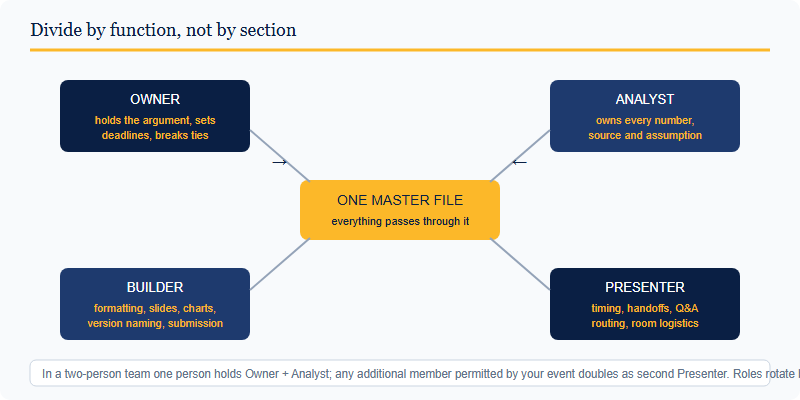
Owner is not “the smartest one” — it is the person who holds the single-sentence argument of the entry in their head and refuses to let it drift. They also do the least glamorous job in the team: setting internal deadlines and enforcing them, and making the final call when two members disagree and the meeting has gone twenty minutes over.
Analyst owns every number in the entry and can name where each one came from. A judge asking “where did that growth rate come from?” should produce one answer from one person, immediately. If nobody can name a source, the number should not be in the document.
Builder owns the artefact as an object: formatting consistency, chart legibility, file naming, and the mechanics of submission. This role is systematically undervalued and is where teams lose late-stage points to sloppiness that nobody had time to fix.
Presenter owns the live performance as a system — not just their own speaking, but the transitions, the timing, and the routing of questions. This is the person who says “Q about the model goes to Wei, Q about the market goes to me” and drills it until it is reflex.
The cadence: a fixed weekly slot beats heroic weekends
Teams that meet “when we need to” meet rarely, then panic. The single highest-return decision a team makes is a recurring fixed slot — same day, same time, forty-five to sixty minutes, from the first week of the season. Short and frequent beats long and occasional, because the point of the meeting is catching divergence early, not producing work.
| Season phase | Weekly ritual | What must exist by the end of the phase | Most common failure here |
|---|---|---|---|
| Setup (first 2-3 weeks) | Read the current-year guidelines aloud together, line by line | One-sentence argument, agreed roles, master file created, internal deadline list | Skipping the guidelines read because “we did this event last year” |
| Build | 15-minute status, 30-minute working block, 10 minutes logging decisions | Complete rough draft of every section — bad is fine, missing is not | Perfecting section one while sections four and five do not exist |
| Integration | Read the whole entry end to end, out loud, as a group | One consistent voice, numbers reconciled across sections, no contradictions | Merging at the last minute and discovering the sections disagree |
| Freeze and rehearse | Full run plus adversarial Q&A, timed, every session | Handoffs automatic, Q&A routing reflexive, timing inside the limit with margin | Still editing content during what should be rehearsal weeks |
| Conference | One short pre-brief; no new content | Calm delivery of a thing already rehearsed dozens of times | Rewriting slides in the hotel the night before |
Two rules make the cadence survive a real school term. First, the meeting happens even when someone cannot attend; the absent member reads the decision log. Second, the meeting has a written output every time, even if that output is three lines. A team with a decision log never re-litigates the same argument in March.
One master file, and a freeze date you actually honour
Version chaos is the most preventable disaster in team competition. The rules are simple and should be agreed in week one:
- One master file. Everyone edits the same document. Personal working copies are for drafting only and must be merged in within the week, by the Builder.
- Dated version names. EventName_v2026-11-14_master beats final, final2, FINAL-real. Never let the word “final” enter a filename before the freeze.
- A written change note. Two lines per version: what changed, who changed it. This takes fifteen seconds and saves an hour of forensic reading in the spring.
- An offline copy plus a second cloud location. Cross-border network access can be unreliable; assume at the worst moment it will be.
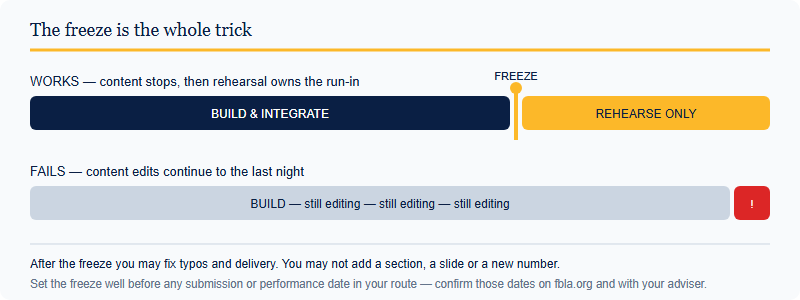
The freeze feels premature every single time. Do it anyway. A slightly weaker entry delivered fluently and answered confidently generally outperforms a slightly stronger entry delivered by three people seeing the final version for the first time.
The one-voice problem
Judges experience a team as a single unit. Three competent individuals who sound like three separate projects read as weaker than three merely-good individuals who sound like one team. Producing one voice is a rehearsal task with specific drills:
- The read-aloud merge. Read the entire entry aloud as a group in the integration phase. Tone shifts and contradictions are almost inaudible on screen and glaring in the ear.
- The swap drill. Each member presents someone else’s section once. Anything they cannot explain is a section the team does not collectively understand yet.
- Scripted handoffs. Write the actual transition sentences and rehearse them. The three seconds between speakers is where a team most visibly looks unprepared.
- Q&A routing. Build a routing table — topic to person — and drill it until nobody hesitates. Agree a fallback phrase for questions nobody can answer, and agree that only the routed person answers unless they hand off explicitly.
- Adversarial questioning. Have someone outside the team attack the weakest assumption repeatedly. The point is not to win the argument; it is to remove the visible flinch.
For students working in English as an additional language, the swap drill matters more than any vocabulary work. Fluency inside your own memorised section is not the same skill as answering an unexpected question about someone else’s numbers — and it is the second skill that judges test.
The weak link, the exit conversation, and what the record suggests
Every long-running team faces a member whose contribution has quietly dropped. The failure is not that it happens; it is that teams wait until March to talk about it. Have the conversation the second time a deadline is missed, privately, and make it concrete: here is the specific deliverable, here is the date, here is what happens otherwise. Most of the time capacity has been eaten by exams and the honest answer is a smaller scope, not an exit.
If someone does need to leave, do it early and formally: tell your adviser, check what the current-year rules permit regarding roster changes at your stage, and redistribute in writing. Whether and when a team’s composition may change is set by the competition — confirm it on fbla.org rather than assuming.
One de-identified first-party observation, shared per Hanlin, with results varying by student and cohort and not connected to any admission outcome: across the operator’s record, team formats appear repeatedly at the upper tiers — a team placed first nationally in Marketing in 2023-24; teams took national top-two placings in Business Ethics and in Sports & Entertainment Management in 2022-23; and in 2020-21, 11 teams reached the global finals, with one placing second globally in Business Financial Plan. Those are group outcomes, which is the point worth taking: it is plausible that teams reaching those tiers solved coordination early, but the record lists placings only and cannot show that. How the tiers connect is set out in our guide to qualifying for the national conference.
Frequently asked questions
How often should an FBLA team meet?
A fixed weekly slot of 45-60 minutes from the season’s start. Frequency matters more than length, because the goal is catching divergence early.
Who should be the team leader?
Not necessarily the strongest student — the person who will hold the argument, set internal deadlines and break ties when a meeting stalls.
When should we stop editing content?
Set a freeze well before your performance or submission date, then rehearse only. Confirm the actual dates for your route on fbla.org.
What if a teammate stops contributing?
Have a concrete conversation at the second missed deadline. Involve your adviser early, and check the current-year rules on roster changes.
Published by the FBLA editorial desk, operated by Hanlin Education for China-based international-school students. Official rules are set by the competition and change yearly — confirm current details on fbla.org. Errors are corrected within 7 working days.