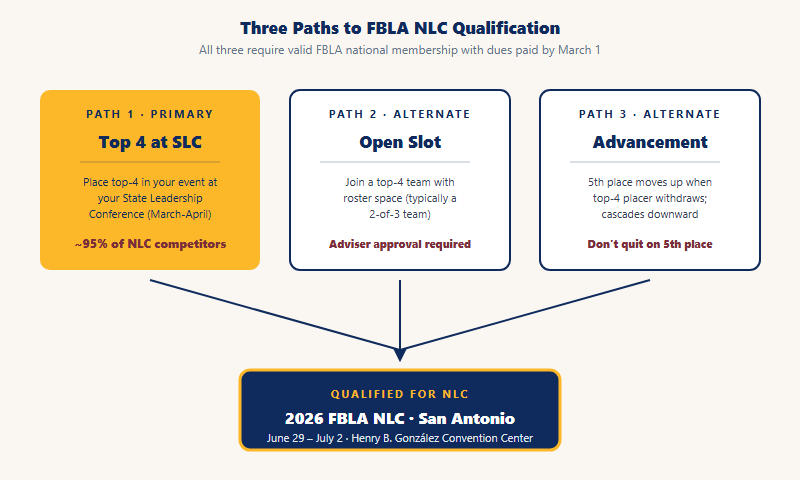
Qualifying for the FBLA National Leadership Conference (NLC) follows one of three paths: (1) the standard route — place in the top 4 of your competitive event at the State Leadership Conference (SLC); (2) open-slot advancement — join a team that has roster space, with adviser approval; or (3) withdrawal-based advancement — move up the qualifying list when top-4 placers withdraw. All three paths require valid FBLA national membership with dues paid by March 1 of the school year. This guide breaks down each path, the eligibility prerequisites, the four-region structure, and the path differences for international chapters.
Quick Facts
| Primary qualification path | Top 4 placement at your State Leadership Conference (SLC) |
| Alternate paths | Open-slot team join (adviser approval required) · Advancement from withdrawal of top-4 placers |
| Prerequisite: National membership dues | $10 (HS national); paid through chapter adviser via FBLA Connect |
| Prerequisite: State / region dues | Varies ($6-$8 in many states; total annual cost $14-$18 typical) |
| Dues deadline for NLC eligibility | March 1 of the school year |
| 4 FBLA regions | Eastern, Southern, Central, Western (US-state-mapped; international chapters mapped to a US region for administrative purposes) |
| 2026 NLC dates & venue | June 29 – July 2, 2026 at Henry B. González Convention Center, San Antonio, TX |
| Pool advancing from SLC | Typically top 4 per competitive event per state; ~5,000-7,000 competitors total reach NLC across all states + international |
Path 1: Top 4 at SLC (The Standard Path)
The dominant qualification route is placing in the top 4 finishers of your competitive event at your State Leadership Conference, held by each state FBLA office in March or April. This rule applies uniformly across the US states and across nearly all of FBLA’s 55+ competitive events — individual, team, and chapter formats alike.
What “top 4” actually means
- Per event: The top-4 rule applies separately to each competitive event. A student competing in Business Plan and Sales Presentation can qualify in both, but each placement is its own qualifying spot.
- Per state: Each state advances its own top 4. A state with a stronger competitive field still advances exactly 4 per event, so qualifying from a competitive state is harder than qualifying from a less competitive state.
- Minimum score threshold: Some events also impose a minimum score for NLC eligibility — placing top 4 without meeting the threshold does not advance the competitor. Check the specific event’s 2025-2026 Competitive Events Guidelines for any score floor.
When SLC happens
SLC dates vary by state but cluster in March and April. California FBLA, Pennsylvania FBLA, Florida FBLA, and most other state organizations publish their SLC schedules in the fall of the prior school year. By the time SLC arrives, your competitive event preparation should already be 4-8 months in. Chapters that begin event prep in February consistently underperform chapters that began in October-November.
Path 2: Open-Slot Advancement (Adviser-Approved)
If a state’s top-4 qualifying teams in a team event have open roster slots (typically a 2-3-person team with only 2 members), advisers may approve a non-placing student joining the team for NLC. This path is rarer than Path 1 but accounts for several hundred NLC competitors each year nationally.
Adviser approval is the gating step — both the joining student’s adviser and the team’s existing adviser typically need to sign off. The joining student must have been a paid FBLA member in good standing during the same school year (i.e., not a last-minute add).
Path 3: Withdrawal-Based Advancement
When a top-4 placing competitor withdraws between SLC and NLC — for academic conflicts, family reasons, or other circumstances — the 5th-place finisher moves up to the qualifying pool. This shift cascades: if 6th place is not available, 7th moves up, and so on, until the slot is filled or the SLC eligibility window closes.
Withdrawal-based advancement happens every year. A 5th-place finish at SLC, particularly in events with sometimes-volatile top-4 retention (high senior-class withdrawal events), can absolutely become an NLC qualifying spot. Don’t treat 5th place as the end of the road — continue NLC preparation through April-May until your state office formally rules you out.
Prerequisite #1: FBLA Membership in Good Standing
Qualifying via any of the three paths requires that you are a paid FBLA member in good standing for the current school year. The membership stack:
National Membership Dues
- FBLA High School national dues: $10 per member per year
- Paid by: chapter adviser, in bulk for the chapter, through FBLA Connect (the national member portal)
- Deadline for NLC eligibility: March 1 of the school year (per fbla.org)
State Membership Dues
- State dues vary: Pennsylvania $6 (total $16 with national), Maryland $8 (total $14 with national), other states publish their own schedules
- Paid alongside national dues through the same chapter-adviser workflow
- Some states also require chapter-level dues to cover regional competition costs
For International Chapters
International chapters (including FBLA China) pay through their region’s centralized office rather than directly to FBLA national. The dues structure is similar but administered with an extra coordinating layer; start the workflow in January rather than February to absorb processing time and ensure the March 1 deadline.
Prerequisite #2: Membership Eligibility
Per FBLA national policy, membership in the FBLA High School division is open to students who meet all of:
- Grade level: Currently enrolled in grades 9-12 (the parallel FBLA Middle School division covers grades 5-9)
- Course enrollment: Enrolled in a business or business-related course at your school (or equivalent for international schools where the course taxonomy differs)
- Acceptance of purpose and creed: Members affirm the FBLA mission and creed at membership
- Willingness to contribute: Active engagement in chapter activities and community contributions
- Demonstrated qualities for employment: Professional conduct, dependability, integrity
For Chinese international schools, the “enrolled in a business or business-related course” criterion is interpreted by chapter advisers in coordination with FBLA China. Most international schools offering economics, business, finance, accounting, entrepreneurship, or marketing courses satisfy this requirement; if the school’s course taxonomy is in question, the adviser should confirm with FBLA China before chapter dues are paid.
The Four FBLA Regions
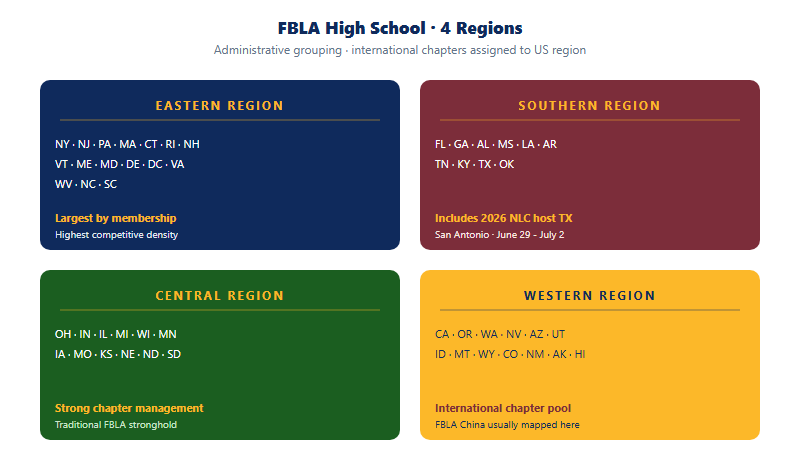
FBLA High School organizes its US footprint into four regions for administrative and competitive purposes:
| Region | States (illustrative) |
|---|---|
| Eastern | NY, NJ, PA, MA, CT, RI, NH, VT, ME, MD, DE, DC, VA, WV, NC, SC |
| Southern | FL, GA, AL, MS, LA, AR, TN, KY, TX, OK |
| Central | OH, IN, IL, MI, WI, MN, IA, MO, KS, NE, ND, SD |
| Western | CA, OR, WA, NV, AZ, UT, ID, MT, WY, CO, NM, AK, HI |
International chapters are mapped to one of these four regions for administrative reporting; the specific region assignment for FBLA China is managed by the FBLA national office in coordination with FBLA China. The region assignment does not affect NLC eligibility — all qualifying competitors regardless of region compete in the same national event roster at NLC.
Common Reasons Qualified Students Don’t Make It to NLC
Patterns observed across past seasons of competitors who qualified at SLC but did not appear at NLC:
1. Missed the March 1 dues deadline
A chapter that submits national dues on March 2 forfeits NLC eligibility for the entire chapter for that school year. This is the single most preventable cause. Set the chapter’s internal deadline to February 15 to absorb any state-office processing delays.
2. Visa or travel documentation lapses (international)
International students who qualify at SLC must still secure US travel authorization. A B1/B2 visa application started in May for a late-June NLC can fail to be processed in time. Apply by early April at the latest.
3. School-year academic conflicts
June 29 – July 2 overlaps with end-of-year exams in many international school calendars. Verify the school calendar conflict-check in March, not June. If a conflict exists, raise it with the school administration immediately — some schools will accommodate finals shifting for NLC qualifiers.
4. Late event-day withdrawal
A small but real number of qualifiers withdraw in May-June for reasons that were addressable earlier — usually team coordination failures or last-minute funding gaps. Lock the chapter’s full NLC roster commitments by mid-April; treat April through May as a no-changes period.
After You Qualify: The 8-Week Roadmap to NLC
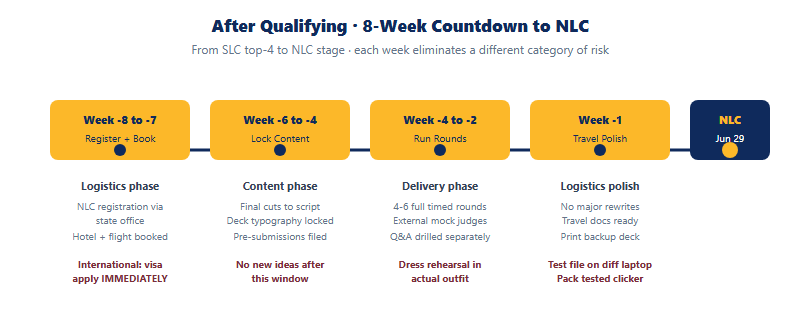
Once qualifying status is confirmed, the operational work begins. A condensed action checklist:
- Week -8 to -7: Register for NLC through your state/region office. Book hotel block; confirm flight (international: book hotel + flight by mid-April at latest).
- Week -6 to -4: Lock event content — presentation deck, written report, or pre-submission deliverable. No new ideas after this window.
- Week -4 to -2: Run 4-6 full timed practice rounds with external mock judges. Dress code rehearsal in actual suit/shoes.
- Week -1: Travel logistics finalized. Pack per the FBLA NLC 2026 packing list. Print backup deck.
For the detailed week-by-week tactical breakdown including mock judging methodology and the “Don’t Watch Other Competitors” rule, see 5 Weeks to NLC: The Final Push.
Frequently Asked Questions
What is the main way to qualify for FBLA NLC?
The primary qualification path is placing in the top 4 of your competitive event at your State Leadership Conference (SLC). This rule applies across the US states and to FBLA’s 55+ competitive events. Two alternate paths also exist: open-slot team advancement with adviser approval, and withdrawal-based advancement when top-4 placers withdraw.
When is the deadline to pay FBLA dues for NLC eligibility?
Per FBLA national policy, national membership dues for the current school year must be paid by March 1 to be eligible for NLC competition. Chapters should set internal deadlines to mid-February to absorb any state-office processing delays.
How much do FBLA dues cost?
FBLA High School national membership dues are $10 per member per year. State dues vary — typical state dues run $6-$8, bringing combined annual dues to $14-$18 per member. Some states or chapters also charge additional chapter-level dues for regional competition expenses.
Can a 5th-place finisher at SLC still go to NLC?
Yes, through withdrawal-based advancement. When a top-4 placer withdraws between SLC and NLC, the 5th-place finisher moves up to the qualifying pool; if 5th is unavailable, 6th moves up, and so on. Continue NLC preparation through April-May until your state office formally rules you out.
Do international students follow the same NLC qualification rules?
Yes, with administrative differences. International chapters (including FBLA China) compete through their region’s country-level qualifier (analogous to a US state SLC), and top finishers advance to NLC. Dues and registration flow through the international region’s office rather than direct FBLA national contact, requiring longer lead time on processing.
What are the FBLA membership eligibility requirements?
FBLA High School membership is open to students who are: (1) in grades 9-12, (2) enrolled in a business or business-related course at their school, (3) accept the FBLA purpose and creed, (4) willing to contribute to chapter activities, and (5) demonstrate qualities for professional employment.
Related Resources
- 📅 NLC 2026 logistics → FBLA NLC 2026 San Antonio: Schedule, Hotels & What to Pack
- 🌍 International students → FBLA for International Students: China Chapter Guide
- 🏁 Final 5-week push → 5 Weeks to NLC: The Final Push
- 📋 Competition rules → FBLA Competition Format & Rules
- ✍️ Registration walkthrough → FBLA Registration
- 📞 Contact our editorial desk → Contact
Data on FBLA national membership dues, eligibility criteria, and the top-4 SLC qualification rule sourced from fbla.org and state FBLA organization publications (PA FBLA, California FBLA, Maryland FBLA, Florida FBLA, Nebraska FBLA) for the 2025-2026 school year.
For International School Students · The FBLA China Pathway
This site (en.fbla.org.cn) is the FBLA China editorial desk, operated by Hanlin Education (linstitute.net). We focus specifically on Chinese international school students navigating FBLA from outside the United States — a path the official fbla.org documentation covers in general terms but not in operational detail for cross-border applicants.
For students at SCIE, SHSID, Pegasus, Shanghai American School, WAB, ISB, and other Chinese international schools, FBLA qualification involves three additional considerations not present for US-based chapters:
- Chapter formation timeline: New chapters in non-US international schools generally need 4-6 months for formal recognition by FBLA International, plus the school’s own student-organization approval cycle. Plan chapter launch one full academic year before the first NLC attempt.
- Regional competition equivalence: International chapters do not have a State Leadership Conference (SLC) in the US sense. Most qualify to NLC via the SLC’s international division track or via the membership-tier direct-qualification rules.
- Visa and travel logistics: NLC takes place in late June each year. B1/B2 visa applications for the China cohort should start by mid-March to allow 12-week interview-slot buffer.
Hanlin Education has worked with FBLA-track students at Chinese international schools across multiple seasons. The most common qualification path for our cohort applicants is: Year 1 chapter formation → Year 2 first NLC attempt (often as Senior Division participant) → Year 3 senior-year NLC (with a thesis aligned to Common App “Activities” framing).
Talk to a Hanlin Education Advisor
Editorial desk · Hanlin Education · last updated 2026-05-27 · This guide is published by the Hanlin Education editorial desk. Hanlin Education is an authorized China-region educational partner, but this site is not the official program administration site. All facts on this page are cross-referenced against the program’s official publications. We correct any factual errors within seven working days of a reported issue.