Recognising a business term and deploying it under pressure are different skills, and FBLA quietly scores the second one. Published rating sheets reward things like showing evidence of research and demonstrating understanding of the case — and no row we have seen scores vocabulary recall on its own. This page is a 60-term audit across six clusters, a three-level command test you score yourself against, and a four-week routine for repairing whatever you fail.
Recognition is not command, and only one of them is scored in the room
Most students preparing from a China campus study business vocabulary the way they study any subject glossary: read the term, read the definition, tick it off. That method is well matched to one FBLA format and badly matched to the others. FBLA’s most recent published high school list ran to 76 competitive events across five formats — objective tests, presentation events, role play events, chapter events and production events; the 2026-27 lineup goes live in early September, so confirm it on fbla.org. A multiple-choice paper can be beaten with recognition. A judge cannot.
The gap shows up in a specific, recurring way. A student who knows perfectly well what opportunity cost means will describe a decision for ninety seconds without ever using the phrase — and the judge, marking a row about analysis and evidence, has nothing to reward. The knowledge was there. The deployment was not.
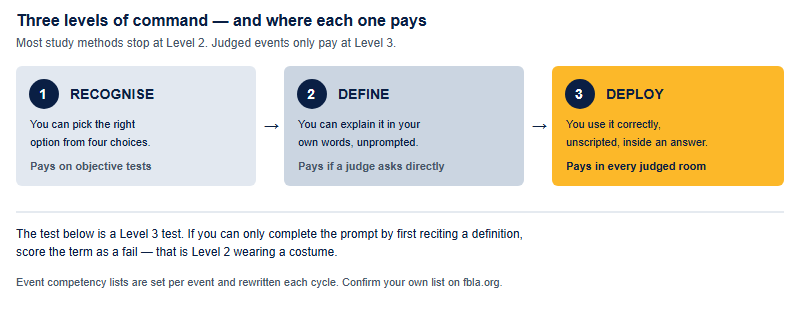
There is a second reason this matters more for competitors working in a second language. Under time pressure, people fall back on the words they have actually spoken before, not the ones they have read. A term you have only ever seen on a page tends not to arrive when a judge is looking at you. That is a rehearsal problem rather than a knowledge problem, and it is fixable in weeks — see our guide for international students competing in FBLA for the broader version of this issue.
The six clusters, and how to run the audit
FBLA’s objective tests and case-based events draw on business areas including accounting, economics, finance, marketing, management, business law and technology applications; the exact competencies are listed per event, and FBLA has stated the 2026-2027 Competitive Events Guidelines, including topics, go live at the beginning of September. Pull your own event’s list from fbla.org and weight the clusters accordingly — the six below are a general spine, not a substitute for your event’s competency list.
Run it like this. Take one cluster at a time. For each term, say the deploy prompt aloud, in a full sentence, about your own project or a case you know — out loud, not in your head, and without looking anything up. Give yourself 1 point only if the sentence is correct and arrived within about five seconds. Hesitation is a fail; so is a sentence that would make an accountant wince.
| Cluster | The ten terms | Deploy prompt — complete it aloud, about your own case | You only have recognition if… |
|---|---|---|---|
| A. Accounting and statements | accrual · depreciation · amortisation · gross margin · operating income · working capital · accounts receivable · liability · retained earnings · cash flow statement | “Our gross margin is ___ because ___, and it differs from operating income because ___.” | You can define the term but cannot say which statement it appears on |
| B. Finance and investment | return on investment · break-even point · cost of capital · liquidity · valuation · equity · debt financing · net present value · burn rate · leverage | “We break even at ___ units, because fixed costs are ___ and contribution per unit is ___.” | You reach for “profit” whenever a finance word is needed |
| C. Marketing and customer | segmentation · positioning · value proposition · customer acquisition cost · churn · conversion rate · brand equity · distribution channel · price elasticity · target market | “Our target segment is ___, and our value proposition to them specifically is ___.” | Your “target market” is a country or an age range and nothing else |
| D. Management and operations | key performance indicator · supply chain · inventory turnover · capacity · delegation · organisational structure · stakeholder · standard operating procedure · lead time · span of control | “The KPI I would track is ___, measured ___, and it would tell us ___ by ___.” | You name a goal rather than a measurable indicator |
| E. Economics and market structure | opportunity cost · marginal cost · economies of scale · supply and demand · inflation · market share · barrier to entry · externality · substitute good · gross domestic product | “We chose ___, and the opportunity cost of that choice was ___.” | You use “opportunity cost” to mean “the price we paid” |
| F. Law, ethics and risk | breach of contract · intellectual property · compliance · fiduciary duty · non-disclosure agreement · negligence · antitrust · due diligence · conflict of interest · data privacy | “The main compliance risk here is ___, and we would manage it by ___.” | Every legal answer becomes “we would consult a lawyer” |
Score it, and read the band honestly
Total your points out of 60. The bands below are ours, drawn from how the gap tends to behave in practice rather than from any official scale — treat them as a diagnostic, not a prediction of any result.
| Score | Band | What it actually means | Your next move |
|---|---|---|---|
| 0–24 | Recognition only | You would likely survive a multiple-choice paper and struggle in any defended format | Repair before you commit to a judged event; consider an objective test this cycle |
| 25–39 | Patchy command | Two or three clusters carry you; the others collapse under a follow-up question | Repair your two weakest clusters only. Do not spread the effort evenly |
| 40–51 | Working command | You can hold a normal exchange but reach for the same four or five terms repeatedly | Widen range inside your event’s own competency list; drill the unused terms |
| 52–60 | Deployable | Terms arrive unprompted and correctly, which is the level a judged room actually rewards | Stop studying vocabulary. Your remaining points are in evidence and delivery |
One warning about the top band. Deployable does not mean “use more jargon.” Judges mark understanding, not decoration, and a competitor who packs six terms into one sentence reads as someone hiding behind vocabulary. The standard is one precise term where a vague phrase would otherwise sit — not density.
The four-week repair routine
Repair is not re-reading. The failure was retrieval under time pressure, so the fix has to be spoken, timed and applied to your own material. Ten terms a week, four weeks, roughly twenty-five minutes per session.
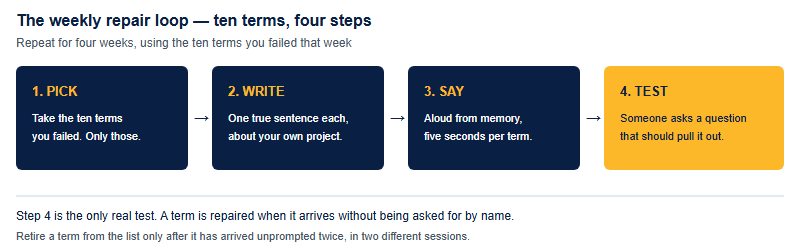
Three rules keep the routine honest. Write about your own case, never a generic example — a sentence about a hypothetical coffee shop will not surface in a room where you are discussing your own project. Do step 4 with someone who has not seen your sentences, so they cannot cue you. And do not add new terms while old ones are still failing; the common mistake is grinding through all sixty every week, which trains recognition again and repairs nothing.
How this connects to the rest of your season
Two practical consequences follow from your score. First, it is a legitimate input into which event you enter. A student sitting at 22 out of 60 in early September has a genuinely better season in an objective test event than in a defended format, and can move to a judged event next cycle from a stronger base — that is sequencing, not retreat. Our guide to the competitive events lays out what each format asks of you.
Second, command tends to matter more, not less, as you move up. Questioning at higher levels is generally sharper simply because the field is stronger, so a vocabulary that holds together at chapter level can be exposed later; if you are planning that far ahead, how to qualify for NLC sets out the levels involved. None of this determines an outcome at any level — what it does is remove one specific, fixable reason for losing rows on a sheet.
Finally, re-run the audit once, cold, about two weeks before your first competition. Scores drift downward during exam season, and it is far better to discover that in a bedroom than in front of a judge.
Questions students ask about business vocabulary
Should I memorise definitions word for word?
No. Judges mark applied understanding, not recall. Memorised definitions tend to arrive as recitation, which reads worse than plain accurate language.
Is it a problem if English is my second language?
It is a rehearsal issue more than a knowledge one. Terms you have spoken aloud arrive under pressure; terms you have only read often do not.
How many terms do I actually need?
Fewer than you think, deployed precisely. Range matters less than reliability — one exact term beats three approximate ones in the same answer.
Where do I find my event’s real competency list?
On fbla.org, in your event guideline. FBLA has said the 2026-2027 guidelines and topics go live at the beginning of September.
Published by the FBLA editorial desk, operated by Hanlin Education for China-based international-school students. Official rules are set by the competition and change yearly — confirm current details on fbla.org. Any error here is corrected within 7 working days.