In FBLA’s prejudged events, your report or project is judged before the conference and must be submitted electronically by the date stated in your event’s guideline. That means your file passes through a compliance gate before any judge evaluates your thinking — and compliance is where careful students lose points they never see. This is the audit to run before you upload.
Why the file is a separate gate from the work
FBLA groups its high school events by format — objective tests, presentation events, role play events, production events and chapter events — and a number of those events carry a prejudged report or project. Prejudged events work differently from the rest in one decisive way. The material is not carried into a room and defended live; report or project content is prejudged ahead of the conference, and prejudged projects and reports are submitted electronically by the date listed in the Competitive Events Guidelines. Confirm the specifics for your event on fbla.org, because they are set event by event.
The practical consequence is that your submission passes two gates, not one, and they are judged by different criteria.
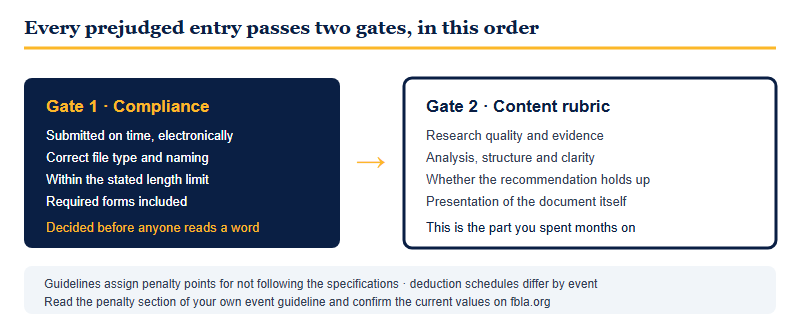
Guideline documents have described penalty points deducted for not adhering to the specifications — deductions triggered by things such as a missing Statement of Assurance or incorrectly labelled materials. The exact deductions, the maximum, and which items trigger them vary, so read the penalty section of your own event guideline and write the numbers down. Do not carry over what a friend remembers from a different event or a previous cycle.
Step one: capture the spec before you write anything
The single most useful hour of a prejudged season is spent turning your guideline into a filled-in sheet. Copy this table, open the current guideline for your event on fbla.org, and complete the right-hand column in your own words. If a row comes back "not stated", write that down too — it tells you where to ask your adviser rather than guess.
| # | Specification to capture | Why it bites | What your guideline says |
|---|---|---|---|
| 1 | Electronic submission deadline, with time and time zone | A deadline in a US time zone is a different calendar day in China | |
| 2 | Where the file is submitted | Portal access and account setup take longer than the upload | |
| 3 | Accepted file format | A document that will not open scores nothing | |
| 4 | Page or word limit | Limits are set event by event — there is no single FBLA number | |
| 5 | What counts toward the limit | Cover page, table of contents and appendices may or may not count | |
| 6 | Cover page contents and order | A named required element that is missing is an easy deduction | |
| 7 | Table of contents requirement | Often required, often forgotten in the final export | |
| 8 | Statement of Assurance or equivalent form | A separate document with its own signature and deadline | |
| 9 | Whether names or school appear, or must not | Anonymity rules differ; breaking either direction costs points | |
| 10 | Citation and source requirements | Integrity rules are enforced, not decorative | |
| 11 | Team member listing rules | Wrong or missing names create eligibility problems late | |
| 12 | File naming convention | Named in some guidelines; a silent deduction when ignored | |
| 13 | Penalty point schedule and maximum | Tells you which mistakes are cheap and which are expensive | |
| 14 | Whether a live component follows the submission | Changes how you build the document in the first place |
Two warnings about this sheet. First, fill it in from the current guideline: FBLA republishes guidelines and topics each cycle, around the start of September, and specifications move between years. Second, if your state or region issues its own competitive events documentation, read both — regional rules can add requirements that the national guideline does not mention. Our guide to the competitive events programme explains how the event families and formats fit together if you are still deciding.
Step two: the 20-check audit
Run this once at roughly a week out, and again immediately before uploading. Score one point per pass. Anything under 20 means you are not finished, however good the writing is.
| # | Check | Passes when |
|---|---|---|
| 1 | Deadline converted to China Standard Time | You have written the local date and hour on your calendar, not the US one |
| 2 | Submission portal tested | You have logged in successfully at least once, days early |
| 3 | File format matches the spec exactly | Not "close enough" — the stated format |
| 4 | Length verified in the exported file | Counted after export, not in the editing view |
| 5 | Counted and excluded pages classified correctly | You know which sections the limit includes |
| 6 | Cover page carries every required element | Checked line by line against the guideline |
| 7 | Table of contents present and accurate | Page numbers match the exported document |
| 8 | Page numbers continuous and correct | No restart at each section, no missing numbers |
| 9 | Statement of Assurance or equivalent completed | Signed, dated, and submitted by its own route |
| 10 | Anonymity rule followed in the right direction | Names present if required, absent if prohibited |
| 11 | Every team member listed correctly | Spelling and name order consistent with membership records |
| 12 | Sources cited in the required style | Consistent throughout, including tables and figures |
| 13 | No uncited borrowed text, image or chart | Including anything generated with a tool |
| 14 | File name follows the convention | Exactly as specified, including separators |
| 15 | Fonts embedded and the export opens cleanly | Opened on a second device before submission |
| 16 | Images legible at normal reading size | Checked on a laptop screen, not only on a phone |
| 17 | Every figure and table referenced in the text | Nothing floating without explanation |
| 18 | An outside reader has read it end to end | Someone who did not write it found nothing confusing |
| 19 | Any required live component is planned | You know what happens after the file is judged |
| 20 | A backup copy exists outside your laptop | Retrievable if the device fails on deadline week |
Check 18 deserves emphasis. The most common substantive weakness we see in China-based prejudged entries is not weak English — it is a document that makes perfect sense to its author and none to a stranger, because context that lives in the writer’s head never made it onto the page. An outside reader finds that in twenty minutes. You will not find it yourself at any point.
Four failure modes specific to competing from China
The time-zone trap. Deadlines are stated in a US time zone. Converted to China Standard Time, a US evening deadline can fall in the early hours of the following morning locally — or, read carelessly the other way, a full day earlier than you assumed. Convert it once, write the local date and hour down, and treat that converted moment as final. Do not plan to submit on the deadline day at all.
The portal assumption. Students discover on deadline night that they cannot reach the submission system, that their account was never activated, or that their adviser holds the credentials. All three are solvable in September and unsolvable at midnight. Log in early, upload a placeholder if the system permits it, and confirm with your adviser who is responsible for pressing submit.
The export problem. Documents built on a machine configured for Chinese-language use can export with substituted fonts, broken layout, or mangled characters when opened elsewhere. Export the final file, open it on a different device, and look at it. This takes five minutes and prevents a category of failure that no amount of writing quality compensates for.
The name-order problem. Family-name-first ordering, English names that differ from passport names, and inconsistent romanisation all create mismatches between your document, your membership record and your registration. Pick the form that matches your official membership record and use it identically everywhere. Our guide for international students competing in FBLA covers the administrative details that trip up China-based candidates.
A submission runbook that removes deadline-week panic
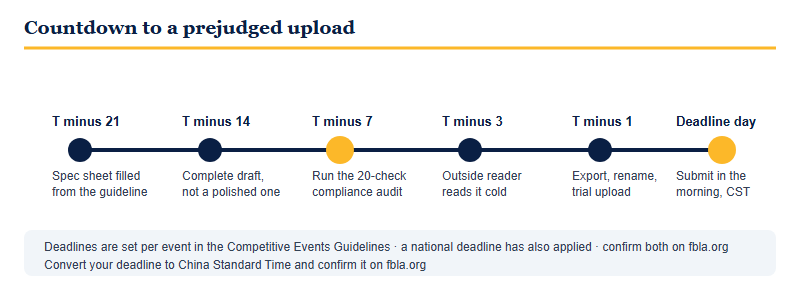
The logic of the runbook is that every task sits far enough from the deadline to survive one thing going wrong. A complete draft at fourteen days out is deliberately unpolished — its purpose is to expose structural problems while there is still time to fix them. The compliance audit at seven days is early enough that a formatting failure is an afternoon of work rather than a crisis. And submitting in the morning, China time, on the deadline day leaves hours of margin instead of minutes.
If your event is the prejudged component of a longer progression, remember that the file is a checkpoint rather than an endpoint. Our walkthrough of how to qualify for the National Leadership Conference sets out where each round sits, so you can see what comes after the upload.
Questions about prejudged submissions
When are FBLA prejudged reports due?
Each event states its own electronic submission date in the Competitive Events Guidelines, and FBLA’s national manual has also carried a single deadline for prejudged projects and reports. Confirm both for 2026-27 on fbla.org and with your adviser.
Do cover pages and appendices count toward the page limit?
It depends on the event. The guideline states what is counted and what is excluded, so read that line before you format anything.
What happens if I break a formatting rule?
Guidelines assign penalty points for not following the specifications. Confirm the current deduction schedule for your event on fbla.org.
Can I submit late if my internet fails?
Plan as if not. Treat the stated deadline as final, convert it to China time, and upload days early rather than on the day.
Published by the FBLA editorial desk, operated by Hanlin Education for China-based international-school students. Official rules are set by the competition and change yearly — confirm current details on fbla.org. Errors reported to this desk are corrected within 7 working days.