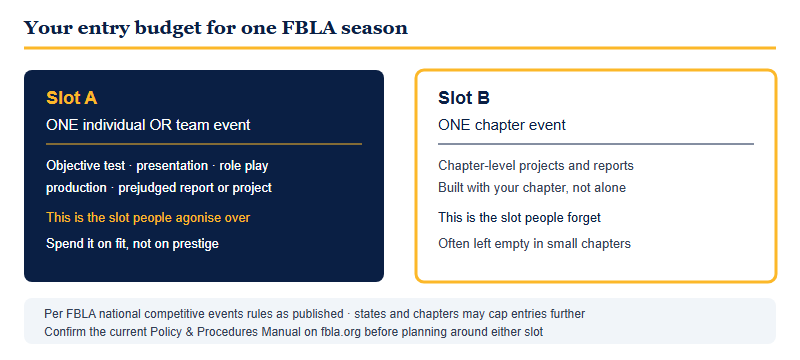
Fewer than most students assume. FBLA’s national competitive events rules have limited each competitor to one individual or team event plus one chapter event — not three, not five. Confirm the current edition on fbla.org, because the manual is reissued yearly and states and chapters can impose tighter caps. If that is the rule, your season is a single allocation decision, and this page is the grid for making it.
The rule, stated plainly — and where to verify it
FBLA’s National Competitive Events Committee publishes a Policy & Procedures Manual each year. That manual has stated that each competitor may compete in only one individual or team event and one chapter event. It is the sentence that governs your whole season, and almost nobody reads it before choosing.
Three things follow, and you should verify all three rather than take them on trust:
- Verify the current edition. The manual is republished annually and wording changes. Find the version that matches the 2026-27 cycle on fbla.org before you plan around it.
- Check your state or region separately. State and regional organisations routinely add caps that national rules do not — for example, limiting how many entries one chapter may submit in a given event. Your adviser is the authority here, not a forum post.
- Check the event guideline itself. Individual guidelines carry their own eligibility conditions, team sizes and submission requirements. Two students reading the same national rule can still end up ineligible for different reasons.
Why this matters more for China-based candidates than for a US chapter: a large American chapter can absorb a bad event choice, because the student simply competes again next year alongside thirty chaptermates who have already run the event. In a chapter of eight at an international school in Shanghai, one wasted slot is a meaningful share of the school’s total competitive output for the year. Precision costs nothing and buys a lot.
What one slot actually costs
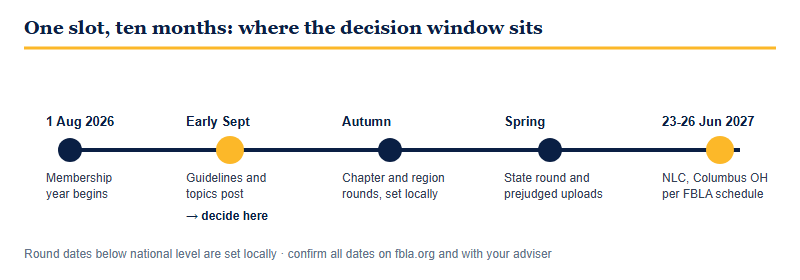
Put the calendar next to the rule and the stakes get concrete. FBLA’s Schedule at a Glance for 2026-2027 lists the membership year as beginning 1 August 2026, and it lists the 2027 National Leadership Conference as 23-26 June 2027 in Columbus, Ohio. Confirm both on fbla.org before you build anything around them, and note that chapter, regional and state rounds are scheduled locally, so those dates are not on the national sheet.
That is roughly a ten-month runway. But the decision point is not ten months away — it is now. Updated guidelines and topics have posted around the start of September, and once you have read yours, the useful window for switching events closes fast. Change in September and you lose a fortnight. Change in January and you have burned a term.
The Slot A decision grid
List your two or three candidate events across the top of a page. Score each one against every factor below, multiply by the weight, and total it. The weights are our editorial judgement from coaching China-based chapters, not an official FBLA scheme — adjust them if your situation differs, but adjust them before you score, not after you see the result.
| Factor | Why it decides seasons | Score 0 | Score 1 | Score 2 | Weight |
|---|---|---|---|---|---|
| Guideline read in full | You cannot score anything else honestly without it | Not read | Skimmed | Read, with the format and submission lines noted | ×3 |
| Coursework overlap | Determines whether your timetable subsidises your prep | None | Partial | Direct | ×3 |
| Prejudged workload | A written or uploaded component is a second, hidden season | Large and undefined | Large but scoped | None, or small and already drafted | ×3 |
| Exam-season collision | Mocks and finals do not move for you | Peak work lands on mocks | Tight but survivable | Clear runway | ×2 |
| Rewrite resilience | Events get renamed, merged, retired or reformatted each cycle | Prep is event-name specific | Mostly transferable | Pure skill, transfers anywhere | ×2 |
| Team dependency | A team event fails if one member disappears in February | Team not confirmed | Team confirmed, roles vague | Individual event, or team with written roles | ×2 |
| Chapter capacity | Your chapter may already be at its entry cap in this event | Unknown | Adviser aware | Confirmed with adviser | ×1 |
| Genuine interest | Ten months is long enough for boredom to become a result | Chose it for the name | Neutral | Would do it unwatched | ×1 |
How to read the total. Above 26, commit and stop shopping — further comparison is procrastination. Between 18 and 26, the choice is viable but one factor is usually dragging; find it and fix that specific thing rather than switching events. Below 18, you are about to spend your only slot on something you have not investigated, and the cheapest possible action is to spend two more hours reading guidelines.
Notice that the three heaviest weights are all things you can settle this week: read the guideline, check the overlap, scope the prejudged work. None of them require talent, permission or money. That is deliberate — the factors that decide FBLA seasons are mostly administrative, and administrative factors are the ones students skip. For how the events are grouped and formatted in the first place, our competitive events guide is the place to start.
Slot B: the chapter event most people leave empty
Here is the asymmetry worth exploiting. If the national rule allows one individual or team event plus one chapter event, then a student who enters only an individual event has voluntarily left half their entry budget unused. In small international-school chapters this is close to universal, usually because nobody realised the second slot existed.
Chapter events are a different kind of work. They are built with your chapter over the year rather than crammed by one person in April, they typically produce a documented project or report rather than a test score, and they reward the organisational effort a small chapter has to do anyway to function. If your chapter is running activities, you are already generating the raw material.
Three practical notes before you count on it:
- Chapter events need an actual chapter. This is not an individual side project with a different label. If your chapter has four members and no activity record, the honest answer is to build the chapter this year and enter the event next year.
- The documentation is the deliverable. Chapter events generally involve a prejudged submission, which means specifications, a deadline and a file. Start the record-keeping in September, not in March, because you cannot retroactively photograph an event that already happened.
- Check the current rules before assuming both slots are available. The one-plus-one structure is what the national manual has stated; confirm it for 2026-27 on fbla.org and with your adviser, since a state may narrow it.
Three ways students waste the slot
Waste one: choosing before reading. Students pick in July from an event name, then read the guideline in October and discover a prejudged report with a spring deadline. The slot is now committed to a workload they never scoped. The fix is trivially cheap — read the guideline before you commit, and specifically read the submission and format lines, not just the description.
Waste two: the phantom team. A team event entered with friends who agreed in September and disengaged by February leaves one student doing three people’s work under a deadline. If you take a team event, write down who owns what and what happens if someone withdraws. If you cannot get that written down in September, that is data about the team, and an individual event is the safer use of your only slot.
Waste three: treating the slot as a lottery ticket. Choosing the event you think looks most impressive, rather than the one you can actually prepare for, is the most common error in international-school chapters. No event confers an outcome — nothing here guarantees a placement or an admissions result — and an event you can genuinely prepare for produces better work than one chosen for its name. Our notes for international students competing in FBLA and our walkthrough of how to qualify for the National Leadership Conference both cover what the progression actually asks of you.
One closing note on honesty. If you read the current rules and find that the limit has changed for 2026-27, believe fbla.org over this page and over anyone’s memory of last year. The whole point of an allocation plan is that it is built on the rule as written this season.
Common questions about FBLA entry limits
How many FBLA events can one member enter?
FBLA rules have limited each competitor to one individual or team event plus one chapter event. Confirm the current manual on fbla.org.
Does a chapter event count against my individual entry?
No. Chapter events have been treated as a separate slot from the individual or team entry. Verify the current wording with your adviser.
Can my chapter enter two teams in the same event?
Entry caps per chapter are set in the official guidelines and by state or regional policy. Ask your adviser before you build two teams.
When is NLC 2027?
FBLA lists NLC 2027 as 23-26 June 2027 in Columbus, Ohio in its 2026-2027 schedule. Confirm on fbla.org before booking anything.
Published by the FBLA editorial desk, operated by Hanlin Education for China-based international-school students. Official rules are set by the competition and change yearly — confirm current details on fbla.org. Errors reported to this desk are corrected within 7 working days.