FBLA Role Play events (officially the “Interactive Role Play” category) combine an objective test with a timed, unseen case scenario you receive on site, prepare against a short clock, and then perform in front of a judge who plays a client or manager. Events like Marketing, Entrepreneurship, Business Management and Hospitality & Event Management sit here. For a competitor who freezes at “write a plan months in advance,” this is often the fastest route to a rating that counts. Formats change yearly, so confirm current rules on fbla.org.
What “Role Play” actually means at FBLA
In the FBLA competitive-events system, events are grouped into categories: Objective Tests, Presentations, Role Plays (Interactive Role Play), Production Tests, and Chapter Events. Role Play events are their own family, and they behave very differently from a prejudged project such as the Business Plan or the wider events catalogue. Instead of building something over a semester, you walk in with general business knowledge, receive a fresh scenario, get a fixed block of preparation time, and then role-play a solution live.
Most Role Play events share a two-part structure: an objective test (taken online, typically ahead of the performance) plus the interactive role play itself. Your combined result decides your rating. Some events in this family are individual; many allow a team of up to three. The mix of events, team sizes and time limits is set each year in the official At-A-Glance and Guidelines on fbla.org — treat any list you read online, including this one, as a starting map and verify the current edition.
Here is a representative slice of the Role Play family so you can see the range of business contexts it covers. Event names and eligibility are set annually by FBLA; confirm the current roster before you register.
| Role Play event | Business context | Individual or team |
|---|---|---|
| Marketing | Positioning, promotion, campaigns | Team (up to 3) |
| Entrepreneurship | Launching and running a venture | Team (up to 3) |
| Business Management | Operations, staffing, strategy | Team (up to 3) |
| Banking & Financial Systems | Retail banking, lending, risk | Team (up to 3) |
| Hospitality & Event Management | Hotels, events, guest service | Team (up to 3) |
| International Business | Cross-border trade and strategy | Team (up to 3) |
| Sports & Entertainment Management | Sponsorship, ticketing, promotion | Team (up to 3) |
| Client Service / Help Desk | Handling a customer live | Individual |
How a Role Play round runs, step by step
The precise minutes vary by event and by conference level, and FBLA specifies them in each event’s Guidelines. The shape of the experience, however, is consistent. Do not memorise the numbers below as gospel — read your event’s current rating sheet — but do internalise the sequence, because the sequence is what your practice should rehearse.
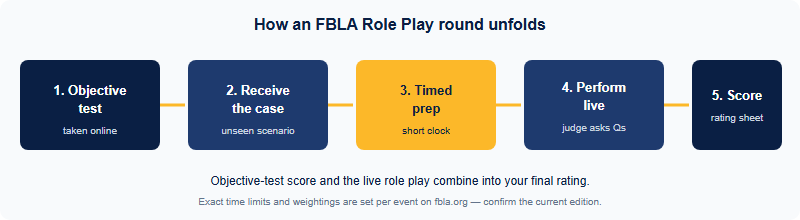
- Objective test. A knowledge check in the event’s subject area, usually taken online during the testing window. Weak test scores quietly cap otherwise strong performers, so this is not a throwaway.
- Receive the case. At the conference you are handed a scenario — a business with a problem, a client with a need, a decision to make. You have not seen it before.
- Timed preparation. A fixed, short window to read, think and make notes on the materials the event allows. You cannot bring pre-written scripts into most events; check what note materials are permitted.
- Live performance. You enter and role-play your solution with a judge who often stays in character as the client or supervisor and asks follow-up questions.
- Scoring. Judges mark against a published rating sheet. Higher levels (state, national) may use preliminary and final rounds.
A repeatable method for the 20-minute case
The students who do well are not necessarily the ones with the most business knowledge. They are the ones with a structure they can run under pressure. Because you cannot predict the scenario, you train a process, not a script. Here is a five-move method you can rehearse until it becomes automatic. Use whatever prep window your event actually gives; the proportions matter more than the exact minutes.
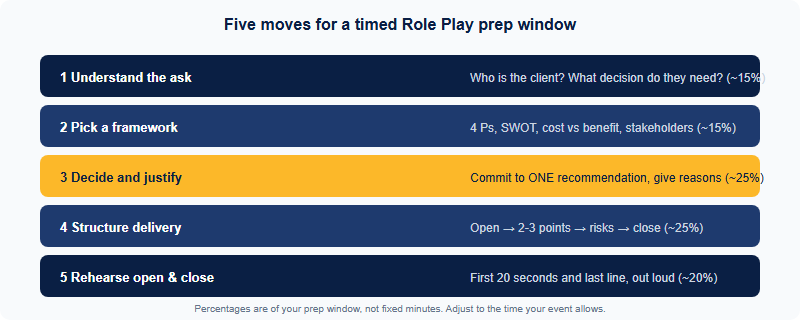
- Understand the ask. Read once for the story, once for the task. Underline the exact decision the client wants. Most panics come from answering a question the case never asked.
- Pick a framework. Reach for one lens that fits the event — the 4 Ps for a Marketing case, a stakeholder map for Business Management, a simple cost-versus-benefit for a financial call. A framework buys you a coherent structure in seconds.
- Decide and justify. Judges reward a clear recommendation over a hedge. Commit to one course of action and be ready to say why in two or three reasons drawn from the case’s own facts.
- Structure the delivery. Plan an opening line, two to three supporting points, an honest note on risk or trade-off, and a close. This skeleton survives contact with a nervous stage.
- Rehearse the open and close. If you only get to practise two things, make them your first twenty seconds and your final sentence. A confident open and a crisp close frame everything in between.
Why Role Play events suit many international students
Chinese international-school students sometimes assume the English-heavy events are out of reach. Role Play rewards a different profile than a written project. It prizes clear thinking, a firm recommendation and calm delivery over native-level idiom. A few practical reasons this category is worth a serious look, and a few honest cautions:
- No months-long build. You do not need to produce a polished report or website in advance, which lowers the barrier to entering and competing at chapter and regional level.
- Speaking beats writing here. Judges hear a short, structured argument. Practising delivery is faster to improve than perfecting written English.
- Team option. Many Role Play events allow a team of up to three, so you can pair a strong analyst with a strong speaker and share the load. Confirm current team sizes on fbla.org.
- Honest caution: the objective test still matters. A weak test can hold back a strong performance, so budget real study time for the knowledge component.
- Honest caution: improvisation is trained, not innate. The “unseen case” only feels manageable after a dozen practice runs against old prompts and business scenarios.
If you are still weighing FBLA against other routes, our overview of FBLA for international students puts the competition in the wider China-cohort context, and how to qualify for NLC explains how a strong Role Play rating carries you from chapter to nationals.
A four-week practice plan you can start now
Because NLC 2026 in San Antonio (June 29 – July 2, 2026) has just wrapped, the smart move is to build a base over the summer, well before next season’s registration and district events. This is a base-building block, not a countdown; scale it to your own calendar.
| Week | Objective-test work | Role-play work |
|---|---|---|
| 1 | Read the knowledge areas listed in your event’s Guidelines; take one sample test | Learn the five-move method; run one practice case slowly, no timer |
| 2 | Drill the two topic areas where you scored lowest | Run two cases with a generous timer; record yourself; review the open and close |
| 3 | Second full sample test; log every missed question by topic | Two cases at the real time limit; have someone play the judge and ask follow-ups |
| 4 | Light review; rest the day before | Two cases under realistic pressure; polish framework choice and delivery |
One first-party observation from coaching China-based competitors: the single biggest score jump usually comes not from more business knowledge but from forcing students to commit to one recommendation and defend it. Learners trained in exam-style hedging tend to present three options and pick none; judges reward the student who chooses. Building that decisiveness is the highest-leverage thing you can practise this summer.
Frequently asked questions
Do all FBLA Role Play events have an objective test?
Most pair an objective test with the interactive role play, but a few individual events are performance-only. Check your specific event’s Guidelines on fbla.org.
Can I bring notes or a script into the role play?
Rules on prepared notes and permitted materials vary by event and change yearly. Do not assume you can bring a script — confirm what is allowed in the current Guidelines.
How long is the preparation window before I perform?
It is a short, fixed block set per event and per conference level. The exact minutes are published in each event’s rating sheet on fbla.org; confirm before you compete.
Is Role Play better than the Business Plan for a beginner?
Neither is universally “better.” Role Play needs no months-long build and rewards live thinking; the Business Plan rewards deep preparation. Pick the one that fits how you work best.
Published by the FBLA editorial desk, operated by Hanlin Education for China-based international-school students. Official rules are set by the competition and change yearly — confirm current details, event names, formats and time limits on fbla.org. Errors are corrected within 7 working days.