FBLA Production Test events — Computer Applications, Spreadsheet Applications, Word Processing and Slide Deck Applications — pair an objective test with a hands-on, timed production test where you build real documents against a brief. Because they reward software fluency, accuracy and speed rather than native-level spoken English, they are one of the most under-used medal paths for Chinese international-school students. Event names and formats are set yearly, so confirm the current roster on fbla.org.
What a “Production Test” event is
FBLA sorts its competitive events into categories: Objective Tests, Presentations, Role Plays, Production Tests and Chapter Events. Production Tests are a distinct family, and they are unusual because most of your score comes from a practical, on-the-computer task, not a speech or a report. You are given a business scenario and a set of instructions — format this document, build this spreadsheet, produce this deck — and you execute against a clock while judges mark the finished files against a rating sheet.
The 2025-2026 FBLA overview lists the high-school Production Test family as Computer Applications, Spreadsheet Applications, Word Processing and Slide Deck Applications. These are individual events. The precise event list, eligibility and time limits are published each year in the official Guidelines and At-A-Glance on fbla.org; use the table below as a map and verify the current edition before you register.
| Production Test event | What you produce | Core skills judged |
|---|---|---|
| Word Processing | Formatted business documents (letters, reports, tables) | Formatting accuracy, layout, speed |
| Spreadsheet Applications | Worksheets with formulas, charts and analysis | Formula logic, data handling, presentation |
| Slide Deck Applications | Presentation slides to a business brief | Design, structure, adherence to spec |
| Computer Applications | Mixed tasks across office productivity tools | Breadth, accuracy under time pressure |
How the two parts fit together
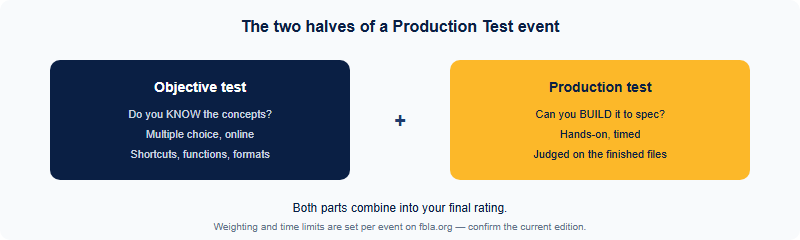
Like several FBLA categories, Production Test events typically have two components: an objective test and the production test itself. The objective test checks that you know the concepts behind the software; the production test checks that you can actually build the deliverable to spec, fast and clean. Your combined performance decides your rating. The exact weighting and minutes are event-specific and published on fbla.org — do not assume, confirm.
Why this is a smart path for international students
Many Chinese international-school students self-select out of FBLA because they picture a room of native speakers giving polished presentations. Production Test events flip that assumption. The deliverable is a file, not a speech, and the judging is about whether the spreadsheet computes correctly and the document matches the format brief — objective, checkable things. A few honest reasons to consider this family, and the trade-offs:
- English load is lower. You still read instructions in English, but you are not judged on accent, idiom or live delivery. Skill and accuracy carry the score.
- The skills transfer directly. Formula design, clean formatting and slide structure are exactly the office skills you will use in a business or STEM degree and internship. This is genuinely useful practice, not just a medal chase.
- Objective, less subjective. A cell either has the right formula or it does not. That reduces the “did the judge like me” variance that worries some competitors.
- Honest trade-off: speed is unforgiving. These are timed. A student who knows Excel casually is not the same as one who can build a correct, formatted worksheet against a clock. That gap is closed only by repetition.
- Honest trade-off: it is individual. There is no teammate to lean on. Your preparation is entirely on you.
If you are mapping out which event family fits you, our complete FBLA competitive events guide shows how Production Tests sit alongside the other categories, and the wider case for the programme is in FBLA for international students.
Which Production Test event fits you
The four events reward slightly different strengths, so choosing well is half the battle. There is no single “easiest” event — the right pick is the one that matches the software you already enjoy and the kind of thinking you are fastest at. Use this as a self-diagnosis, then confirm the current event roster and grade eligibility on fbla.org before you commit.
| If you enjoy… | Consider | Because it rewards… |
|---|---|---|
| Logic, numbers, “what if” thinking | Spreadsheet Applications | Formula design, conditional logic, clean charts from messy data |
| Precise layout and written documents | Word Processing | Formatting discipline, styles, tables, following a format brief exactly |
| Visual structure and storytelling | Slide Deck Applications | Turning a business brief into clear, well-designed slides at speed |
| Breadth across office tools | Computer Applications | Versatility and accuracy across mixed tasks under one clock |
A practical tip for international-school students: pick the event whose software you can practise every day, not the one that sounds most impressive. Daily reps on Spreadsheet Applications will beat occasional practice on a “harder-sounding” event, because these events are won on automaticity. If you are still deciding between whole event families rather than within this one, the competitive events guide lays out all the categories side by side.
How to train: a skill-first study plan
Production Test events reward deliberate, hands-on practice more than reading. The goal is to make correct formatting and formula-building automatic, so your limited exam time goes to the hard parts of the brief, not to hunting for a menu. Here is how to structure a summer base-building block. Adjust to your event and to the real time limit published on fbla.org.
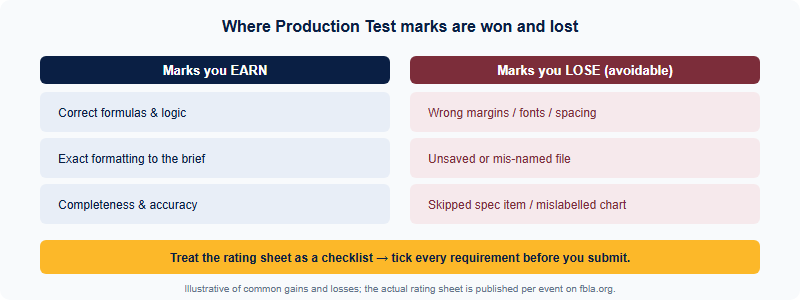
- Learn the rating sheet first. Download your event’s Guidelines and read exactly what earns points. Students lose easy marks by ignoring formatting instructions (margins, fonts, file naming) that the rating sheet explicitly rewards.
- Build a shortcut and function library. For Spreadsheet Applications, drill the functions the knowledge areas list — lookups, conditional logic, aggregation, charting. For Word Processing, drill styles, tables, headers and reference formatting. Speed comes from not thinking about mechanics.
- Practise against a brief, not free-form. Recreate business documents from instructions, then check every requirement off a list. The skill being tested is “follow the spec exactly,” which is different from “make something that looks nice.”
- Time yourself early and often. Do full production tasks at the real time limit. Track not just whether you finished, but how many spec items you missed under pressure.
- Study the concepts too. The objective test can quietly cap a strong builder. Spend real time on the terminology and features behind the tools, not only on doing.
| Week | Focus | Concrete task |
|---|---|---|
| 1 | Rules and baseline | Read the Guidelines and rating sheet; do one untimed production task to find your gaps |
| 2 | Mechanics | Drill the top functions/formatting features daily until they are automatic; one sample objective test |
| 3 | Spec discipline | Timed tasks; check finished files against every rating-sheet requirement; log misses |
| 4 | Pressure and polish | Full timed runs; second objective test; tighten file naming, formatting and speed |
A first-party pattern from working with China-based competitors: the students who medal in Production Test events are rarely the ones who “know the software best” in the abstract. They are the ones who treat the rating sheet as a checklist and lose zero marks to careless formatting — wrong margins, an unsaved file, a mislabelled chart. Building that checklist habit is worth more than another advanced function you will rarely need.
How Production Tests fit your season and your applications
FBLA competitors advance from chapter and district events toward the National Leadership Conference; NLC 2026 was held in San Antonio, TX, June 29 – July 2, 2026. A Production Test rating counts toward that journey the same way any other event does — see how to qualify for NLC for the path from chapter to nationals. On applications, be honest and specific: a strong Production Test result signals disciplined, practical business-software skill. It is a real, verifiable achievement, but like any single activity it is one signal among many, not a guarantee of any admissions outcome.
Frequently asked questions
Which software do FBLA Production Test events use?
They use standard office productivity tools for word processing, spreadsheets and presentations. The exact platform and version for the national level are specified in the event Guidelines on fbla.org — confirm before you prepare.
Are Production Test events individual or team?
The high-school Production Test events are individual. Team sizes for all events are set yearly in the official At-A-Glance on fbla.org.
Do I need to be a native English speaker to do well?
No. You read instructions in English, but scoring is based on the accuracy and quality of the files you produce, not on spoken English or accent.
Is there an objective test as well as the production test?
Yes, these events typically pair a concept-based objective test with the hands-on production test, and both feed your rating. Check the current weighting on fbla.org.
Published by the FBLA editorial desk, operated by Hanlin Education for China-based international-school students. Official rules are set by the competition and change yearly — confirm current details, event names, formats and time limits on fbla.org. Errors are corrected within 7 working days.