There are two honest ways to prepare for FBLA (Future Business Leaders of America): self-study and coaching. Both produce strong results — the difference is whether you want structure and feedback, or prefer to drive it yourself. This guide does not start by selling a course. With 55+ events, the first real skill is picking the right one; this guide breaks the events into types, gives a four-phase roadmap, and shows what good prep looks like even if you self-study.
First, know what you are preparing for
FBLA is not one competition — it is 55+ events in a few families, and each rewards almost opposite preparation. Choosing your event is half the battle:
| Event type | Examples | Self-study-friendly? |
| Objective tests | Accounting, Business Law, Economics, Marketing (written exams) | ✅ Yes, if you can drill content |
| Presentation / role-play | Sales Presentation, Public Speaking, Job Interview, role-play events | ⚠️ Hard — needs feedback & rehearsal |
| Projects / prepared | Business Plan, Business Financial Plan, Marketing campaigns | ⚠️ Hard — needs review cycles |
An objective test and a Sales Presentation reward completely different preparation. Settling your event first is the single most useful decision you can make — it determines whether self-study is even viable for you.
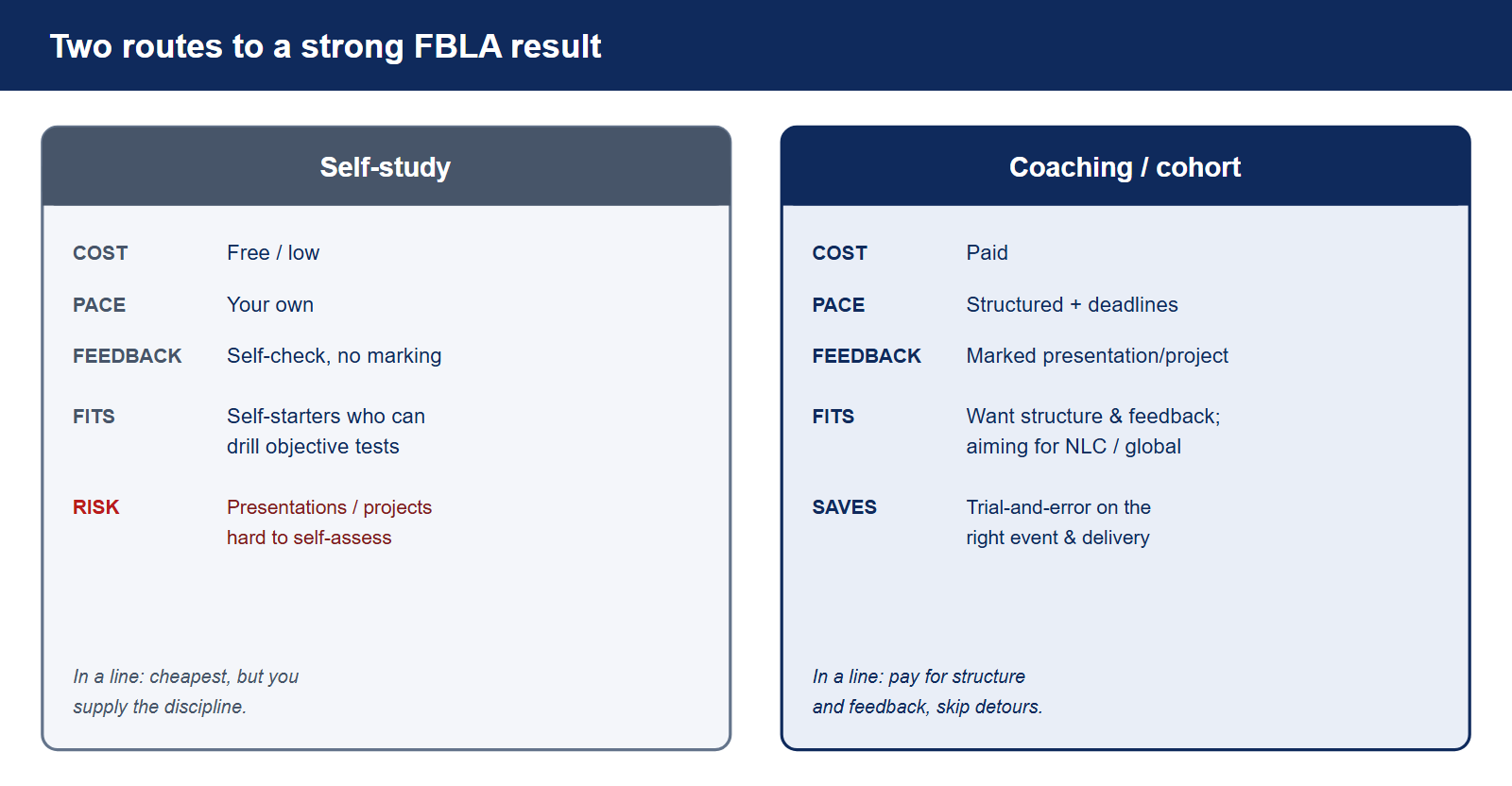
Self-study vs coaching: how to choose
An honest test, by event type: if your event is an objective test (Accounting, Economics, Business Law…) and you can drill content and self-mark, self-study is genuinely viable. If your event is a presentation, role-play or project — where the gap between “good idea” and “well delivered” is wide and hard to judge alone — feedback is what moves the needle. Students chasing the National Leadership Conference (NLC) or the global round usually lose ground on delivery and structure, not knowledge — the hardest things to fix without an outside eye.
The four-phase roadmap below works for both routes: self-studiers follow it; coached students use it to check a program covers each phase.
A four-phase roadmap (~16 weeks)
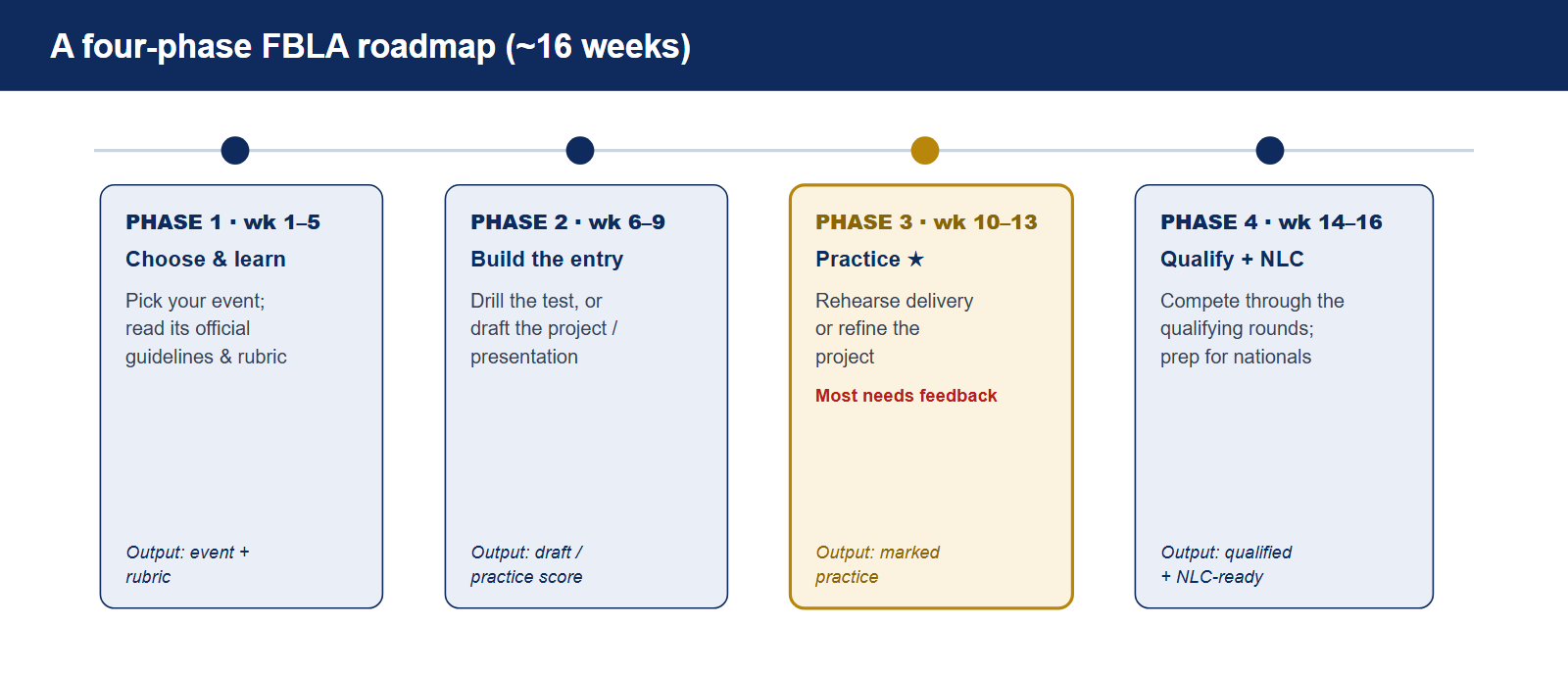
Phase 1 (Choose & learn) is decisive: read the official guidelines and scoring rubric for your exact event before preparing anything. Phase 2 (Build) drills content for tests, or drafts the project/presentation. Phase 3 (Practice) is the divider — rehearsing delivery or refining a project against the rubric. Phase 4 (Qualify + NLC) turns preparation into a competition run from the qualifying rounds toward nationals.
How to pick your FBLA event (by goal)
| If you are… | Lean toward… | Why |
| A strong test-taker, limited time | Objective test (Economics / Accounting) | Self-studiable, rewards content mastery, clean result |
| Confident speaking, want a standout entry | Presentation / role-play (Sales / Public Speaking) | Showcases communication — memorable, but needs rehearsal & feedback |
| A builder with a real idea or venture | Project (Business Plan / Financial Plan) | Deepest portfolio piece; strong “founder” narrative for applications |
For international students, objective-test events travel best for self-study; presentation and project events reward the rehearsal and review that are hard to arrange alone.
What good FBLA prep looks like (a checklist you can use either way)
| ✅ 1 · Event-specific | Does it prepare you for your event and rubric, not generic “FBLA tips”? |
| ✅ 2 · Real feedback | Is your presentation or project actually rehearsed, reviewed and marked — the thing self-study can’t give you? |
| ✅ 3 · Qualification path clear | Does it walk the membership → competitive events → NLC → global path and season timeline? |
| ✅ 4 · Transparent results | Are results specific by year, event and placement — not a vague “many winners”? |
| ✅ 5 · No guarantees | Honest coaching never promises a placement — results depend on the student; it promises process. |
About our cohort (disclosure + real results)
To be transparent: this site is the FBLA China editorial desk, and we run an FBLA preparation cohort — so this section is a disclosure of commercial interest. We coach because we have verifiable, real FBLA results (Hanlin internal data, anonymised):
2023–24 FBLA China — our teams placed #1 nationally in Marketing, and 3 students won national gold and advanced to the global NLC.
Other seasons — national Top-2 in Business Ethics and Sports & Entertainment Management, and a global runner-up in Business Financial Plan — the first Chinese students to reach that event’s global top 3.
These are actual FBLA outcomes — not numbers borrowed from another competition. We publish them so you can run checklist items 4 and 5 against us. Our cohort turns the four-phase roadmap into a structured program, with the most effort on the step self-study can’t replicate: Phase 3 marked presentation and project feedback.
The mistakes that cost international students
When strong students underperform at FBLA, it is rarely the knowledge — it is one of four avoidable habits. Choosing the wrong event: a great test-taker forced into a role-play, or a builder stuck on an objective test, wastes months on the wrong skill. Ignoring the rubric: presentation and project events are scored against published criteria — prepare to the rubric, not to a vague idea of “good”. Under-rehearsing delivery: the gap between a solid idea and a confident, timed delivery decides close calls and can’t be faked. Misjudging qualification: students who treat the qualifying rounds casually lose the NLC spot their work deserved. Fixing these four is usually worth more than another business textbook.
Is an FBLA result worth it for applications?
For students applying to business, economics or entrepreneurship programs, yes — as evidence of applied business skill and leadership, not as a trophy. An FBLA placement, especially at the NLC or global level, signals that you can do real business work and perform under competition conditions — and the event you choose shapes the story (a project reads as a builder, a presentation as a communicator, a test as analytical depth). It does not guarantee admission, and you should treat it as one credible signal among many. The work itself — a finished business plan, a polished pitch — is often the part that genuinely strengthens an application, whether or not you place.
Frequently asked questions
Do I need coaching to do well at FBLA?
Not always. For objective-test events, a disciplined self-studier can do very well alone. Coaching matters most for presentation, role-play and project events, where feedback on delivery and structure — not knowledge — decides results.
Which FBLA events are easiest to self-study?
Objective-test events such as Economics, Accounting or Business Law, if you can drill content and self-mark. Presentation, role-play and project events are much harder to prepare for without outside review.
How do international students take part?
Through FBLA China / SKT-iFBLA and the competitive-events path: become a member, compete in qualifying rounds, then advance toward the NLC and global round. Confirm the current season timeline on the official channels.
Are your FBLA results real and how can I check?
Yes — actual FBLA outcomes from our cohort (Hanlin internal data, anonymised), specific by year, event and placement, such as the 2023–24 national #1 in Marketing and a global runner-up in Business Financial Plan. We do not relabel results from other competitions as FBLA results.
Can coaching guarantee a placement?
No. Any “guaranteed placement” claim is a red flag. Results depend on the student’s own effort; honest coaching only commits to the process — event-specific prep, marked feedback and a clear qualification timeline.
This site is the FBLA China editorial desk, operated by Hanlin Education. This article describes our own preparation cohort, so it is a disclosure of commercial interest. The results cited are real FBLA outcomes from our cohort (Hanlin internal data, anonymised) — actual FBLA results, not borrowed from other competitions. Confirm current events, dates and the season timeline on the official FBLA and FBLA China channels; confirmed errors are corrected within 7 working days.