Securing school approval is often the hardest hurdle when you decide to start an fbla chapter. Many new chapters, however, stall immediately after that milestone. They have permission to exist, a handful of interested students, and perhaps a willing teacher, but no operating rhythm. Established chapters have years of institutional memory: old practice files, alumni advice, adviser experience, and a known calendar. A new chapter has none of that. This guide focuses on the post-approval phase. It is independent editorial advice, not official FBLA guidance. It explains how to choose a realistic founding event mix, set a first-semester practice cadence that survives school assessments, document early evidence, and use simple adviser checkpoints without pretending that one teacher must master every event.
After Approval: The First-Year Trap of Copying an Established Chapter
The most common first-year mistake is trying to copy a mature chapter’s full portfolio. A school with ten years of FBLA history may enter many events because it has experienced advisers, returning competitors, parent volunteers, and a deep archive of past materials. A new chapter usually has none of these advantages. If the founding team tries to prepare for too many categories at once, practice sessions become shallow, students miss deadlines, and the adviser burns out.
Treat the first year as a pilot program. The goal is not to win national titles. The goal is to build a workflow that can survive after the founding students graduate. That means narrowing scope deliberately. Choose a small number of event formats, define who is responsible for each, and create a practice calendar that fits your school’s real academic pressure points. A chapter that runs three events well is stronger than one that attempts ten and finishes none.
Choosing a Founding Event Mix
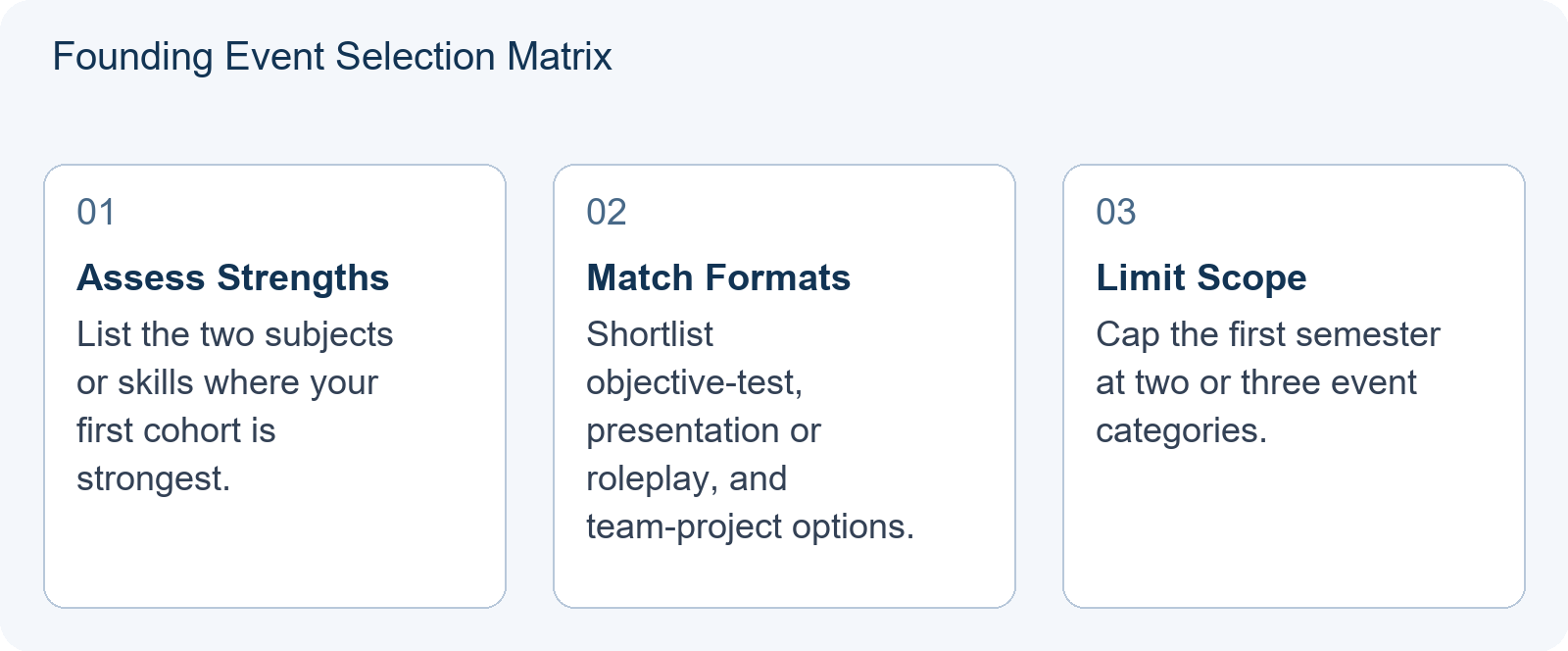
When planning the first semester, group candidate events by preparation format rather than by prestige. In practical terms, most business-competition preparation falls into three broad formats: objective-test style work, presentation or roleplay style work, and team-based project work. These labels describe how students practice, not an official event taxonomy.
- Objective-test style work: This suits students who already have strong content knowledge from business, economics, accounting, or similar courses. Practice can be organised around short weekly drills, vocabulary review, and timed diagnostics. It is easier to run without specialised equipment or live judges.
- Presentation or roleplay style work: This builds confidence, structure, and quick thinking. It requires feedback loops, so a new chapter should limit these events in the first semester. One or two is usually enough unless the adviser has significant presentation-coaching capacity.
- Team-based project work: This can bond the founding cohort, but it fails when roles are vague. Do not create a five-person team if only four students consistently attend. Assign a project lead, a research lead, a documentation lead, and a presentation lead from the start.
A workable teaching illustration is a first-semester mix of two objective-test style categories and one presentation or roleplay category. This spreads risk. If one area proves too difficult, the others still give members a meaningful competition experience. The exact mix should depend on student strengths, adviser bandwidth, and access to practice materials. Do not choose an event only because it sounds impressive.
Building a First-Semester Practice Calendar Around School Assessments
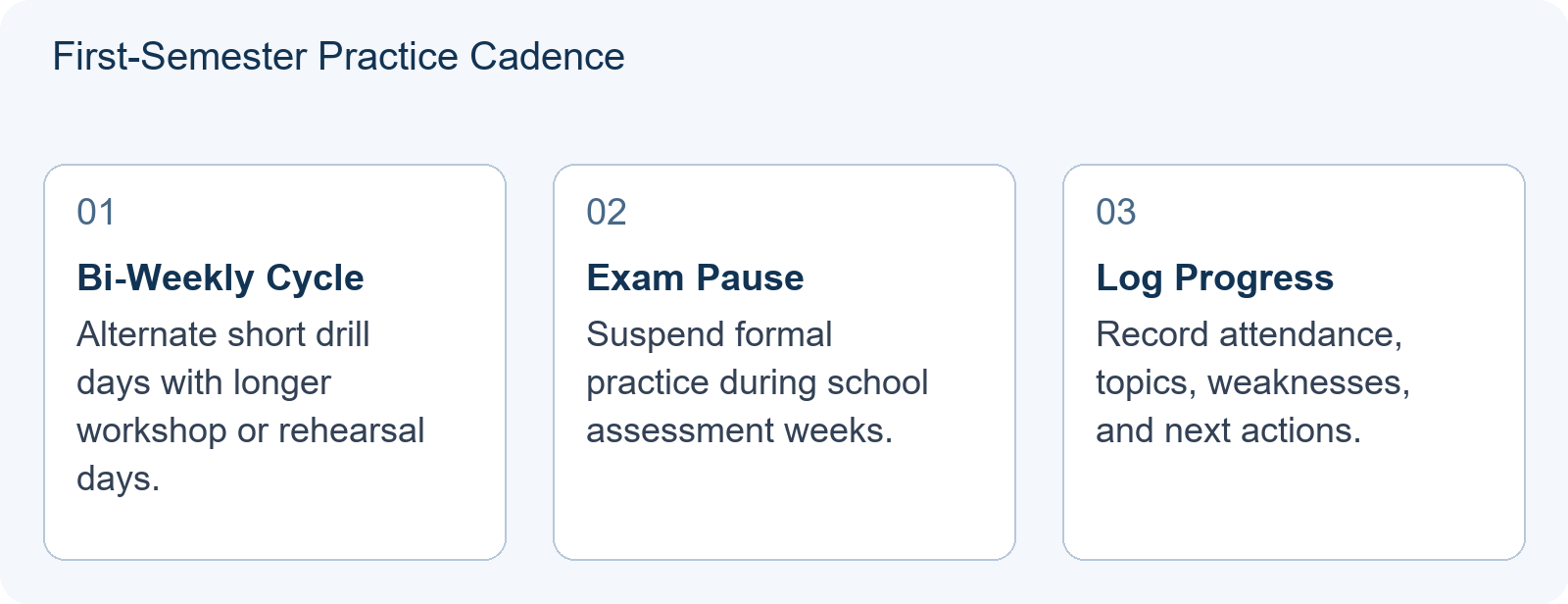
Academic pressure is the main enemy of consistency. In many international schools, the first semester includes midterms, internal assessments, project deadlines, and university application work. A rigid daily practice schedule will collapse. A better approach is a modular, bi-weekly cadence that can shrink or expand without breaking the chapter.
A teaching illustration, not an official requirement, is to use one short lunch session for objective-test drills and one longer after-school session for presentation rehearsal or project review. The short session might last 15 minutes and cover ten recall questions. The longer session might last 45 minutes and include a timed rehearsal, peer feedback, and a written action list. Alternate the focus so neither format dominates.
Pause formal practice during school assessment weeks. Announce the pause in advance. This reduces guilt and prevents students from quietly dropping out because they cannot attend every meeting. After exams, hold a reset session. Do not jump straight into new content. Review what was missed, adjust the plan, and confirm who is still committed.
Where possible, connect practice to coursework. If a student is studying marketing, finance, or business strategy in class, ask them to prepare a short explanation for the chapter using the same concepts. This dual-use strategy lowers the perceived cost of participation and reinforces academic learning.
Creating Early Wins That Attract Members Without Overpromising Results
A new chapter cannot point to trophies, rankings, or alumni placements. It must create visible early wins that show value. These wins do not have to be competition victories. They can be a well-run mock interview session, a completed case analysis, a polished presentation rehearsal, or a clear explanation of a business concept that members previously found confusing.
Document these activities. A simple chapter newsletter or social media post can highlight what students learned, not just what they attended. For example: ‘Our founding members analysed three local business scenarios and identified the key assumptions behind each recommendation.’ This tells prospective members that the chapter offers intellectual rigor and practical skill development.
Invite parents or teachers to observe a final rehearsal. Seeing students speak confidently about business ideas builds community support. It also gives the chapter an early audience that does not depend on official competition results. Avoid promising that participation will guarantee awards, university admission, or any specific outcome.
Documentation Habits: Evidence Folders, Practice Logs and Role Records
Without documentation, a new chapter loses its memory when founding students leave. Set up a shared drive with a small number of standard folders. A simple structure can include Rules and Guidelines, Practice Logs, Member Profiles, and Competition Prep. The exact names do not matter, but the habit does.
Keep a practice log for each event format. Record the date, topic, attendance, what was practised, the weakness observed, and the next action. This log helps the adviser plan the next session based on real gaps. It also gives school administrators evidence of consistent effort if they ask how the chapter is using its time.
For individual members, keep a portfolio of drafts, feedback notes, and final outputs. This record helps students explain their growth later, whether in a chapter officer interview or a broader academic reflection. It also makes it easier to hand over event knowledge to the next year’s team.
Working With an Adviser Who Does Not Know Every Event
It is unreasonable to expect one teacher to be an expert in every competitive event. The adviser may be a mathematics teacher who has never judged a roleplay, or an English teacher who is unfamiliar with financial statements. Acknowledge this openly. Do not pretend the adviser must teach all technical content.
Shift the adviser’s role from content expert to process manager. The adviser organises the schedule, enforces deadlines, facilitates peer review, and asks probing questions. Students take responsibility for learning the technical material from official guidelines and reliable practice resources. The adviser then evaluates the quality of the output against the relevant rubric or task description, even if they are not a subject specialist.
This model makes the workload manageable and gives students more ownership. If a specific event requires deep expertise, invite a guest speaker, connect with another chapter, or arrange a joint workshop. For structural questions about what a school needs to sponsor a chapter, the existing guide on FBLA Adviser Requirements: What Your School Needs to Sponsor a Chapter and Why It Matters for China Students covers the topic in more detail.
A 12-Week First-Semester Plan for a New Chapter
The following 12-week outline is a teaching illustration, not an official mandate. It assumes a new chapter focusing on a small event mix and no major school exams during the core preparation weeks. Adjust it to your own academic calendar.
- Weeks 1-3, Foundation: Confirm officer roles, review event guidelines, run baseline diagnostics, set up the shared drive, and agree on meeting norms.
- Weeks 4-8, Core Preparation: Run weekly topic modules for objective-test style work and a draft-and-revise cycle for presentation or project work. Hold a mid-term check-in to remove weak commitments and rebalance roles.
- Weeks 9-11, Simulation: Use timed mock tests, full-length rehearsals, peer judges, and structured feedback. Practise recovering from mistakes rather than restarting from the beginning.
- Week 12, Review and Planning: Analyse the practice logs, record what worked, plan the next semester, and recruit new members for the following term.
The emphasis is steady, incremental progress. A chapter that logs its weaknesses and adjusts its plan is learning faster than one that only measures whether students felt busy.
Course-Fit and Resource Preparation
Before launching, check whether your school’s curriculum and facilities support the events you have chosen. If you select finance-related preparation, confirm that students can access suitable textbooks or practice materials. If you choose technology-heavy work, confirm computer lab availability. For presentation events, find quiet rooms and simple timers. For objective-test practice, confirm calculators or other permitted materials.
Prepare a short resource list and share it with families early. Transparency about what students need prevents friction later. For team cohesion, see How to Run an FBLA Team That Does Not Fall Apart: Roles, Cadence and the One-Voice Problem (2026-27). For recognition options that do not depend on travel, review The FBLA Award You Can Earn Without Boarding a Plane: Business Achievement Awards (BAA), Explained for China Students.
If your chapter wants a structured launch plan, Hanlin’s Full Competition Roadmap offers a free consultation. It is an independent educational service, not an official FBLA programme, and it should be treated as planning support rather than a promise of competition results.
Frequently Asked Questions
Can we start with just one event?
Yes. Starting with one event category is a valid way to minimise risk and build depth before expanding. The first year should prove that your chapter can run a reliable practice cycle, not that it can enter every possible event.
What if our adviser cannot teach the content?
The adviser should focus on managing schedules, enforcing deadlines, and facilitating peer review. Students can use official guidelines and reliable resources for content mastery, while the adviser evaluates the quality of the final output against the task or rubric.
How do we recruit members without past wins?
Highlight skill development and tangible outputs such as completed case analyses, mock interviews, or presentation rehearsals. Show what students learned and produced, rather than promising competition results or awards.