When an FBLA case study asks you to recommend a strategy, the first number that pops into your head often feels right because it is convenient, not because it is proven. The skill that separates strong responses from average ones is the ability to pause and ask: What exactly supports this assumption, and what would make it collapse?
This article works through two original teaching illustrations—one where an assumption holds and one where it fails—so you can practice the diagnostic habit before you ever open a scoring rubric. These are classroom-style hypotheticals, not official past-paper questions or claimed marking criteria.
§01 — The Trap: Confusing Familiarity With Evidence
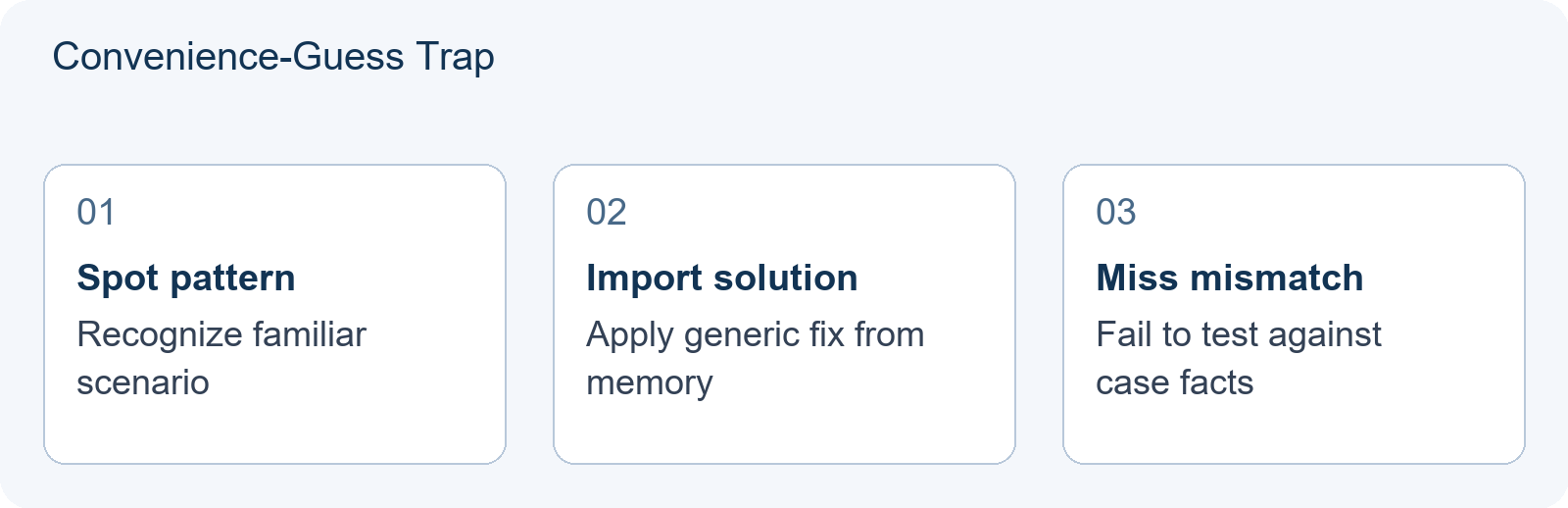
Case-study prompts usually bury a few numbers inside a short business narrative. A student might read that a fictional café chain “opened 12 new locations last year, up from 4 the year before,” and immediately assume rapid expansion is the company’s priority. That assumption feels safe because growth is a common business goal. But feeling safe is not the same as being correct.
The real task is to decide whether the evidence in the case supports the assumption, or whether the assumption is merely a comfortable pattern your brain supplied. This distinction—evidence versus convenience—shows up in nearly every competitive event that uses case-study formats, including the portfolio of FBLA competitive events where students analyze business scenarios and present recommendations.
§02 — Worked Hypothetical A: When the Assumption Holds
Scenario sketch: A regional bookstore chain’s case notes mention declining foot traffic, a 15% year-over-year drop in physical sales, and a new competitor offering same-day delivery. The prompt asks for a customer-retention strategy.
Assumption tested: “The core problem is delivery speed, so we should invest in a local distribution network.”
Evidence check:
- The case explicitly cites same-day delivery as the competitor’s main draw.
- The 15% sales drop correlates with the competitor’s launch quarter.
- No other factor (pricing, assortment, staff changes) is mentioned as a concurrent change.
Verdict: The assumption is grounded. The case provides a direct link between the competitor’s speed advantage and the sales decline. A recommendation to build local distribution would be evidence-based, not guessed.
Teaching suggestion: In your own practice, underline every cause-and-effect phrase in the case. If your assumption maps cleanly onto those phrases, you have a defensible starting point. This discipline becomes especially important when preparing for presentation events where judges can question your reasoning directly.
§03 — Worked Hypothetical B: When the First Assumption Fails
Scenario sketch: A family-owned restaurant group’s case notes show rising ingredient costs, a stable customer count, and a recent 8% price increase. The prompt asks how to protect profit margins.
Initial (convenient) assumption: “Raise prices again, since the last increase did not hurt customer counts.”
Evidence check:
- The case states customer counts are stable, not growing—there is no evidence of price tolerance, only of price indifference at current levels.
- Rising ingredient costs are described as “industry-wide due to supply-chain disruptions,” meaning competitors face the same pressure.
- The restaurant’s brand positioning is described as “neighborhood gathering place,” which implies price sensitivity may be nonlinear—another increase could tip perception.
Verdict: The assumption is convenient but unsupported. The evidence does not show that customers accept higher prices; it only shows they have not yet left. The supply-chain context also suggests cost-side solutions (portion adjustments, supplier renegotiation) may be more defensible than another price hike.
Teaching suggestion: When you catch yourself thinking “this worked before, so it will work again,” list the specific evidence that links past success to the current context. If the link is missing, your assumption is a shortcut. For students working on delivery skills, this same discipline applies to how you structure answers under time pressure.
§04 — Diagnostic Table: Evidence vs. Convenience
| Question to ask yourself | Evidence-based signal | Convenience-guess signal |
|---|---|---|
| Does the case mention this factor explicitly? | Yes, with numbers or direct quotes | No; you supplied it from general knowledge |
| Is the causal link stated or inferred? | Stated (“X led to Y”) | Inferred (“probably X caused Y”) |
| Would the opposite assumption also fit? | No; the case rules it out | Yes; the case is silent |
| Does the assumption rely on outside knowledge? | No; it uses only case data | Yes; you imported a real-world example |
Use this table as a quick self-check during practice, not as an official scoring tool. Many students find that applying this filter consistently improves their performance in judged events where reasoning quality affects scores.
§05 — A Targeted Practice Sequence
If you want to build this skill deliberately, try this three-step sequence with any case-study prompt:
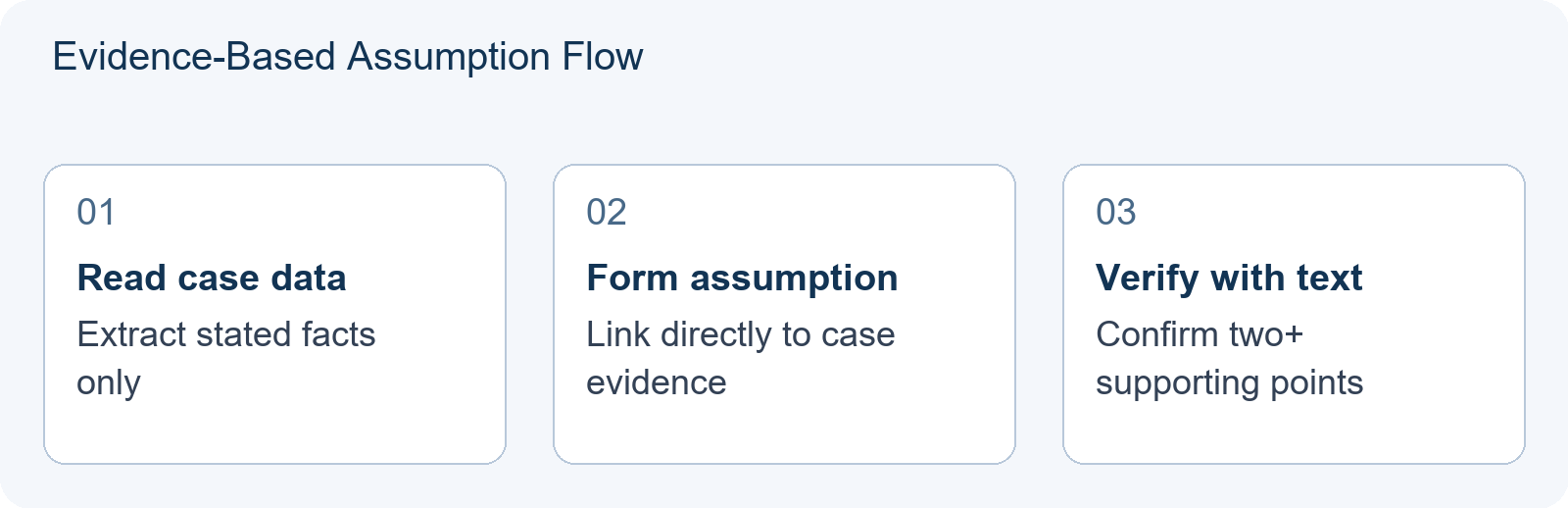
- Isolate the assumption: Write your first recommendation in one sentence, then underline the noun phrase that carries the most weight (e.g., “invest in social media marketing”).
- Audit the evidence: Go back through the case and highlight every sentence that directly supports that noun phrase. If you highlight fewer than two sentences, your assumption is likely convenience-based.
- Stress-test the opposite: Argue against your own recommendation using only case evidence. If the case cannot support the opposite either, you may need more data—or a different angle entirely.
For related preparation guidance, see our article on FBLA Presentation Coaching: Choosing Feedback on Delivery, Slides and Questions, which covers how to receive and apply critique on your reasoning structure. For historical context on the organization you are competing within, see Who Founded FBLA? The 1937 Idea, 1942 First Chapter, and a Source-Checked Timeline. If you are researching what your school needs to sponsor a chapter, the FBLA Adviser Requirements: What Your School Needs to Sponsor a Chapter and Why It Matters for China Students page covers sponsorship logistics.
§06 — What to Demonstrate Next
After working through these hypotheticals, you should be able to:
- State your core assumption in a single sentence before writing any recommendation.
- Cite at least two pieces of case evidence that either support or undermine that assumption.
- Recognize when you have imported outside knowledge that the case does not confirm.
This is not about eliminating intuition—it is about making intuition accountable to the text in front of you. In timed competition, that accountability is what turns a plausible guess into a persuasive response. The students who consistently perform well in business case competitions tend to share this habit of explicit assumption-checking, even when working under pressure.
Frequently Asked Questions
Can I use outside business knowledge in my case-study response?
Outside knowledge can help you generate ideas, but your scored argument must rest on evidence supplied in the case. If the case does not mention a factor, treat it as unknown rather than assumed.
What if I cannot find two pieces of supporting evidence?
Then your assumption is likely too strong for the case data. Either narrow the recommendation to what the case does support, or explicitly flag the uncertainty and propose how to gather more information.
Does this apply to team events as well as individual ones?
Yes. In team events, the same discipline applies to each section of your response. Dividing labor by assumption-auditing—one member checks evidence, another stress-tests the opposite—often strengthens the final submission.