Your school syllabus does not pick your FBLA event for you, but it does decide which events are cheap to prepare and which ones cost you a whole term. Roughly speaking, subject content transfers well, test-taking habits transfer partly, and US business context does not transfer at all. This page turns that into a table you can score yourself against before the 2026-27 event list posts.
Why coursework is a better first filter than interest
Every August, students in Shanghai, Shenzhen and Beijing open the FBLA events list and pick the event with the most exciting name. Six weeks later they discover the event tests a body of knowledge their school has never taught, and the prep bill is several times what they budgeted.
Interest is a fine second filter. Coursework is a better first one, because it is the only variable you already control. You are going to sit IB Business Management or AP Microeconomics or A-Level Computer Science this year regardless of what FBLA does. Any event that reuses that work is effectively subsidised by your timetable.
The timing helps you here. FBLA has published its updated competitive events guidelines and topics around the start of September each year, and the events list plus a summary of that cycle’s changes have appeared earlier in the year, ahead of the guidelines. Confirm the current posting dates on fbla.org. That makes late August exactly the right moment to run the mapping exercise below on last season’s list, then re-check your shortlist against the 2026-27 names the week the guidelines drop.
One caution before the table: FBLA rewrites part of the programme annually. In the 2025-26 cycle, for example, Technology Support & Services appeared as an individual role-play-plus-objective-test event, previously named Help Desk; Retail Management arrived as a new objective test; and Supply Chain Management was modified from an objective test into a team presentation event with a topic. Map to the family of skills rather than to a specific event name and you will not have to start over when a name changes.
The syllabus-to-event map
FBLA organises high school events into career clusters — Agriculture; Arts, Entertainment & Design; Career Ready Practice; Digital Technology; Education; Financial Services; Management & Entrepreneurship; Marketing & Sales; Hospitality, Events & Tourism and others — and groups them by format — objective tests, presentation events, role play events, production events and chapter events — with a prejudged report or project attached to a number of them. Confirm the current cluster and format list on fbla.org, and read our guide to the competitive events programme for how the clusters are structured.
| Your 2026-27 course | Cluster to look in first | What genuinely transfers | What your syllabus will not have taught you | Prep-cost signal |
|---|---|---|---|---|
| IB Business Management | Management & Entrepreneurship; Marketing & Sales | Frameworks (marketing mix, organisational structure, stakeholder analysis), case-reading discipline, written structure | US business law and terminology; the speed of a fast multiple-choice paper; American company examples judges treat as common knowledge | Low |
| IB Economics / A-Level Economics | Management & Entrepreneurship; Financial Services | Micro and macro models, diagram reasoning, elasticity and market-structure logic | US institutional detail; day-to-day operations vocabulary such as payroll, inventory and credit terms | Low to medium |
| AP Microeconomics / Macroeconomics | Management & Entrepreneurship; Financial Services | Content overlap, plus something rarer: you are already trained at American multiple-choice pace | Business functions beyond economics — accounting mechanics, marketing execution, human resources | Low |
| AP Computer Science A or Principles | Digital Technology | Algorithmic fluency, Java or Python comfort, debugging under time pressure | Networking and hardware vocabulary; IT-support scenarios; certification-style terminology | Low for coding events, high for infrastructure events |
| IB Computer Science / IGCSE ICT | Digital Technology | Systems concepts, data representation, structured problem decomposition | US certification vocabulary; the specific tool versions some production events assume | Medium |
| AP Statistics / IB Math AI | Digital Technology (data events); Financial Services | Reading distributions, describing uncertainty honestly, spotting a misleading chart | Business framing — turning a finding into a decision a judge can act on | Medium |
| IGCSE Business Studies / BTEC Business | Management & Entrepreneurship; Marketing & Sales | Operations vocabulary, break-even and cash-flow basics, business plan structure | Advanced finance and accounting; the depth expected once you are past the entry rounds | Low at entry level |
| Accounting coursework (uncommon in international schools) | Financial Services | Double-entry mechanics and statement preparation — the rarest transferable asset on this list | US-flavoured terminology and reporting conventions | Low, and unusually high leverage |
| English Lang & Lit, TOK, Extended Essay | Any prejudged report or presentation event | Structured argument, evidence handling, citation habits, editing to a hard limit | Business framing; the fact that judges reward decisions, not literary nuance | Low for the writing, medium for the content |
| School debate, MUN, drama | Presentation and role play events | Composure, unscripted Q&A, projecting to a room in a second language | Business decision frameworks; the discipline of a fixed time limit and a rating sheet | Low for delivery, medium for substance |
The three layers of transfer, and which one always fails
It helps to stop thinking about transfer as a single percentage and start thinking about three separate layers, because they behave very differently.
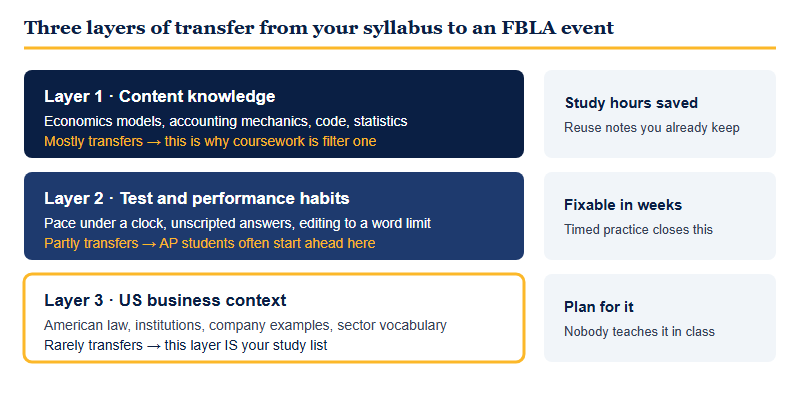
Layer 1 is the good news. If you have done a year of economics, an economics-adjacent objective test is largely a vocabulary exercise laid on top of knowledge you already own. You are not learning the subject; you are learning what it is called here.
Layer 2 is the quiet advantage. Fast American multiple-choice papers are a skill in themselves, not just a knowledge check. To make that concrete with a published example: FBLA’s Introduction to FBLA guideline for 2025-26 described a 50-minute test of 100 multiple-choice questions, one point per correct answer, with no deduction for wrong answers. That works out to about 30 seconds per item, and it means a blank answer is strictly worse than a guess. Students trained on IB or A-Level papers, where questions are fewer and longer, routinely under-practise this exact rhythm. Check the format, item count and scoring rule for your event on fbla.org, because they differ event to event and year to year.
Layer 3 is where the term actually goes. No international-school syllabus in China teaches US business terminology, American regulatory bodies, or the company examples an American judge treats as obvious. This is not a small gap, and it is not closed by being generally good at business. Budget for it explicitly, in hours, with sources. Our guide for international students competing in FBLA covers how that context gap shows up in judged rooms as well as on tests.
Score your transfer: a 10-point audit
Take your two or three candidate events. For each one, score every row 0, 1 or 2, then total out of 10. Do this on paper, honestly, before you commit a season to a choice.
| # | Check | 0 points | 1 point | 2 points |
|---|---|---|---|---|
| 1 | Subject overlap with a course you are taking this year | None | Partial | Direct |
| 2 | You can name three specific topics the event tests | No | One or two | Yes, taken from the guideline |
| 3 | You have read the current guideline for this event end to end | No | Skimmed it | Yes, and noted the format |
| 4 | Format fit: test, presentation, role play, production or prejudged | Actively dislike it | Neutral | Plays to a strength you can evidence |
| 5 | Your US-context gap is written down as a study list, not a worry | Not started | Rough idea | Listed, with sources |
| 6 | Timed practice under the real clock is scheduled in your week | No | Occasionally | Fixed weekly slot |
| 7 | The event survives exam season without colliding with mocks | Direct collision | Tight | Clear runway |
| 8 | If the event is renamed or modified next cycle, your prep still counts | Prep is name-specific | Mostly reusable | Fully skill-based |
| 9 | Any prejudged or written component fits your real writing capacity | Unknown | Ambitious | Realistic and drafted early |
| 10 | You would still choose this event if nobody ever saw the result | No | Maybe | Yes |
Reading the score: 8 to 10 means your timetable is subsidising your competition, and you should move. 6 to 7 is workable if you have written down the gap and put hours against it. 5 or below usually means, in our experience coaching China-based chapters, that the event was picked on its name. The fix is not to try harder; it is to run the map again with a different candidate.
One honest caveat about row 1. A high overlap score is a cost signal, not a result predictor. It tells you the season will be affordable, not that you will place. Plenty of students win events far from their coursework because they were willing to fund Layer 3 properly, and plenty of economics students underperform in economics events because they assumed Layer 1 was the whole job.
How to use this when the 2026-27 list changes
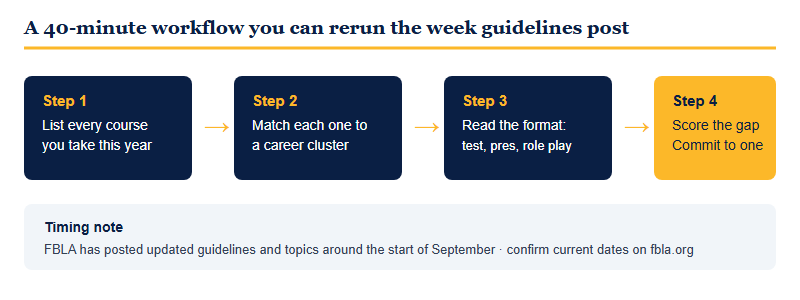
Two habits make the map durable. First, write your shortlist as skills, not names. "Fast business objective test with an economics core" survives a rename; "the event called X" does not. Second, read the annual changes summary before the full guidelines. FBLA publishes a document listing what was added, retired, renamed or modified each cycle, and it is the fastest way to see whether your plan just moved. If your event has become a team presentation with a set topic, that is a materially different season of work, and you want to know in September rather than February.
Then hold the map lightly. It tells you what a season will cost, not what it is worth. Once your event is chosen, the next question is how the season is actually structured from a chapter in China through to nationals — our walkthrough of how to qualify for the National Leadership Conference covers the available routes and what each one demands of you.
Questions students ask us in August
Do I need a business class to compete in FBLA?
Check with your adviser. FBLA’s published high school membership eligibility describes active members as students enrolled in a business or business-related course, so confirm the requirement for your chapter on fbla.org. Coursework also changes which events are cheapest for you to prepare.
Does IB Business Management prepare me for an FBLA objective test?
Partly. Frameworks transfer; US business terminology and the fast multiple-choice pace usually do not. Budget study time for both.
When does the 2026-27 event list come out?
FBLA has published updated guidelines and topics around the start of September. Confirm the current posting date on fbla.org.
Can I pick an event outside my subject strengths?
Yes, but the gap becomes your study plan. Map what the event tests against what your syllabus covers before you commit.
Published by the FBLA editorial desk, operated by Hanlin Education for China-based international-school students. Official rules are set by the competition and change yearly — confirm current details on fbla.org. Errors reported to this desk are corrected within 7 working days.