FBLA judges do not form an impression of you — they tick a grid. Each criterion is marked at one of four levels, the points go in a Points Earned column, penalties come off the bottom, and penalties come off the bottom. Once you know that shape, you can score your own entry before anyone else does. This page is that self-check.
What an FBLA rating sheet actually is
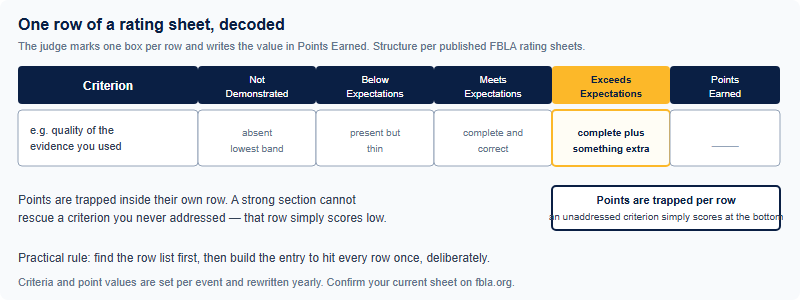
Published FBLA high school rating sheets open with an instruction to the judge, not to you: mark one score per row, write that score in the Points Earned column, and total the sheet. That single sentence tells you three useful things.
First, scoring is row-by-row, not holistic. A brilliant opening does not raise the score on an unrelated criterion. Points are trapped in their rows. Second, every row is worth something whether or not you address it — an ignored criterion is not neutral, it is a row scored at the bottom of the scale. Third, close finishes are normal, which means the difference between placing and not placing often comes down to one or two rows rather than an overall impression.
Above those rows the sheet is normally divided into two blocks. A content block carries the analysis: how well you handled the case or topic, whether you applied real business concepts, the quality of your research and evidence, and whether you demonstrated command of the subject. A delivery block carries the performance: organisation, poise and confidence, voice, and how you handled the judges’ questions. On published sheets, content has carried the larger share of the total and delivery the smaller one, with the whole performance structured around a 100-point scale before penalties — but the exact criteria and their point values are set per event and rewritten every year, so treat that as the shape rather than the number, and pull your own event’s current sheet from fbla.org.
Why “Meets Expectations” is the trap
Most prepared competitors sit at Meets Expectations across the sheet. They answered the question, the work is correct, nothing is missing. And they finish outside the placings, because a field of prepared competitors is a field of Meets Expectations scores, and the ranking is then decided by the handful of rows where somebody reached Exceeds.
The gap between those two bands is not effort — it is specificity. Meets is “you covered the criterion.” Exceeds is “you covered it and did something the judge did not have to ask for”: you named the assumption behind your number, you gave the counter-argument before the judge raised it, you cited where a figure came from, you tied a recommendation back to a constraint you identified earlier. Those are small, deliberate additions, and they are the entire competitive margin.
For China-based competitors there is a second, quieter version of this. Delivery rows reward organisation, poise and question handling — none of which is the same thing as accent or fluency. A student with heavily accented English who structures an answer clearly, holds eye contact and answers the actual question asked can score above a native speaker who rambles. Score yourself on structure and directness, not on how native you sound.
The self-check: score your own entry
Print this and score yourself honestly, one row at a time, using the same four bands the judges use. Score it twice — once by yourself and once by someone who has not seen your entry before. Any row where the two scores differ by more than one band is a row where you are overestimating clarity.
| Block | Ask yourself | Not Demonstrated (0) | Meets (2) | Exceeds (3) |
|---|---|---|---|---|
| Content | Have I stated the actual problem before proposing anything? | Jump straight to the solution | Problem stated clearly | Problem stated and scoped — what is in, what is out |
| Content | Does a named business concept drive my analysis? | General reasoning only | Concept named and applied | Concept applied, and its limits acknowledged |
| Content | Can a judge check every number I used? | Unsourced figures | Sources given | Sources given with dates and a stated assumption |
| Content | Have I addressed the obvious objection? | Not raised | Raised in Q&A | Raised and answered before the judge asks |
| Content | Does my recommendation follow from my own evidence? | Recommendation appears from nowhere | Logically connected | Explicitly traced back to a finding I presented |
| Delivery | Can a listener state my main point after 30 seconds? | No clear thesis | Thesis stated once | Thesis stated, signposted, and returned to at the close |
| Delivery | Do I finish inside the time limit? | Cut off or far short | Inside the limit | Inside, with a deliberate closing line |
| Delivery | Do I answer the question I was asked? | Answer a different question | Answer directly | Answer directly, then add one supporting fact and stop |
| Delivery | Am I audible and steady without reading? | Reading from notes | Mostly independent of notes | Fully independent, controlled pace, eye contact |
| Compliance | Have I re-read the guideline this week? | Not since September | Read once | Checked line by line against the finished entry |
The scoring bands above are a self-assessment device, not FBLA’s point values. Their purpose is to make you distinguish between “done” and “done plus.” If your total sits mostly in the Meets column, your entry is competent and unremarkable, which is exactly the position most competitors are in the week before a conference.
The penalty block: the cheapest points on the sheet
Below the criteria, published rating sheets carry deductions that are subtracted from the subtotal to reach the grand total. The published deduction on FBLA’s high school sheets is five points if you do not follow the Dress Code or are late to the testing site or your assigned presentation time. Violating the Code of Conduct or Honor Code can lead to disqualification rather than a point deduction. Confirm the deductions on your own event’s current sheet on fbla.org.
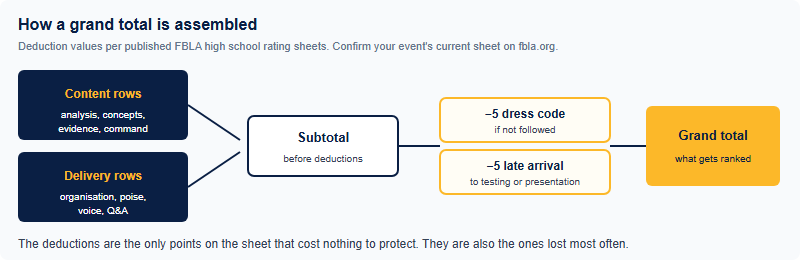
Think about what that means arithmetically. A competitor who turns up out of dress code, or arrives late to their assigned presentation time, loses points before a judge evaluates a single idea — and guideline breaches such as an over-length entry cost you against the criteria themselves. Two competitors separated by that margin will never know it was formatting rather than analysis that decided the placing.
So run a compliance pass that is entirely separate from your content work, and run it late. Sit with the current guideline, read one requirement at a time, and physically check the finished entry against it. Do not read for meaning — read for compliance. These are different activities and doing them together is why students miss things they have technically read five times.
Get your actual sheet: the August release nobody uses
Here is the part most students never act on. FBLA states that scores and rating sheets from the 2026 National Leadership Conference are available by 1 August. If you competed at nationals, your marked sheet exists — FBLA releases NLC scores and rating sheets to chapter and state leaders, so ask your adviser to pull yours and show you the judges’ actual marks.
That is the single highest-value hour available to you right now, in August, before the new season begins. Three things to do with it:
- Find your lowest row, not your lowest block. “I need better delivery” is not actionable. “I lost points on question handling” is.
- Check for any deduction. If points came off at the bottom, that is a process failure, and process failures are fully fixable before you touch content.
- Compare the row list to the new guideline in September. Criteria are rewritten annually, so a row that cost you points last year may not exist this year — and a new one may.
If you did not compete at nationals, ask your adviser whether rating sheets from your state or chapter level are available, and read the current published sheet for your event regardless. Pair it with the complete competitive events guide so you can see how the sheet differs between an objective test, a role play and a presentation event. If you are still working out which conference level you are aiming at this year, how qualification to nationals works sets out the route.
Frequently asked questions
Where do I find FBLA rating sheets?
They are published on fbla.org alongside the competitive event guidelines, which release at the beginning of September for 2026-27.
What are the standard deductions?
Published high school sheets show five points off if you do not follow the Dress Code or are late to the testing site or your assigned presentation time. Confirm your event’s current sheet on fbla.org.
Do judges score holistically?
No. They mark one score per row and record it in a Points Earned column, and total the sheet from those rows.
Can I see my own score from nationals?
FBLA states NLC scores and rating sheets are available by 1 August. Ask your adviser how to access yours.
Published by the FBLA editorial desk, operated by Hanlin Education for China-based international-school students. Official rules, event rosters, eligibility and rating sheets are set by the competition and change every year — confirm current details on fbla.org before acting on anything here. Errors are corrected within 7 working days of being reported.