FBLA’s high school competitive events poster groups its events into career clusters, and the largest technical one is Digital Technology, covering programming, cybersecurity, data, networking, IT support and web development. The exact 2026-27 roster ships with the season’s guidelines — confirm on fbla.org. If you write code, or want to, this is where you belong. The hard part is not learning to code — it is choosing the right one of the 14.
What is actually inside the Digital Technology cluster
Most students at a China international school first meet FBLA as a business organisation and quietly conclude that it is not for them because they intend to study computer science. That conclusion is wrong, and the 2026-27 event poster is the evidence. Alongside the finance, marketing and management clusters, FBLA publishes a Digital Technology grouping. The events below are those on the most recently published poster; confirm the current 2026-27 roster on fbla.org:
| Event (2026-27 Digital Technology cluster) | Subject territory the title signals | Does the title imply hands-on building? |
|---|---|---|
| Coding & Programming | Writing a standalone application against a defined problem | Yes |
| Computer Game & Simulation Programming | Game or simulation logic, interaction, rules | Yes |
| Computer Problem Solving | Operating systems, hardware, troubleshooting concepts | No — knowledge-led |
| Cybersecurity | Threats, defences, secure practice | No — knowledge-led |
| Data Analysis | Reading a dataset and drawing defensible conclusions | Partly — analysis plus communication |
| Data Science & AI | Modelling, machine-learning ideas, AI principles | No — knowledge-led |
| Introduction to Information Technology | Foundational IT vocabulary and concepts | No — entry level |
| Introduction to Programming | Programming fundamentals for newcomers | Entry level |
| Management Information Systems | How organisations run systems and information | No — knowledge-led |
| Mobile Application Development | Designing and building an app | Yes |
| Network Design | Network architecture and infrastructure decisions | Partly — applied |
| Networking Infrastructures | Deeper networking concepts and equipment | No — knowledge-led |
| Technology Support & Services | Helping users, service delivery, diagnosis | Partly — applied |
| Website Coding & Development | Building a working site with real functionality | Yes |
Read the right-hand column as an interpretation of the event titles, not as a statement of the rules. The organisation decides each event’s format, and that decision is published in the guidelines, not in the name. Adjacent clusters also carry work that CS-minded students enjoy — Website Design sits under Arts, Entertainment & Design, for example — so if you are surveying the whole roster rather than this cluster alone, start with our complete guide to the FBLA competitive events and come back here to narrow down.
The name tells you the subject. The codes tell you the work.
The single most useful skill in the first fortnight of an FBLA season is reading one row of the official events poster properly. Each row carries four separate pieces of information, and students routinely absorb one of them and ignore the other three.
The poster tags every event with short format codes. The poster prints a key to its format codes alongside the event grid, and that key is republished each season — read the current one on fbla.org rather than relying on a remembered list. An event may carry more than one code — that combination is the actual description of your year. It also states team size, which appears as a single participant or a small range, and eligible grades, which for some events is the full 9 to 12 and for others is restricted to the lower grades.
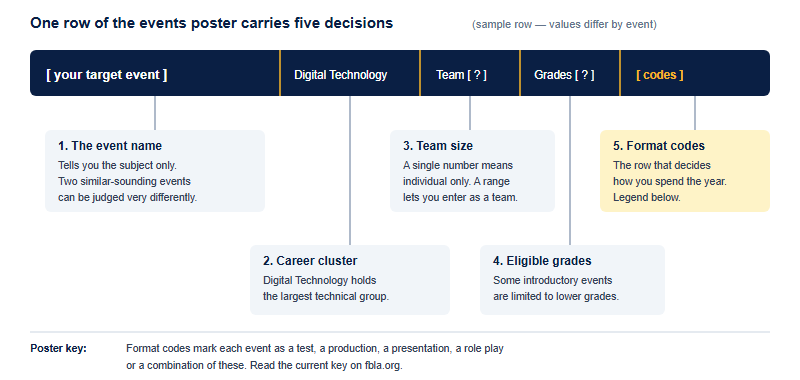
Why this matters so much in this particular cluster: the Digital Technology titles are unusually misleading if you read them casually. A student who sees “Cybersecurity” and imagines a capture-the-flag hacking exercise, or sees “Data Science & AI” and starts training models, may have prepared for a version of the event that does not exist. Equally, a student who assumes everything in the cluster is a written test may miss that some events ask for a genuinely built artefact submitted before the conference. Take the format from the codes and the guidelines, not from the vibe of the name.
Choosing inside the cluster: three honest entry points
Fourteen events is too many to compare fairly, so collapse them into the three questions that actually separate them.
- Can you already build and finish something? Not “have you done a coding course” — can you take a project from idea to a version that runs, on a deadline, without a teacher rescuing it? If yes, the build-and-submit titles are the strongest use of your ability, because finishing is rarer than coding.
- Do you have breadth rather than build stamina? Some students know a great deal about how systems, networks and security work but have never shipped a project. Knowledge-led events reward exactly that, and they reward it on a schedule you can control with study sessions rather than build sprints.
- Are you in grade 9 or 10 and starting from nothing? The roster contains introductory events for precisely this situation. Entering one is not a lesser choice; it is a correctly sized one, and it gets you a full competitive cycle of experience before the stakes rise. Check the eligible-grades column, because some introductory events are restricted to the lower grades and will close to you later.
One trap specific to strong students at Chinese international schools: choosing the hardest-sounding event as a statement of ability. Judges do not award difficulty points for event selection. A finished, well-explained project in a mid-difficulty event outperforms an abandoned ambitious one every time, and the competitive path from chapter level upward — which we set out in our guide to how to qualify for the National Leadership Conference — rewards consistency far more than bravado.
Preparation looks completely different across the three formats
Once you know your event’s codes, your calendar writes itself, because the three archetypes have almost nothing in common operationally.
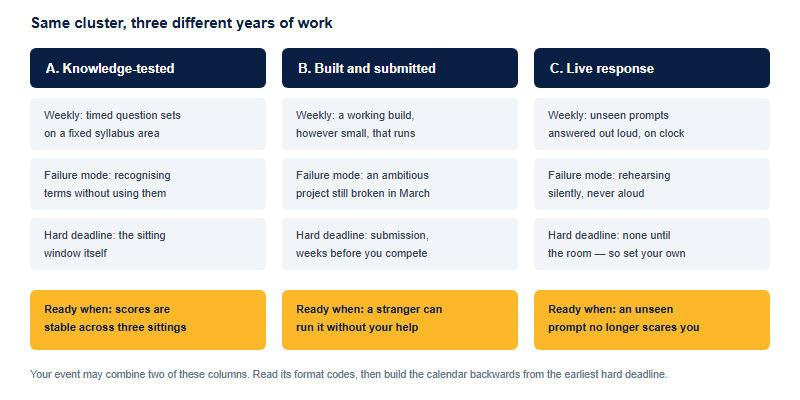
The practical consequence for build-type events is the one students underestimate: when an event requires an asset judged before the conference, your real deadline is the submission date, not the competition date. Every week you spend polishing after submission is wasted, and every week you assumed you had before it is fictional. Work backwards from that date and freeze the project early enough to test it on a machine that is not yours.
For knowledge-led events, the discipline is different and duller: repeated timed practice on the stated content areas, with a written log of what you got wrong and why. A student who can define a term but has never had to choose between two plausible answers under time pressure is not prepared, only informed.
Building the year around the September guidelines drop
FBLA states on its 2026-27 high school competitive events page that guidelines, including topics and rating sheets, will be available by September 1, 2026. That single sentence should shape your August. Two things follow from it.
First, anything you decide before that date is provisional. Event rosters, formats, eligibility and rating sheets are reviewed annually, and the 14 events above are the 2026-27 listing — treat any older list you find on a state site or a forum as historical. Second, and more usefully, the skills underneath a cluster do not change on September 1. Programming fluency, the habit of finishing a build, comfort reading an unfamiliar dataset, security and networking vocabulary — all of that is safe to develop now and will still be valuable whichever event you land on.
A workable August-to-September sequence looks like this:
- Now: shortlist three events in the cluster, not one, and write down why each is plausible for you.
- Now: build one small thing end to end, or run three timed practice sets, depending on which half of the cluster you are aiming at. You are testing your own appetite, not preparing content.
- From the guidelines release: read the rating sheet for all three shortlisted events before choosing. The rating sheet, not the description, tells you what earns points.
- After choosing: put every submission and qualifying date on one calendar, and confirm with your adviser how your chapter handles entry, since the route from chapter to state to national level and the deadlines attached to it are administered locally.
If your chapter is based outside the United States, verify your participation route before you invest a term in a specific event — the mechanics for international members are set out in our guide for international students, and they occasionally determine which events are practical for you regardless of which one you would prefer.
Frequently asked questions
Do I need to know how to code to enter a Digital Technology event?
No. Several events in the cluster are knowledge-led and test understanding of systems, security or data concepts rather than asking you to build anything.
How many Digital Technology events are there in 2026-27?
Digital Technology is the largest technical cluster on the poster. The exact count and roster are revised yearly — confirm the current list on fbla.org.
When are the 2026-27 guidelines and rating sheets published?
FBLA states they will be available by September 1, 2026. Read your target event’s rating sheet before committing your season.
Can I enter a Digital Technology event as a team?
It depends on the event. The poster marks each event as individual or as a small team range — check that column for your specific event.
Published by the FBLA editorial desk, operated by Hanlin Education for China-based international-school students. Official rules, event rosters, eligibility and rating sheets are set by the competition and change every year — confirm current details on fbla.org before acting on anything here. Errors are corrected within 7 working days of being reported.