Almost every FBLA event asks you to demonstrate something external — a business idea, a dataset, a case, a body of knowledge. The Career Ready Practice cluster on the 2026-27 high school list is different. Its events, among them Job Interview and the career portfolio event, take you as the subject — confirm the current cluster roster and the exact event names on fbla.org. Your evidence is your own record, and the hardest part is having collected it.
Two events, one underlying skill
On the high school events poster, Career Ready Practice is a small cluster built around Job Interview and a career portfolio event; the roster and event names are republished each season, so confirm them on fbla.org. Broadly, Job Interview asks you to prepare professional application materials and then perform in a live interview, while Career Portfolio asks you to assemble and present a compiled record of your own development. The precise document requirements, submission mechanics and interview structure are set in the annual guidelines, which FBLA states will be available by September 1, 2026 — read the rating sheet for whichever you choose before you write a word.
What makes this pair worth a serious look, particularly for students at international schools in China, is that the two events share one engine. Both run on evidence about you: what you did, when, with what result. Everything else — formatting a résumé, drafting a letter, answering an interview question under pressure — is downstream of whether that evidence exists in usable form. Students who lose here almost never lose on interview technique. They lose because in March they are trying to remember what they actually did in October.
A warning before going further, because it matters for how you use these events: preparing strong application materials is a genuinely useful skill that transfers to internship applications, summer programme forms and university supplements. It is not a shortcut to any admission outcome, and no competition result should be presented as one. Treat the transfer as skill and artefact, nothing more.
The evidence problem, and the pipeline that solves it
The standard objection from a fifteen-year-old is reasonable: I have never had a job. True, and irrelevant. What these events reward is not employment history but the ability to describe real work precisely. A student who ran the logistics for a 90-person school event has genuine operational evidence. The problem is that in most cases nobody wrote it down, so by the time it is needed it has decayed into “I helped organise an event.”
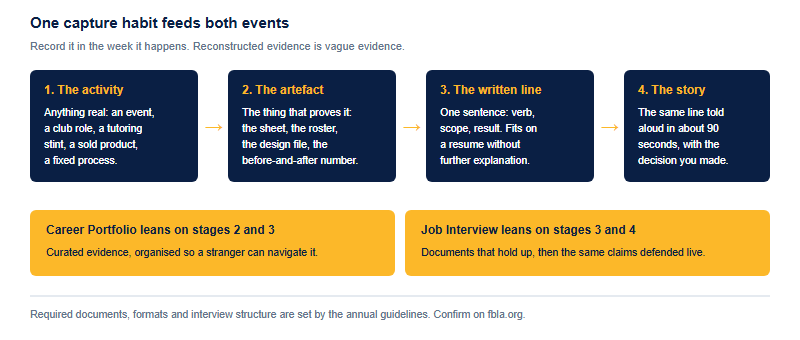
The fix is a capture habit, not a writing habit. In the week something happens, record four things: what the task was, what you specifically did, what changed as a result, and any artefact that survives — a spreadsheet, a poster, a message thread, a photograph, a set of numbers. Both events then draw from the same store.
Keep it in one file with five columns — date, activity, my role, what changed, where the artefact lives — and nothing else. The temptation is to build something elaborate; resist it, because a log that takes ten minutes a week survives a school year and a beautiful system does not. Two details are worth the discipline: write the date properly rather than “last term”, and save artefacts somewhere that will still exist after the school year ends, since files stored inside a graduating cohort’s shared drive have a way of disappearing exactly when you need them.
Turning school-scale work into lines a judge can score
The transformation students find hardest is stage three: converting a real experience into a line that survives contact with a reader who has no context. Three repairs do most of the work — name the scope, name your own action rather than the group’s, and end on something observable.
| What students usually write | What is missing | A version a judge can actually score |
|---|---|---|
| Helped organise the school charity event | Scope, your role, outcome | Coordinated vendor logistics for a 90-attendee charity fair, managing a six-person setup team and a two-week schedule |
| Member of the student business club | Any action at all | Ran the club’s weekly finance session for 12 members, building the term’s session plan and materials |
| Good at Excel | Evidence, application | Rebuilt the club’s membership tracker in a single sheet, cutting monthly reconciliation from about two hours to under thirty minutes |
| Tutored younger students | Duration, scale, result | Tutored four grade-8 students in mathematics weekly across one academic year, with all four moving up a set by June |
| Participated in FBLA competitions | Which, what you did | Prepared and delivered an individual presentation event through the chapter and regional stages, building the entry independently |
Two rules keep the right-hand column honest. First, every number must be one you can defend if asked where it came from — an estimate you can explain is fine, an invented figure is not, and an interviewer’s follow-up question is exactly where invented figures die. Second, “we” belongs in the story, but your line has to state what you did, because the judge is scoring one person.
Non-native English writers should also watch a specific habit: over-qualifying. “I tried to help improve the process a little” is polite in one register and unscoreable in another. Business English rewards flat, declarative, verb-first construction. This is a stylistic switch you can practise, not a language ability you either have or lack.
The room: budgeting an answer instead of filling silence
Live interview performance is where preparation shows most visibly, and the most common failure is structural rather than linguistic. Asked about a challenge, students spend most of their time explaining background, arrive at what they did with seconds left, and never state the outcome. The interviewer hears context and no evidence.
Budget the answer instead. Roughly ninety seconds is a comfortable target for a substantive question, and the proportions matter more than the total.
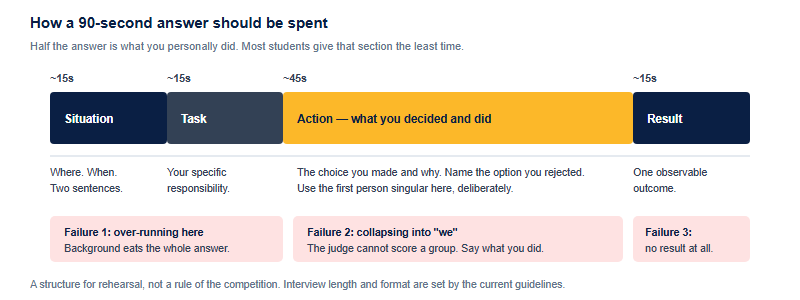
Practise this out loud, with a timer, against questions you have not seen. Silent rehearsal produces students who know what they would say and cannot say it. Ten recorded attempts at three different questions will do more for your score than another week of editing your documents.
There is also a category of question you can genuinely prepare, because it recurs in interview settings generally: why this field, describe a time you failed, describe a conflict, what would a teacher say about you, where do you want to be in five years. Prepare the evidence for each — not a memorised paragraph, which sounds recited, but a specific incident with a number attached.
Two moments carry more weight than their length suggests. The first thirty seconds set the register: walk in, greet the interviewer, sit when invited, and give a short self-introduction that names what you do rather than listing adjectives about yourself. The last thirty seconds are the part almost every student wastes. When asked whether you have any questions, “no, thank you” closes the conversation flat. One prepared, specific question — about the role, the organisation or what strong performance looks like in it — costs nothing and reads as genuine interest rather than compliance.
One further note for the portfolio side: curation is a scored skill in its own right. A collection of everything you have ever done is harder to assess than a smaller set chosen to show a direction, because the judge has to find the argument themselves. Decide what your portfolio claims about you, then include the items that support that claim and leave out the ones that merely fill space.
What to verify, and how this fits your season
Because these events are document-driven, the details that vary yearly are exactly the ones that can cost you points automatically. Before drafting anything, confirm the following in the current guidelines and rating sheet rather than assuming from last year or from a state chapter’s archive:
- Which documents are required, in what file format, and whether they are submitted in advance or brought to the room.
- Any length, layout or naming requirements — these are frequently scored, and they are the cheapest points on the sheet to lose.
- The interview structure itself, including how long it runs and whether anything is prepared in advance.
- Eligible grades and team size for the event, both of which are printed on the events poster.
- How your chapter handles entry and the deadlines above chapter level, which sit on the route described in our guide to qualifying for the National Leadership Conference.
For the season shape: FBLA states 2026-27 guidelines, topics and rating sheets will be available by September 1, 2026, so the sensible August work is capture, not drafting. Spend the pre-guidelines weeks writing down the last twelve months of activity in the four-part form described above, while you can still remember specifics. Then draft against the actual rating sheet when it lands.
If you are weighing this cluster against the rest of the roster, the honest comparison is in our guide to the FBLA competitive events; and if your chapter sits outside the United States, confirm your participation route first in our guide for international students, since that occasionally constrains which events are practical.
Frequently asked questions
Can I enter Job Interview with no work experience?
Yes. These events reward precise description of real work, including school, club, volunteer and self-directed projects — not employment history.
What is in the Career Ready Practice cluster for 2026-27?
A small cluster on the high school poster, built around Job Interview and a career portfolio event. Rosters and event names change yearly, so confirm on fbla.org.
Are the required documents the same every year?
No. Document requirements and formats are set in the annual guidelines, published by September 1, 2026 for this season. Never reuse an old year’s specification.
Does competing in Job Interview help with college applications?
It builds transferable materials and interview practice. No competition result guarantees any admissions outcome, and it should not be presented that way.
Published by the FBLA editorial desk, operated by Hanlin Education for China-based international-school students. Official rules, event rosters, eligibility and rating sheets are set by the competition and change every year — confirm current details on fbla.org before acting on anything here. Errors are corrected within 7 working days of being reported.