Adding a second business competition only helps if it produces evidence your FBLA season cannot already produce. Most students who stack three end up with three shallow records instead of one deep one. Run four tests before you sign up for anything: signal overlap, calendar collision, evidence yield, and who actually reads the result.
The real question is signal overlap, not prestige
Every autumn the same conversation happens in the same corridors of every international school in China. A student has one business competition going well and hears that a classmate is also doing two others. The instinct is to add. The instinct is usually wrong.
Think about what a competition actually deposits in your file. Strip away the branding and almost every business competition deposits one of five things:
- Tested subject knowledge — you sat an objective test in accounting, economics, business law or finance and scored.
- Built artefact — a business plan, a financial model, a report, a prototype, a campaign.
- Live performance — a presentation, a defence, a role play, an interview under time pressure.
- Sustained project — something you ran over months with other people, with an outcome outside the competition itself.
- Ranked outcome — a placing at a named tier that a stranger can situate.
FBLA is unusual because a single organisation covers most of those categories — 76+ events spanning objective tests, prejudged and produced work, presentations and role plays, and chapter projects. That is precisely why a second business competition so often adds nothing: if it deposits “tested subject knowledge” and you already have that from an FBLA objective-test event, you have bought a duplicate. Two similar signals do not read as twice as strong. They read as one signal, plus a scheduling problem.
Before deciding what to add, be honest about what your FBLA event already yields. If you have not yet chosen deliberately, do that first — the event families and what each one demands are laid out in our complete competitive events guide.
Four tests before you add anything
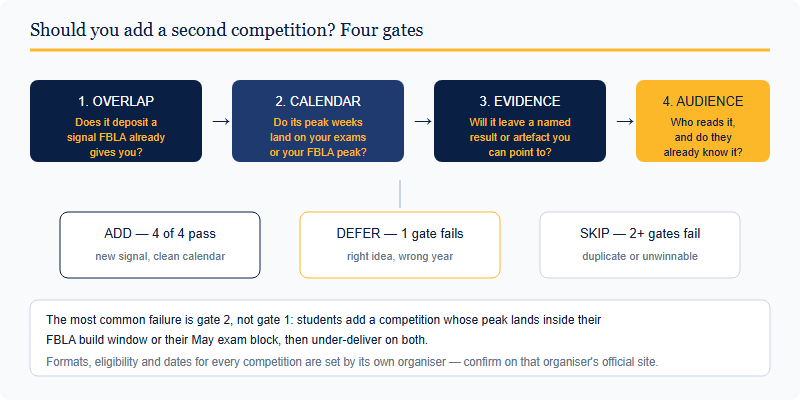
Gate one: signal overlap. Write down, in one line, what your FBLA event proves. Then write the same line for the candidate competition. If the two lines are near-identical, you are duplicating. A student already competing in an FBLA objective-test event gains very little from another multiple-choice business exam; the second score does not double the first.
Gate two: calendar collision. This is where students actually get hurt. Look at three calendars together — the FBLA season, the candidate competition’s season, and your school’s assessment calendar (IB internal deadlines, AP exams, A-Level mocks). Any two of those peaking in the same fortnight is a warning; all three is a guaranteed shortfall somewhere. Every organiser publishes its own dates and changes them yearly, so build this from the official sites rather than from a forum table.
Gate three: evidence yield. Some competitions leave you with a certificate and nothing else. Others leave a report, a model, a deck, a coded tool, a piece of research — an artefact you can keep improving and eventually talk about in an interview. A competition with low ranked-outcome probability but high artefact yield can still be worth doing. A competition with neither is decoration.
Gate four: audience. Ask who will read this line and whether it means anything to them. A regional competition that is well known inside one city and invisible outside it is not worthless — but be clear-eyed that its value is mostly the skill you gain, not the recognition you display.
What actually collides across a school year
The specific dates belong to each organiser and change annually, but the structural collisions repeat every year and you can plan around them now. FBLA’s own season shape is public — the 2026 National Leadership Conference was held in San Antonio in June 2026, and the new season builds toward the 2027 conference, whose host city and dates you should confirm on fbla.org rather than take from a third-party listing.
| Period | Typical FBLA load | Typical school load | Stacking verdict |
|---|---|---|---|
| Late summer | Guidelines reset, event choice, background reading | Light | Best window to add — spare capacity, low stakes if you drop it |
| Autumn term | Skill building, drafting, chapter setup | Coursework ramp, early-decision applications for Grade 12 | Add at most one, and only if it is artefact-based rather than deadline-dense |
| Winter | Practice rounds, early qualifying activity in many routes | Mocks, IB internal assessment deadlines | Do not start anything new here |
| Spring | Qualifying stages, rebuilding entries, rehearsal | AP/IB/A-Level exam block | Hard no — this is the classic three-way collision |
| Early summer | National conference for those who advance | Exams finished | Free capacity, but it is too late to start a second competition this cycle |
Three portfolio shapes, and what each one says
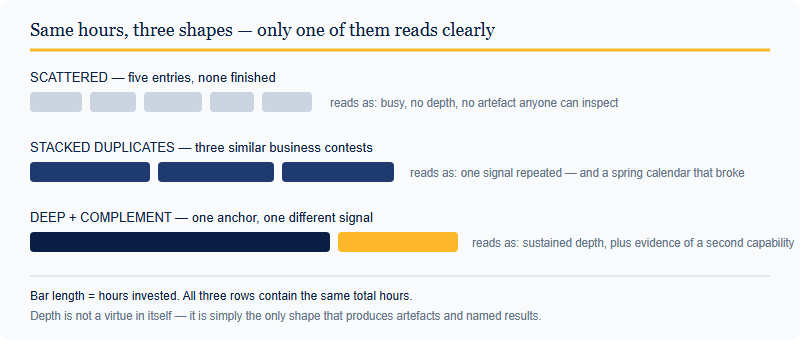
The complement that usually works is one that deposits a different kind of signal. If FBLA gives you tested business knowledge plus a live presentation, a genuine complement is something producing sustained independent work — original research, a piece of quantitative or coding work, an economics essay, or a real venture with real users. If FBLA gives you a built artefact and a team result, a complement might be an individual, examined signal that shows you can perform alone.
The stack that usually fails is three business competitions in the same academic year with overlapping seasons. Students in this pattern typically produce one decent entry and two abandoned ones, and abandoned entries cost more than they appear to: they consume the autumn, they crowd out the rehearsal weeks that actually determine placings, and they leave nothing to write about.
When FBLA should not be your anchor at all
This is a site about FBLA, so take this section seriously precisely because of that. FBLA is a strong anchor for students who want breadth across business disciplines, who benefit from a chapter structure with peers and an adviser, and who perform well in a mix of tested and presented formats. It is a poor anchor for some students, and pretending otherwise wastes their two most useful years.
- If your interest is narrowly one discipline and you want depth rather than range, a single-subject competition or a research project may serve you better.
- If your school has no chapter and no adviser willing to take it on, the logistics may consume more of your year than the competition returns — read our international-students guide before committing, since the chapter route determines almost everything downstream.
- If you cannot realistically travel or attend the conference stage that your route requires, be clear about which tiers are actually reachable for you before you plan a season around advancing.
Leaving a competition is not a failure and does not need to be dramatic. Finish the current cycle if you are already entered, tell your adviser and teammates early rather than in the final fortnight, hand over any shared documents, and keep whatever artefact you built. An unfinished business plan is still a business plan you can talk about.
A first-party note on concentration
Shared per Hanlin and de-identified, with results varying by student and cohort, and not tied to any admission outcome: across several cycles, the operator’s FBLA record shows repeat activity in a limited set of events, though it does not record how many other competitions each student also entered. In 2023-24, 23 students received leadership-conference invitations, one team placed first nationally in Marketing, and three students took national golds and advanced to the global round. In 2022-23, there were 20 leadership-conference invitations, with national top-two placings in Business Ethics and in Sports & Entertainment Management. In 2020-21, 11 teams reached the global finals, one placing top-15 globally in Marketing and one placing second globally in Business Financial Plan.
The useful reading is not “these numbers are impressive”. It is that we cannot tell from these placings alone how many competitions each student was running, so treat concentration as a working hypothesis rather than something the record proves. That is a claim about how the ladder behaves, not a promise about any individual, and the tiering itself is worth understanding before you plan your calendar — see how qualification for the national conference works.
So the answer to “should I add another one?” is usually: not this year, and not until your anchor has produced something finished. Then add exactly one, chosen because it proves something your anchor cannot.
Frequently asked questions
How many competitions should a student run at once?
Most students sustain one anchor plus at most one complement. Beyond that, the failure is almost always execution, not ambition.
Is a less well-known competition worth doing?
It can be, if it yields a real artefact or skill. Judge it on evidence yield rather than on how famous the name sounds.
Can I do FBLA and DECA in the same year?
Some students do, but check both seasons and your exam calendar first — the signals overlap heavily, so the cost is often higher than the gain.
When is the safest time to add a second competition?
Late summer, before the season’s build work begins. Adding anything in the spring exam block reliably damages both entries.
Published by the FBLA editorial desk, operated by Hanlin Education for China-based international-school students. Official rules are set by the competition and change yearly — confirm current details on fbla.org. Errors are corrected within 7 working days.