Write FBLA the way a reader parses it: the organisation, your exact role, the specific event, the highest level you genuinely reached, and one concrete outcome — compressed into roughly 150 characters. Placement and precision beat adjectives every time. None of this guarantees an admission result. It only makes a real record legible to someone reading it in ninety seconds.
Activities, honors and essays do three different jobs
Most students treat their application as one undifferentiated pile of achievements. Readers do not. The activities section answers what did you do, how often, for how long. The honors or awards section answers what was the named result, and at what level. The essay answers what does this reveal about you that nothing else on the form can show.
FBLA can legitimately appear in all three places, but for different reasons:
- Activities. The season itself — chapter membership, the weekly work, an officer role, the number of weeks per year and hours per week you actually put in. This is the place for duration and responsibility.
- Honors. The named placement, at its true level. This is where precision matters most, because a reader can pattern-match “national top-two in Business Ethics” instantly and cannot do anything at all with “FBLA award winner”.
- Essay. Only if FBLA carries a story that nothing else on your application carries. A competition placing is not, by itself, an essay. A specific decision you made under pressure, a business plan that collapsed and what you rebuilt, a role you were bad at for six months — that can be.
One practical warning: application platforms change their fields. Reports for the 2026-27 cycle indicate the Common App activities area was renamed and at least one field became optional. Field names, slot counts and character limits are set by the platform, not by us or by FBLA — check the exact current limits inside your own application account or on commonapp.org before you start drafting to a budget. The method below survives any of those changes, because it is about compression discipline, not about a specific number.
The character budget: four slots, not one sentence
Students lose most of their space to throat-clearing. “Participated in various FBLA competitive events at multiple levels of competition and worked with team members” spends about 140 characters saying almost nothing. Every clause is unfalsifiable.
Instead, treat the description as a budget with four fixed slots — role, action, scale, result — and force yourself to fill each one with something a stranger could verify.
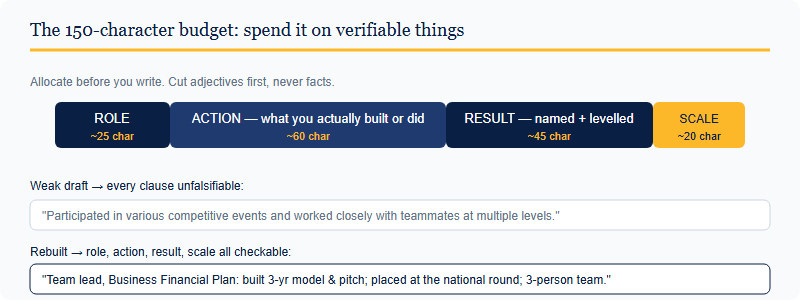
Words to delete on sight: participated, various, several, prestigious, renowned, helped with, was involved in, had the opportunity to. Words to keep: the event name, the number, the level, the verb that describes the thing you personally made.
Name the level precisely — and only the level you reached
This is where most FBLA entries quietly break. FBLA runs a large competitive programme — 76+ events across accounting, finance, marketing, technology, communication, entrepreneurship and more — and it runs on a tiered structure, so “I won FBLA” is not a statement. It is a shrug.
Be careful here in one specific way: the number and names of the tiers are not identical for everyone. They differ depending on your state or charter, and the route looks different again for students competing through an international chapter. Confirm your own route with your adviser and on fbla.org rather than copying the ladder a US classmate describes on a forum. If you are unclear which route applies to your school, our walkthrough of how students qualify for the National Leadership Conference sets out the paths, and our guide for international students covers the chapter-side mechanics.
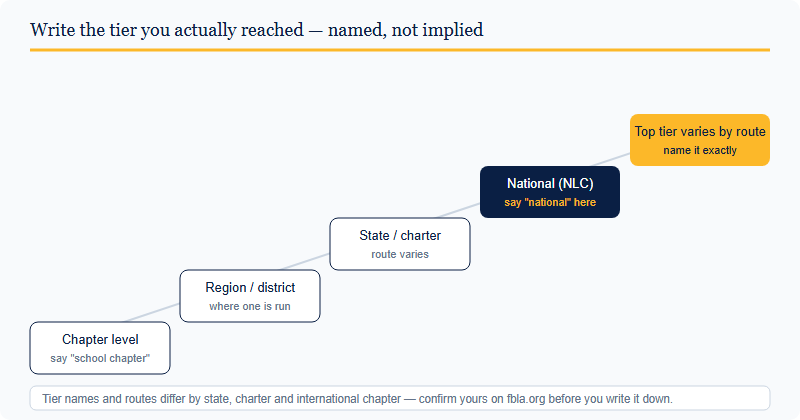
Here is the same idea applied to three common profiles. Notice that in each case the event name does the heavy lifting — which is exactly why choosing your event deliberately matters, as covered in our complete guide to the competitive events.
| Profile | Weak line (what most students write) | Rebuilt line (what a reader can use) | Why it works |
|---|---|---|---|
| Objective-test competitor | Competed in FBLA business tests and won awards at competitions. | Competitor, Accounting objective test; self-built 900-question drill bank; placed at the state-level round. | Names the event family, shows the method you invented, states the exact tier. |
| Team business plan | Worked with my team on a business plan project for FBLA. | Team lead, Business Plan: customer interviews, 3-yr model, timed pitch; advanced to the national round. | Team size, your role within it, three concrete deliverables, one verifiable outcome. |
| Chapter officer | Was an officer of my school FBLA chapter and helped organise events. | VP, school chapter (60 members): ran weekly prep clinic, wrote onboarding guide, recruited 22 new members. | Scale, cadence, an artefact that outlives you, and a number you can defend. |
Claims that break under scrutiny
Admissions offices do not typically verify every line, but interviewers, alumni readers, counsellors and recommenders do notice inconsistency — and a single inflated line contaminates the credibility of everything around it. The claims that most often break:
- Rounding a tier up. A chapter placing described with the word “national” is the most common and most damaging edit students make.
- Inventing a rank. “Top 10 nationally” needs a source. If your result document does not state a rank, do not state one.
- “Founded”. If the chapter existed before you arrived, you did not found it. “Relaunched”, “grew from 12 to 40 members”, “started the Grade 9 track” are all defensible alternatives.
- Hour inflation. Ten hours a week, fifty-two weeks a year, alongside a full IB or AP load, is a claim your teachers can see is false.
- Borrowing the organisation’s marketing language. Adjectives supplied by any competition’s own promotional copy read as filler in an application.
- Numbers that drifted. Your activities list, your résumé, your supplement and your recommender’s letter should agree. Fix the discrepancy before submission, not after.
Build an evidence file in the same week you compete, not in December of Grade 12: the certificate or result notice, the conference programme page listing your event, a dated screenshot of the published results, and your own one-paragraph note on what you personally did. Rules, categories and award names are set by the competition and change from year to year — when in doubt about exactly what your award is called, check fbla.org rather than your memory.
A three-pass edit that survives contact with a real deadline
Pass one — facts only. Write the line with no adjectives at all. Event name, role, team size, deliverable, tier, number. It will be too long and it will read like a police report. That is correct.
Pass two — compress, do not soften. Cut articles, use semicolons, use numerals rather than words, and drop any clause that does not contain a noun a stranger could look up. Never delete a fact to make room for a feeling.
Pass three — the substitution test. Cover the words “FBLA” and your event name, and ask whether five hundred other applicants could write the identical sentence. If yes, you have described the competition rather than your work. The fix is almost always to name the specific thing you built — the drill bank, the interview set, the financial model, the onboarding guide — because that is the part nobody else has.
What the ladder looks like in practice
Vague writing usually comes from vague mental models: students who do not know how granular the ladder is default to “I did FBLA”. So here is one operator’s de-identified competition record, shared per Hanlin as an illustration of the shape of the ladder rather than as any kind of promise. Results vary between students and cohorts, and none of it is tied to any admission outcome.
- 2023-24: 23 students received leadership-conference invitations; one team placed first nationally in Marketing; three students took national golds and advanced to the global round.
- 2022-23: 20 leadership-conference invitations, with teams taking national top-two placings in Business Ethics and in Sports & Entertainment Management.
- 2020-21: 11 teams reached the global finals; one placed top-15 globally in Marketing and one placed second globally in Business Financial Plan.
Read those lines as writing models. Each one contains an event name, a tier, and a position — the three components an application reader needs. “National top-two in Business Ethics” is parseable in under a second. “Won an award at FBLA” is not, and the difference is entirely in the drafting, not in the achievement.
The corollary matters too: if your season produced a chapter-level result, write a precise chapter-level line. A modest result described exactly is more persuasive than a strong result described loosely, because the first tells a reader you understand your own field and the second tells them you are hoping they will not ask.
Frequently asked questions
Should FBLA go in the honors section or the activities list?
Often both. The activity records the ongoing work and your role; the honor records the named result at its real tier. Do not repeat identical wording in both.
Do I need to explain what FBLA is?
One clause at most. Spend the space on your event, role and result instead — readers can look the organisation up on fbla.org in seconds.
Can I list two different FBLA events separately?
Usually it is stronger as one activity naming your best result, unless the two events represent genuinely different roles and time commitments.
Will a national placing get me admitted?
No. No competition result guarantees any admission outcome. It is one verifiable piece of evidence read alongside everything else in your file.
Published by the FBLA editorial desk, operated by Hanlin Education for China-based international-school students. Official rules are set by the competition and change yearly — confirm current details on fbla.org. Errors are corrected within 7 working days.