The FBLA year and the exam year collide at three predictable points: winter mocks, the May examination block, and the late-June conference window that lands right on top of end-of-year school commitments. None of them is a surprise, which means all of them are plannable. The single highest-leverage decision is choosing an event format whose workload peaks when your academic calendar is quiet.
The collision map, month by month
Most students plan FBLA in isolation and then discover in February that their qualifying preparation is sitting on top of internal assessment deadlines. Put both calendars on one page first. The academic column below reflects the typical shape of an IB Diploma, AP or A-Level year in a China international school — your own school’s dates will differ, so check the published school calendar before you commit to anything.
| Month | Typical academic load | Typical FBLA load | Verdict |
|---|---|---|---|
| September | Term starts; grade 12 university applications begin | New guidelines released; membership and event selection | Green — do your event choice and admin now |
| October | Early application deadlines for grade 12; coursework begins | Prep ramp-up, chapter organisation | Green for grades 9–11; amber for grade 12 |
| November | Mock exams in many schools; internal assessment drafts | Steady prep | Amber — first collision |
| December | End-of-term assessments, then a long holiday | Holiday is the best uninterrupted block of the year | Green — protect the holiday for deep work |
| January | Mocks in other schools; coursework and IA deadlines; main UCAS deadline period | Qualifying preparation intensifies | Red — the worst month for most students |
| February–March | Coursework wrap-up; final internal deadlines | Qualifying conference season and submission deadlines | Amber — heavy but manageable if front-loaded |
| April | Revision begins in earnest; study leave in some schools | Post-qualification lull, or NLC logistics | Amber — do logistics, not new prep |
| May | IB, AP and A-Level examination block | Prep near zero — but hard admin deadlines in week 1 | Red — freeze preparation, not paperwork |
| June | Exams finish; end-of-year events; some A-Level papers run into June | National Leadership Conference window | Red for some, green for others — check your board’s final paper date |
| July–August | Holiday | Off-season skill building | Green — the largest free block you get |
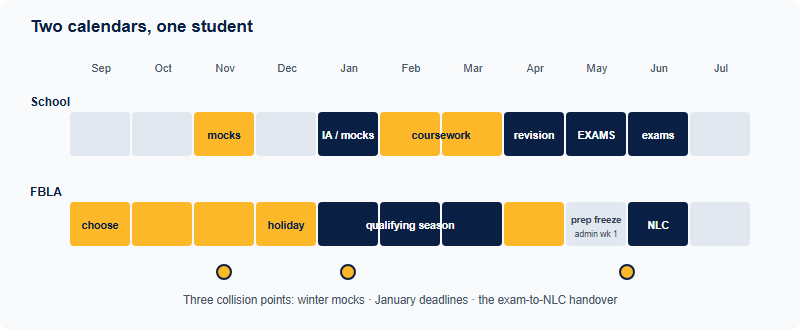
The three pressure points, and what actually breaks
1. Winter mocks versus prep ramp-up (November–January). This is where most students quietly drop out. Mock results feel urgent because they feed predicted grades, so FBLA becomes the thing that gets cut — usually two weeks before the preparation would have compounded. The failure mode is not overwork; it is abandonment. The fix is to reduce FBLA to a floor of one or two hours a week during mock fortnights rather than stopping entirely, so you keep the thread.
2. Submission deadlines versus internal assessments (January–March). Written and prejudged components have deadlines that sit weeks or months before you ever compete, and they land in the same window as coursework and internal assessment deadlines. Two documents due in the same week is a scheduling problem you can solve in October and cannot solve in February.
3. The exam-to-conference handover (May–June). The May examination block should be a blackout for preparation and rehearsal — but not for paperwork, since FBLA’s submission and registration deadlines fall in its first week and are best cleared in April. The risk is what comes immediately after: for some boards, papers run into June, and the national conference window sits at the end of that month. If you are in an A-Level cohort with late papers, check your final examination date against the conference dates before you commit to travel. The mechanics of getting there are covered in our guide to qualifying for the National Leadership Conference; the calendar question is separate and comes first.
Your event format is a scheduling decision
Students usually choose an event by interest, then discover its workload shape. Reverse that. Each of the main FBLA formats concentrates its effort in a different part of the year, and one of those shapes will fit your exam calendar far better than the others. Our complete competitive events guide lists the full catalogue by format; the table below is about when, not what.
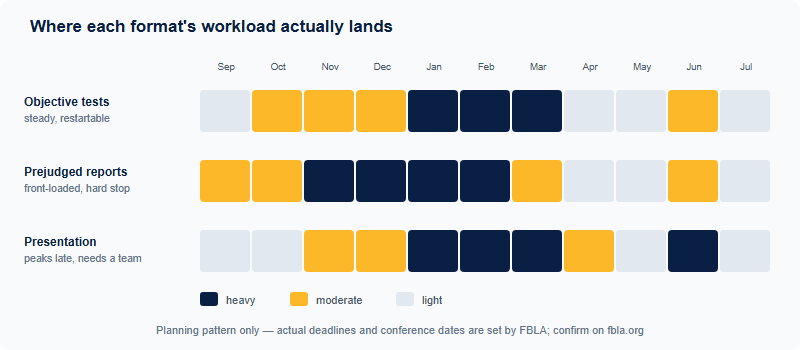
Read that chart as a menu, not a verdict:
- If your exams are the whole story (grade 11 IB, grade 12 A-Level): objective-test formats are the safest. The preparation is granular — twenty minutes of question practice is a real unit of work — so it survives being interrupted and resumed.
- If you want a serious deliverable but cannot rehearse in May: prejudged report formats concentrate the work in autumn and winter and end at a submission deadline. You pay the cost early and walk into exam season with the event already finished.
- If you are in grade 9 or 10 with lighter external exams: presentation and role-play formats are the best investment, because their peak is late and their skills compound over years.
- Avoid the trap combination: a presentation-heavy event and a full external exam session and a team that only becomes available after exams end. That is three constraints stacked in one fortnight.
Five rules that protect your exam weeks
- Declare freeze weeks in September, in writing. Mark the two weeks before mocks and the entire external exam block as no-prep zones and tell your team and adviser then, not in April. A team that knows in September can plan around you; a team told in May cannot. One carve-out: the first week of May is administrative, not optional — FBLA’s published 2026–27 schedule puts BAA and Excellence Award submission on 1 May 2027 and NLC registration and housing on 4 May 2027. Diarise both in September and complete them in April, so the freeze only ever covers preparation and rehearsal.
- Front-load every document. Any written or prejudged component should be finished a month before its deadline. Deadlines are usually published in a US time zone; convert to China Standard Time and set your personal deadline three days earlier.
- Keep a two-hour floor, not a zero. During heavy academic weeks, drop to two hours — one session of question practice, one short rehearsal. Continuity is worth more than intensity.
- Use December properly. The winter holiday is the longest uninterrupted block in your school year and it sits immediately before the qualifying season. One focused week in December is worth a month of fragmented February evenings.
- Rotate roles in team events. If your teammates sit different examination boards, they have different blackout weeks. Assign the research-heavy phase to whoever is free in February and the rehearsal-heavy phase to whoever is free in June.
If a conference genuinely collides with an exam
Sometimes the calendars simply do not fit. Work through it in this order rather than agonising:
- Check the actual dates first. Get your board’s final examination date and the published conference dates side by side before you assume a conflict. Take the conference dates from fbla.org itself — do not rely on a date you saw in a group chat, or on any page that has not been updated for the current season.
- The external examination wins. There is no version of this where missing an IB, AP or A-Level paper is the right call. Competitions repeat annually; a missed paper does not.
- Check whether your event has an alternative route. Some components are submitted rather than performed, and some team events allow a substitution. Whether that applies to your event is governed by the current-year guidelines — read them rather than guessing.
- If you must withdraw, withdraw early and formally. Tell your adviser as soon as you know. Late withdrawal can affect a team’s eligibility, and the rules on this are set by FBLA and your qualifying region.
- Convert the year into a different asset. A year where exams took priority is not a wasted FBLA year: chapter leadership, an individual achievement track, or a completed written component all continue to count.
For students who are building this plan for the first time from outside the United States, our overview of FBLA for international students sets out the membership and participation structure that the calendar above sits inside.
Frequently asked questions
Which FBLA event format is easiest to combine with IB or A-Level exams?
Objective-test formats, because preparation is granular and can be paused and resumed. Prejudged written events also work if you finish them before spring.
Should I stop FBLA completely during mock exams?
Better to drop to about two hours a week than to stop. Students who stop entirely rarely restart, and the qualifying season follows immediately.
Does the national conference clash with IB, AP or A-Level exams?
The conference window sits after most May examination blocks, but some boards run papers into June. Check your final paper date against FBLA’s published dates on fbla.org.
When are FBLA submission deadlines relative to the conference?
Written and prejudged components close well before you compete, and are published in US time zones. Convert to China Standard Time and build in a buffer.
Published by the FBLA editorial desk, operated by Hanlin Education for China-based international-school students. Official rules are set by the competition and change yearly — confirm current details on fbla.org. Errors reported to the editorial desk are corrected within 7 working days.