You can lose an FBLA event before you ever compete — by missing an eligibility rule, blowing a deadline, breaking an originality rule, or mishandling the technology on test day. Disqualification is quiet and final, and it undoes months of preparation. This guide maps the categories of rules that most often trip up China-based competitors, and how to clear each one. Because these policies change yearly, treat every specific here as “confirm on fbla.org.”
Why disqualification is the risk you underrate
Most students pour their energy into content — studying the topic, building the project, polishing the presentation — and almost none into compliance. Yet the compliance rules are the ones with binary consequences. A weak answer costs you a few points; an ineligible entry, a missed form, or a copied paragraph costs you the whole event. Judges and event administrators are not trying to catch you out, but they apply the published rules consistently, and “I didn’t know” is not an appeal that works.
The good news is that every category below is completely within your control, and clearing them is mostly a matter of reading the current rules early and keeping a checklist. The competitors who never get disqualified are rarely the most talented — they are the most organised. Think of compliance as the floor you stand on: get it right once, and everything else you build actually counts.
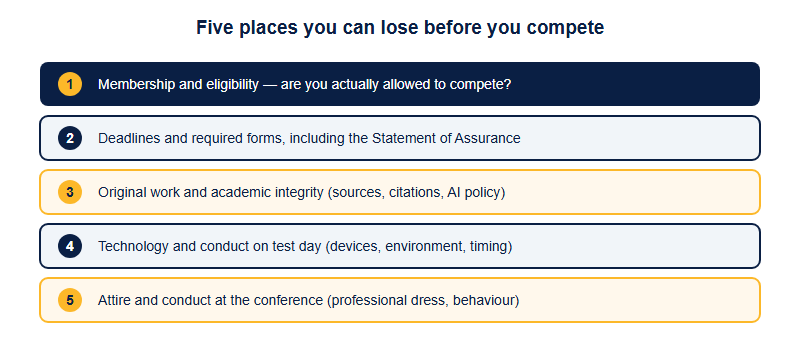
Eligibility and membership: are you actually allowed to compete?
Every competitive entry starts from an active, paid membership in good standing, registered through your chapter within the membership window. From there, individual events layer on their own eligibility rules — grade level, whether you may enter as a team or only individually, and how many events one member may enter. International competitors add one more layer: which parts of the program are available through the FBLA China program, and under what terms. None of this is guessable, and it changes, so verify your standing early with your adviser and against fbla.org. Our guide for international students is the right starting point for the China pathway specifically.
The classic eligibility mistakes are avoidable: registering for membership after the eligibility cut-off, entering more events than the rules allow, or assuming a team event can be entered solo (or vice versa). Confirm three things before you build anything — that your membership is active, that you meet the specific event’s eligibility, and that the event fits within your per-member event limit.
Deadlines, forms and the Statement of Assurance
Competitive events run on hard deadlines and paperwork. Registration closes; prejudged reports must be uploaded by a stated time; and many events require a signed statement — often called a Statement of Assurance or similar — confirming that your work is original and complies with the rules. Miss the upload window or omit a required form, and the entry can be voided regardless of quality.
Two habits protect you. First, build your own deadline calendar from the current, official sources the moment your events are chosen, and set personal reminders several days ahead of every real due date. Second, treat every signature and cover-page field as a scored gate: fill in exactly what is asked, in the format asked, and keep a copy. When a report is due, “submitted late because of the file size” is not a category judges forgive.
Original work and academic integrity
This is the category that ends the most promising entries. FBLA events require work that is genuinely your own, properly sourced, and produced within the rules — and integrity violations, including plagiarism, can lead to disqualification. For China-based students preparing in a second language, the temptation to lean on copied text or on generative AI to “just write it” is real, and dangerous.
- Cite everything you borrow. Facts, figures, images and quotations need attribution in the style the event specifies. When in doubt, cite.
- Know the current policy on outside help and AI. Rules on permitted resources and the use of generative tools are evolving and event-specific. Do not assume — check the current policy on original work and permitted resources on fbla.org, and keep your own drafts to show your process.
- Write in your own voice. Judges reward clear, structured, honest work over polished text you cannot defend. If you cannot answer questions about a sentence, it should not be in your report.
The safe posture is simple: do the real work, document how you did it, and attribute anything that is not yours. That approach also produces a stronger project, because you understand every part of it.
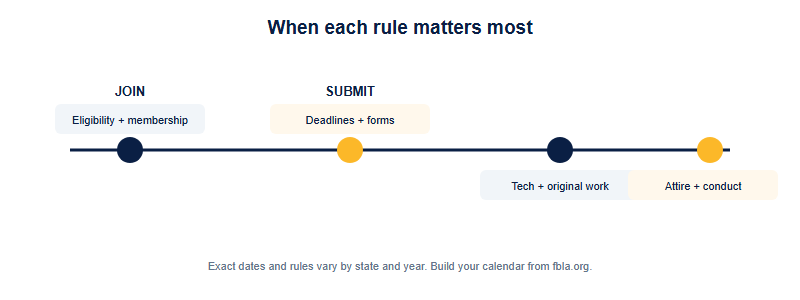
Technology and conduct on test day and at the conference
Objective tests and many events are delivered online under specific conditions: an approved device and browser, a permitted environment, and rules about what materials (if any) you may have to hand. A technology failure — a dropped connection, an unsupported browser, a calculator that is not allowed — can cost you the attempt. Test your setup in advance exactly as the event requires, and read the current technology guidelines rather than relying on what worked last season.
At in-person conferences, professional attire and conduct are part of the deal, and dress-code violations can affect eligibility to compete or be recognised. The specifics — what counts as professional dress, badge requirements, behaviour expectations — are published each year, so confirm the current standards before you travel. If your goal is to advance from a state conference to nationals, the last thing you want is a preventable conduct issue; our guide to qualifying for NLC covers the advancement path itself.
| Rule area | What typically goes wrong | Your move | Where to confirm |
|---|---|---|---|
| Eligibility and membership | Joining after the cut-off; entering too many events | Verify active membership and per-event eligibility early | fbla.org + your adviser |
| Deadlines and forms | Late uploads; missing the Statement of Assurance | Build a personal deadline calendar with early reminders | fbla.org |
| Original work and integrity | Uncited sources; over-reliance on AI or copied text | Cite everything; keep drafts; write what you can defend | fbla.org |
| Technology on test day | Unsupported browser; dropped connection; wrong device | Test the exact setup in advance | fbla.org |
| Attire and conduct | Non-compliant dress; badge or behaviour issues | Confirm the current dress code before you travel | fbla.org |
Frequently asked questions
What is the most common reason FBLA competitors get disqualified?
Preventable ones: missed deadlines or required forms, ineligibility, and integrity issues such as uncited work. Content weaknesses lose points; these lose the event.
Can I use AI to help write my FBLA report?
Policies on generative AI and permitted resources are evolving and event-specific. Do not assume; check the current original-work policy on fbla.org and keep your own drafts.
Is there really a dress code, and does it matter?
Yes. Professional attire and conduct are expected at conferences, and violations can affect your ability to compete or be recognised. Confirm the current standard on fbla.org.
Do international students in China face different eligibility rules?
Availability and terms can differ by program and change yearly. Verify your standing through the FBLA China program and against fbla.org before you register.
This guide is published by the FBLA editorial desk, operated by Hanlin Education for China-based international-school students. Official rules are set by the competition and change yearly; confirm current details on fbla.org. We correct errors within seven working days.