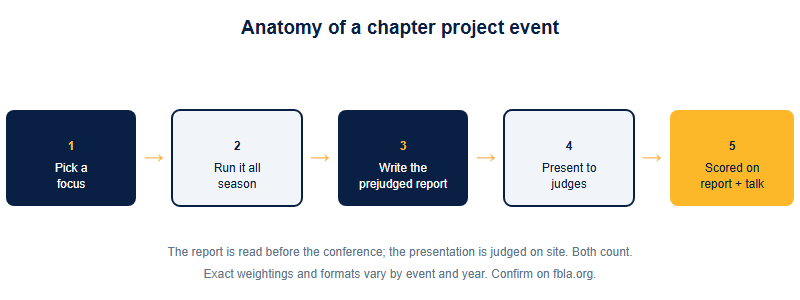
FBLA chapter project events are the ones you build across a whole season, not win in a single timed test. A team picks a focus — an enterprise study, a community-service campaign, a business partnership — runs it through the year, writes a prejudged report, and defends it before judges at a conference. For a China-based chapter, this path rewards initiative and teamwork, and leaves behind a portfolio artifact that a live objective test never can.
What a chapter project event actually is
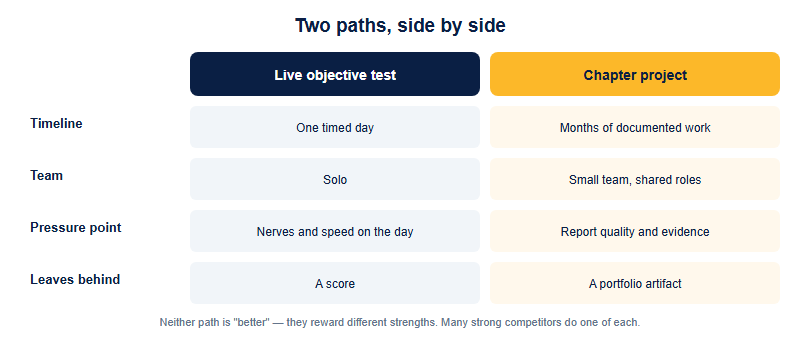
Most students meet FBLA through its objective tests — solo, timed, computer-based exams — because they are the easiest events to picture. Chapter project events work in the opposite direction. Instead of one high-pressure test day, a small team runs a real project over months, keeps records of what it did, compiles a written report that judges read before the conference (the “prejudged” step), and then presents and answers questions on site. Your final result blends the quality of the report with the quality of the live presentation.
That structure changes everything about how you prepare. There is no single moment where luck or nerves can sink you; there is a body of work that either holds up or does not. It also means the calendar is your friend: a chapter that starts early and documents as it goes almost always outperforms one that scrambles a report together in the final week. The full catalogue sits inside our FBLA Competitive Events guide — chapter project events are one family within it, and one that many international competitors overlook.
The main chapter and project events (with the honest caveat)
FBLA groups a set of events around a chapter running a real initiative and reporting on it. The examples below are illustrative of the category’s shape. Event names, categories and eligibility are revised most years, so treat this as a map of the terrain, not a fixed menu — confirm the current list and each event’s guidelines on fbla.org before you commit.
| Example project event | What the team builds | Best for a chapter that… |
|---|---|---|
| American Enterprise Project | A study or campaign exploring the free-enterprise system, documented in a report | wants an economics or finance angle and a research artifact |
| Community Service Project | A season of service tied to a business or civic goal, with measured impact | values social impact and can show real hours and outcomes |
| Partnership with Business Project | A structured partnership with a company, documented end to end | has access to a local business willing to collaborate |
| Local Chapter Annual Business Report | A report on the chapter’s own year: goals, activities, finances, results | runs an organised chapter and can document its operations |
Why this path suits a China-based chapter
In our experience coaching China-based chapters, the project events are the most under-used and most strategically valuable family for three reasons. First, they are calendar events, not test-day events. You are not disadvantaged by a live exam that assumes a US classroom’s cultural references; you are judged on a project you designed and can rehearse. Second, they are genuinely team-friendly. A chapter that struggles to field lone objective-test specialists can still put three motivated students behind one strong project. Third — and this matters most for university applications — they leave something behind: a documented initiative with measurable outcomes, which reads on an application as sustained commitment rather than a one-day result.
That last point deserves a caution. A project placement is a signal of initiative and teamwork, never a guarantee of any admissions outcome. Its value comes from the real work underneath it — the hours logged, the partner engaged, the problem actually addressed. Build the project you would be proud to describe honestly, and the recognition takes care of itself. If your chapter is still forming, our guide for international students walks through joining and organising through the FBLA China program first.
How to build a prejudged report that scores
The report is where most teams leave points on the table, because they treat it as paperwork rather than the main event. Judges read it before they ever meet you, so it sets your ceiling. A few habits separate strong reports from average ones:
- Reverse-engineer from the rating sheet. Each event publishes the criteria judges score against. Map every required element to a section of your report so nothing is missing. Do not guess the point values — read the current sheet on fbla.org.
- Show evidence, not adjectives. “We raised awareness” scores far below “We ran four workshops for 120 students and measured a 30-point pre/post quiz gain.” Numbers, dates and named partners carry weight.
- Document as you go. Keep a shared log of every activity, photo, and metric from week one. Reconstructing a season from memory in the final week always shows.
- Respect the format rules exactly. Page limits, file types, cover-page fields and naming conventions are often scored or used as a gate. A great project can be capped by a formatting slip — verify the current requirements before you submit.
Then rehearse the presentation as a separate discipline. The report proves you did the work; the presentation proves you understand it. Practise the questions a skeptical judge would ask — “What would you do differently?”, “How did you measure that?” — until every team member can answer without notes.
Timeline: from kickoff to conference
The rhythm is what makes or breaks a project event. Aim to lock your focus early in the fall term, run and document the initiative through the winter, finalise and submit the prejudged report on the published deadline, and rehearse the presentation in the weeks before your conference. If your team places, that same project can carry through to the National Leadership Conference — see how advancement works in our guide to qualifying for NLC. A word on dates: FBLA’s competition calendar and deadlines shift by state and by year, so build your plan around your own conference schedule and confirm every fixed date on fbla.org rather than assuming last year’s timing repeats.
Frequently asked questions
Are chapter project events easier than objective tests?
No — they trade test-day pressure for a season of sustained work. They suit teams that can plan, document, and present, rather than solo test specialists.
Can international students in China enter project events?
Chapters in the FBLA China program participate in the competitive program; entry rules and event availability are set by FBLA and can change yearly, so confirm on fbla.org.
How long should the prejudged report be?
Each event sets its own page limit, format and cover-page rules. Do not assume a length — read the current event guidelines on fbla.org before you write.
Does a project placement help university applications?
It can signal initiative and teamwork, but it is never a guarantee. The value comes from the real, documented work behind it.
This guide is published by the FBLA editorial desk, operated by Hanlin Education for China-based international-school students. Official rules are set by the competition and change yearly; confirm current details on fbla.org. We correct errors within seven working days.