If you are preparing for the FBLA Business Management event in the 2026-27 season, the single most useful habit is to stop treating the objective test and the role play as two separate contests. The 2026-27 FBLA High School Competitive Events list confirms that Business Management combines an objective test and a role play, so a student who studies definitions for the paper component and then improvises the simulation is leaving marks on the table. The practical answer is a short, repeatable routine we call theory-to-action mapping: pick a small set of management functions from your study list, decide in advance what each function asks you to do in a live scenario, and then say that function out loud as your reason for acting. Everything below is coaching guidance from our FBLA teaching team, not an official FBLA rating formula.
Understanding the Hybrid Format: Test Plus Simulation
The Business Management event combines recall and application in the same competition. The objective test rewards precise command of management vocabulary; the role play rewards the ability to make and defend a decision in front of a judge. Because the two components draw on one body of knowledge, splitting your preparation is a structural error rather than a time-management error. A student who aces the test and then freezes in the simulation has not failed at two subjects; that student has failed to connect one subject to itself.
The FBLA High School Competitive Events page also cautions that guideline documents can change during the year and advises readers to check the footer date of the current guideline. That warning matters for integrated preparation. If a scenario emphasis shifts between seasons, a student whose role-play repertoire is a memorised script will struggle, while a student who has internalised decision criteria can adapt in the room. The routine below is designed for that adaptability.
Why Separate Test Prep and Role-Play Prep Creates Contradictions
When preparation is siloed, students often treat the role play as a performance exercise rather than a decision-making exercise. A common pattern to watch for is a student who can define delegation cleanly on the test but hesitates to delegate in the simulation because they are nervous about releasing control. The definition is correct; the behaviour contradicts it. We treat that contradiction as a warning sign, not a moral failure: the student has learned the term as a label, not yet as a decision criterion.
A second contradiction appears when students over-import jargon. Reciting four management functions during a short answer makes the answer harder for a judge to follow and crowds out the actual decision. Our judgement is that strong role-play answers usually sound simpler than the student’s study notes, not busier, because the function is used to justify one action rather than to decorate several. Treat that as a coaching observation, not a published scoring rule.
The Theory-to-Action Map: Turning Study Terms Into Decision Criteria
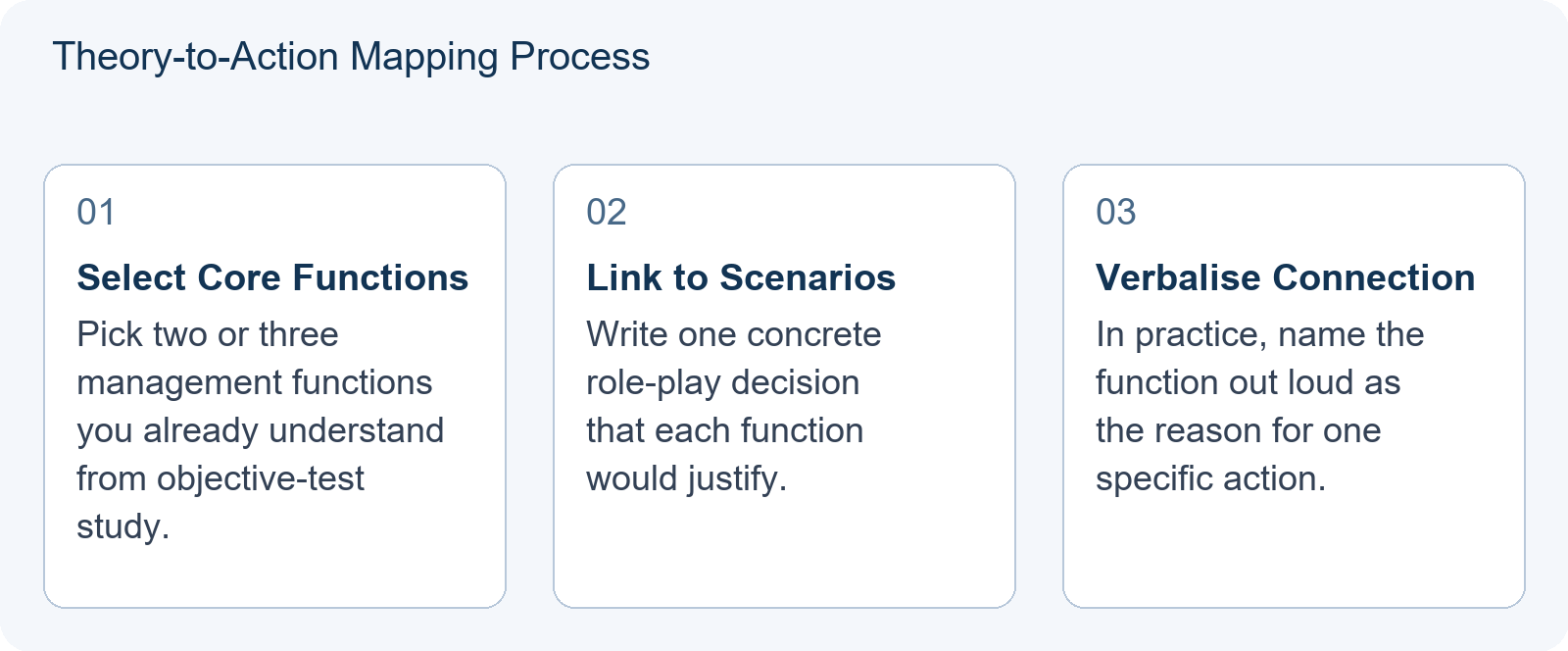
The routine has three moves: select, link and verbalise. Select two or three management functions you already understand from your objective-test study. Link each one to a concrete type of role-play decision. Then verbalise the link during the simulation so the judge hears the theory behind the action. The table below shows how a small set of standard management functions can be converted into decision criteria.
| Management Function You Studied | Question It Forces You To Ask | Role-Play Decision It Justifies |
|---|---|---|
| Planning | What outcome are we committing to, and by when? | Setting a target deadline or a measurable goal before acting |
| Organising | Who has the skills, not just the title, to do this? | Reallocating tasks across a team during a resource problem |
| Leading | How will the team understand why this matters? | Communicating a change so people commit rather than comply |
| Controlling | How will we know if we are drifting off plan? | Building a short review point into an ongoing project |
This mapping is not an official taxonomy of Business Management questions. It is a coaching scaffold built from management functions that commonly appear in introductory management coursework, and it is deliberately small. Two or three functions, deeply linked, will outperform a memorised list of ten.
Worked Hypothetical: A Role-Play Scenario on a Staffing Problem
To see the routine in action, consider a hypothetical scenario a Business Management competitor might meet in the role play: you are the manager of a small retail team, a major seasonal event is two weeks away, and one experienced staff member has just resigned. The judge is playing a district supervisor who has asked you to explain your plan. This is a teaching illustration, not a real FBLA prompt.
A student prepared only for the objective test might recite the definition of human resource planning without committing to anything. A student using the theory-to-action map would select organising as the relevant function and answer in three sentences: name the constraint, name the decision, name the principle. For example: “We lose one experienced staff member before our busiest two weeks. I am going to move two part-time staff onto the evening shift and pair each of them with a senior colleague for the first three days, because the organising function asks me to match people to work by skill rather than by roster seniority. I will review the pairing after three days and adjust.” The decision is simple, but it is visibly rooted in a studied principle, and it gives the judge something concrete to probe.
The contrast matters. The first answer shows knowledge of a term. The second answer shows a decision that grew out of that term. In our coaching judgement, the second pattern is what a judge can build a follow-up question around, which is usually where strong performances separate from adequate ones. That is a coaching view about practice design, not a claim about how FBLA officially scores the event.
Using One Management Function to Justify an Action Under Pressure
In high-pressure simulations, clarity is more valuable than complexity. Rather than trying to incorporate every management theory you studied, focus on justifying one key action using a single function. If you decide to introduce a short daily check-in, say that the decision comes from the controlling function because it lets you detect drift early. If you decide to call a team meeting before a deadline, say that it comes from the leading function because the team needs to hear the reason for the change, not just the instruction.
Our coaching team uses a simple rule of thumb: one action, one named function, one sentence of purpose. This keeps the answer inside the time window, gives the judge a clear thread to follow, and prevents the common failure mode where a student lists four functions in a brief answer and explains none of them. That rule of thumb is a teaching suggestion, not an FBLA guideline.
Practical Diagnostic: Can You Explain Your Role-Play Choice Using the Same Principle You Studied?
A useful self-check is to review a recorded practice session and ask one question: Did I explain my decision using the same terminology I studied for the objective test? If the answer is no, you have found a gap between what you know and what you did. For example, if you studied break-even analysis and then made a pricing decision in the simulation without referring to cost structure at all, you missed a chance to demonstrate integrated competence. The point is not to force every finance concept into every scenario; it is to notice which studied concepts you already own well enough to use under pressure, and which ones you can only recognise on a multiple-choice question.
Run the diagnostic after three or four practice role plays rather than after one. A single session produces noise; a pattern across sessions tells you which functions are genuinely available to you in a live answer and which still live only on the study sheet.
A 2026-27 Preparation Sequence for Students Entering Both Components
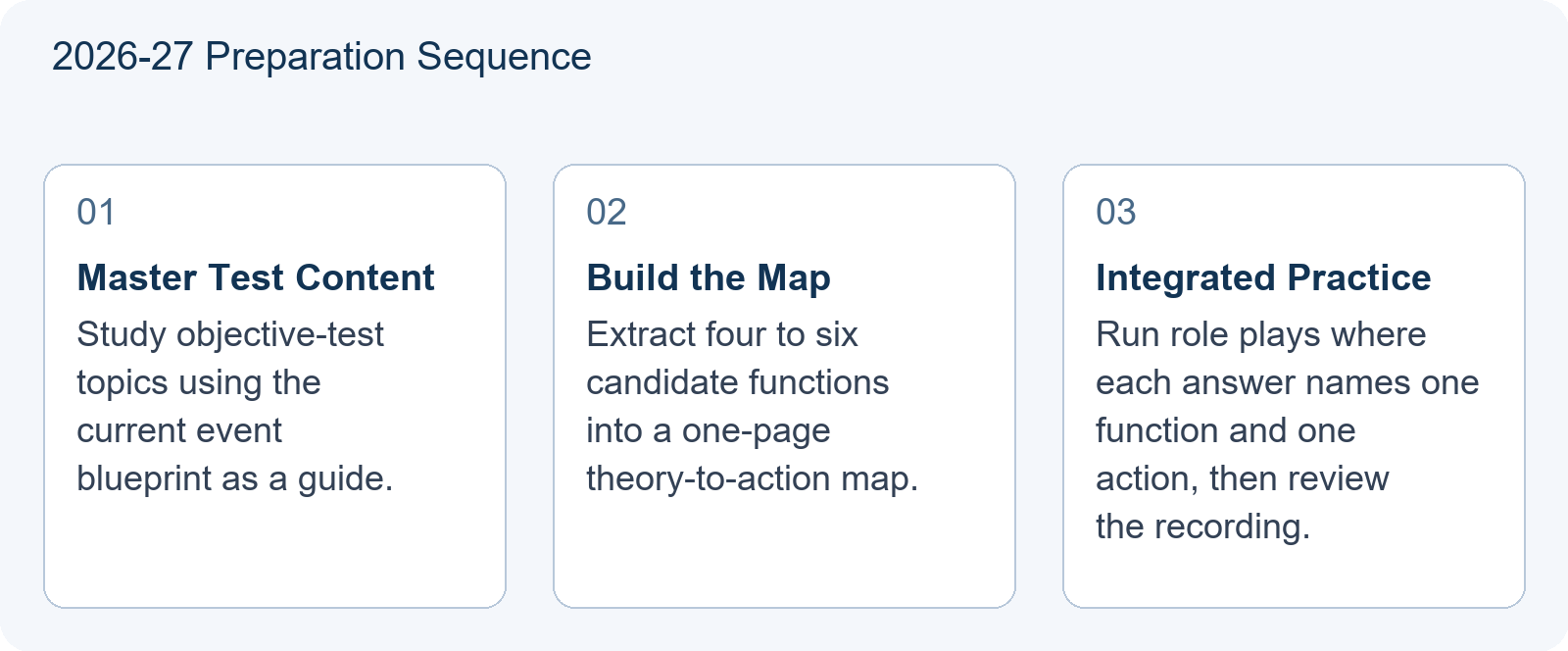
A workable sequence for the 2026-27 season runs in four steps. First, master the objective-test content, and use the FBLA 2026-27 Test Blueprints: Where the 100 Questions Come From in Every Objective Test, With a Study-Hour Allocator to see where the questions are weighted so your study hours follow the blueprint rather than your personal taste. Second, extract four to six candidate functions from that study list and write them into a one-page theory-to-action map using the table above as a template. Third, run practice role plays in which each answer must name one function and one concrete action, then review the recording against the diagnostic question. Fourth, once the pattern is stable, add a follow-up question phase where a partner plays the judge and challenges your decision, so you rehearse defending the choice rather than only making it.
If you are still deciding whether Business Management is the right event for you this season, our article on Reviewing Your FBLA Event Choices in Late October: Keep, Switch or Drop Before Entry Deadlines (2026-27) walks through keep-switch-drop decisions against entry deadlines. And because the objective-test half of this event rewards precise vocabulary, a companion drill from our The FBLA Business-Term Command Test: 60 Terms You Must Use, Not Just Recognise (2026-27) will sharpen the exact language you then reuse in the simulation.
Aligning Objective-Test Study With Role-Play Decision Practice
Success in the Business Management event comes from consistency between what you know and what you do. Treat the objective test and the role play as two views of one competency rather than two contests on one day. Select a small set of management functions, link each to a concrete decision, and practise saying the link out loud until it is automatic. The routine will not replace content knowledge, and it is not an official FBLA scoring method, but it removes the most avoidable source of lost marks in a hybrid event: a competitor who knows the theory and forgets to use it.
General event background is available at Event background.
Frequently Asked Questions
Does the FBLA Business Management event have a fixed scoring formula?
Specific numerical scoring rules for the 2026-27 Business Management event were not verified in the sources for this article, so none are stated here. What is confirmed is that the event combines an objective test and a role play, and that the FBLA competitive events page warns guidelines can change mid-year. Focus your practice on linking studied management functions to visible role-play decisions rather than on guessing a formula.
Can I use the same study materials for both the test and the role play?
You can start from the same content, but the two components ask different things of it. The test rewards accurate recognition of management terms; the role play rewards using a term as a decision criterion in a live answer. Our coaching routine maps each studied function to a concrete decision so the same knowledge serves both components.
What happens if my role-play actions contradict my test answers?
In our coaching judgement, that gap is a warning sign rather than a fixed penalty: it usually means the term was learned as a label, not yet as a decision criterion. The diagnostic in this article asks you to review recorded practice and check whether you explained your decision using the same terminology you studied. Repeated gaps point to functions worth drilling until they are usable under pressure.