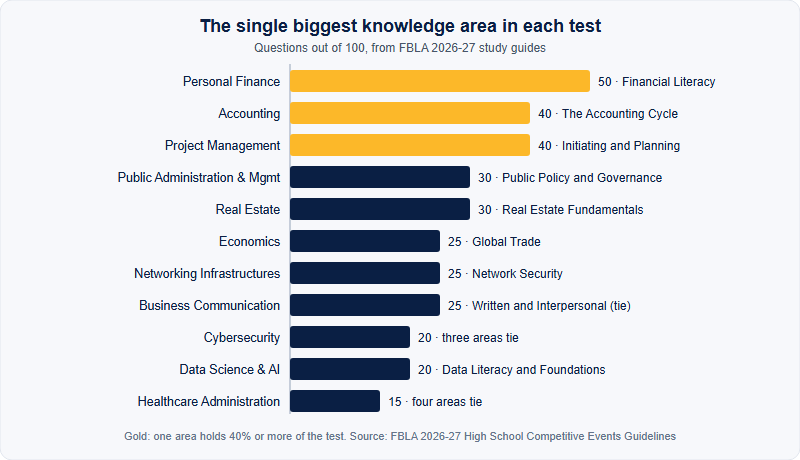
Every 2026-27 FBLA objective test is 100 multiple-choice questions in 50 minutes, but the 100 are not spread evenly. Each guideline’s study guide fixes how many questions come from each knowledge area: 40 of Accounting’s 100 test the accounting cycle, and 50 of Personal Finance’s test financial literacy. This page lays out the blueprint for 30 objective tests and the other events that hide a test, then turns it into a study-hour plan.
The rules that sit on top of every blueprint
The 2026-27 test guidelines share one frame. Check your own event’s guideline for anything specific, but expect the following at the National Leadership Conference:
- Format: 100 multiple-choice questions in 50 minutes, taken online and proctored on-site. Bring a fully powered device and a sharpened pencil; FBLA provides one piece of scratch paper.
- Scoring: one point per correct answer and no deduction for a wrong one, so a blank is always a lost point.
- Ties: broken by 10 pre-selected tiebreaker questions, then 20 pre-selected questions, then the shorter completion time. You are not told which questions they are, so no stretch of the test is safe to rush. If you are working from older advice to protect the last ten questions, note that the 2026-27 text describes pre-selected tiebreakers instead.
- Materials: no reference materials, and no personal calculators; an online calculator sits inside the testing platform.
- Review: you may flag questions for review before results are finalised at the conference.
- Content: questions are based on the knowledge areas and objectives in the event’s study guide, and the guidelines point to official sample test items in CONNECT. Ask your adviser how to reach them.
Chapter-level and China-level rounds are organised locally, so confirm their testing format with your adviser; the national route is set out in our guide to how qualification to nationals works. The current guidelines are on the FBLA competitive events page.
The blueprint for the 22 tests open to Grades 9-12
Question counts per knowledge area, largest first. Area names are shortened where long; the full objectives under each area are in the event’s study guide. If you are still choosing between formats, start with our competitive events guide.
| Test | Questions by knowledge area (of 100) | Largest area |
|---|---|---|
| Accounting | Accounting Cycle 40 · Foundations 10 · Payable & Receivable 10 · Tax 10 · Technology 10 · Careers 10 · Standards & Compliance 5 · Financial Reports 5 | 40 |
| Advanced Accounting | Accounting Cycle 25 · Payroll 20 · Financial Statements 15 · Foundations 10 · Standards & Compliance 10 · Inventory 10 · Managerial 10 | 25 |
| Advertising | Promotion 20 · Marketing Content 20 · Design Principles 20 · Advertisement 15 · Sales-Promotion Activities 15 · Branding 10 | 20 |
| Agribusiness | Safety Procedures & Regulations 20 · Agribusiness Economics 20 · Operations & Management 20 · Finance & Marketing 15 · Nature of Agribusiness 10 · Business Law 5 · Ethics 5 · Natural Resources 5 | 20 |
| Business Communication | Written 25 · Interpersonal Relationships 25 · Verbal 20 · Workplace 20 · Basics 10 | 25 |
| Business Law | Commercial Law 20 · International Trade & Commerce Law 20 · Legal Foundations 15 · Employment Law 15 · Business Ethics 15 · Financial & Tax Law 15 | 20 |
| Computer Problem Solving | Operating Systems 20 · Networks 20 · Hardware & Connectivity 20 · Security 15 · Laptops, Tablets & Mobile 15 · Printers & Peripherals 10 | 20 |
| Cybersecurity | Threats & Vulnerabilities 20 · Security & Design 20 · Protocols & Threat Mitigation 20 · Fundamentals 15 · Network & Data Security 15 · Operations & Management 10 | 20 |
| Data Science & AI | Data Literacy & Foundations 20 · Probability & Statistics 15 · Data Analysis & Statistics for AI 15 · Tools 10 · AI Basics 10 · Machine Learning 10 · Perception & Reasoning 10 · Privacy & Ethics 10 | 20 |
| Economics | Global Trade 25 · Fundamental Concepts 15 · Nature of Business 15 · Economic Systems 15 · Economic Indicators 15 · Cost/Profit 10 · Government’s Impact 5 | 25 |
| Healthcare Administration | Organizations & Structure 15 · Strategic Management 15 · Policy & Regulation 15 · Communication & Leadership 15 · Finances 10 · Staffing 10 · Technology 10 · Billing & Insurance 10 | 15 |
| Human Resource Management | Staffing & Talent Acquisition 20 · Employee Relations 20 · Nature of HRM 15 · Compensation 15 · Training 10 · Performance 10 · Health & Safety 5 · Professional Development 5 | 20 |
| Insurance & Risk Management | Personal Insurance Products 20 · Risk Fundamentals 15 · Industry & Legal Principles 15 · Commercial Products 15 · Claims & Fraud 15 · Operations & Underwriting 10 · Professional Development 10 | 20 |
| Journalism | Principles of Journalism 20 · Research & Investigation 20 · Compose News Stories 20 · Basic Communication 15 · Writing Skills 15 · Editing 10 | 20 |
| Networking Infrastructures | Network Security 25 · Basics 20 · Topologies & Architecture 20 · Protocols & Standards 20 · Hardware & Connectivity 15 | 25 |
| Organizational Leadership | Leadership 20 · Business Relationships 20 · Human Resources 20 · Critical Thinking 15 · Stressful Situations 15 · Role of Management 10 | 20 |
| Personal Finance | Financial Literacy 50 · Principles of Money 20 · Needs & Goals 15 · Service Providers 5 · Investment Strategies 5 · Risk Management 5 | 50 |
| Project Management | Initiating & Planning 40 · Executing, Monitoring & Controlling 30 · Closing 20 · Foundations 10 | 40 |
| Public Administration & Management | Policy & Governance 30 · Public Management 20 · Public Finance 15 · Public Sector Fundamentals 15 · Communication 10 · Ethics 10 | 30 |
| Real Estate | Fundamentals 30 · Laws & Regulations 25 · Transactions & Finance 20 · Agency 20 · Ethics 5 | 30 |
| Retail Management | Selling 20 · Inventory Control 15 · Foundations 10 · Pricing 10 · Market Planning 10 · Visual Merchandising 10 · Display 10 · Product Mix 10 · Warehousing 5 | 20 |
| Securities & Investments | Investment Analysis 25 · Industry 25 · Securities Products 25 · Principles of Money 10 · Financial Markets 10 · Selecting Investments 5 | 25 |
The Grades 9-10 tests, and the tests hidden inside other events
| Grades 9-10 test | Questions by knowledge area (of 100) | Largest area |
|---|---|---|
| Intro to Business Communication | Written 20 · Verbal 20 · Interpersonal Relationships 20 · Basics 10 · Reading to Understand 10 · Active Listening 10 · Workplace 10 | 20 |
| Intro to Business Concepts | Types of Business Activities 25 · Nature of Business 20 · Economic Systems 15 · Economic Concepts 10 · Career Planning 10 · Job-Search Skills 10 · Cost/Profit 5 · Owning a Business 5 | 25 |
| Intro to Business Procedures | Professional Communication 30 · Workplace Protocols & Decision Making 30 · Information Management & Technology 25 · Career Readiness 15 | 30 |
| Intro to FBLA | No published composition; areas include FBLA history, bylaws, programs, competitive events, dress code and deadlines | n/a |
| Intro to Information Technology | Hardware 20 · Networking Concepts 20 · Operating Systems 15 · Information Management 15 · Software Fundamentals 10 · Software Applications 10 · Modern Technologies 10 | 20 |
| Intro to Marketing Concepts | Marketing Fundamentals 20 · Product/Service Management 20 · Selling 20 · Promotion 15 · Channel Management 10 · Marketing-Information 10 · Pricing 5 | 20 |
| Intro to Parliamentary Procedure | Terminology 20 · Classification of Motions 20 · Voting & Elections 20 · Meeting Structure 15 · Handling a Main Motion 15 · Foundations 10 | 20 |
| Intro to Retail & Merchandising | Customer Service & Sales 25 · Stock-Handling 20 · Inventory Storage & Control 20 · Retail Foundations 15 · Display 10 · Careers 5 · Visual Merchandising 5 | 25 |
| Intro to Supply Chain Management | Role in Business 15 · SCM Activities 15 · Inventory Processes 15 · Transportation 15 · Operations 10 · Project Management 10 · Purchasing 10 · Distribution 10 | 15 |
Eleven role plays, Parliamentary Procedure, Business Ethics and Future Business Leader also carry a 100-question test. In role plays the test is a gate: the test score, averaged for teams, decides the top 15 who reach the role play, the role play alone decides the winners, and the test breaks ties. Their heaviest areas are worth knowing: Strategic Management is 30 questions in Business Management, Fostering Positive Relationships 30 in Customer Service, Global Trade 30 in International Business, Hardware and Software Troubleshooting 30 in Technology Support & Services, and Doing the Right Thing 30 in Business Ethics. Future Business Leader’s guideline states that no test composition is available.
Turn the blueprint into hours: the allocator
- Copy your test’s knowledge areas and question counts from its study guide.
- Estimate your accuracy per area from a timed sample set, or honestly from recent coursework.
- Multiply: questions lost = questions × (1 − accuracy).
- Split your hours in proportion to questions lost, not to interest.
- Re-test every three weeks and split again.
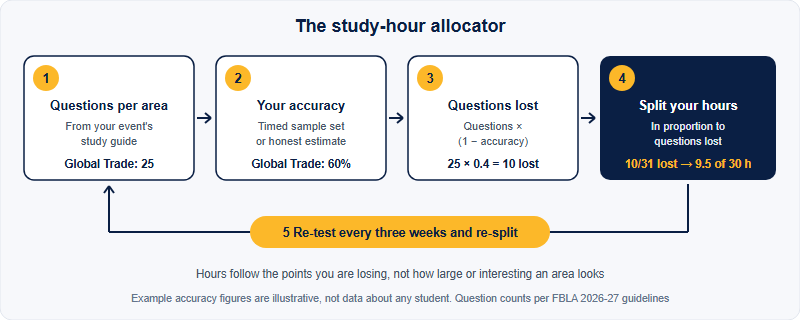
Here is the whole Economics test run through the allocator for a student with a year of IB Economics and 30 study hours. The accuracy figures are illustrative; replace them with your own after one timed sample set.
| Knowledge area | Questions | Estimated accuracy | Questions lost | Hours (of 30) |
|---|---|---|---|---|
| Global Trade | 25 | 60% | 10.0 | 9.5 |
| Nature of Business | 15 | 55% | 6.75 | 6.5 |
| Economic Indicators | 15 | 70% | 4.5 | 4.5 |
| Economic Systems | 15 | 80% | 3.0 | 3 |
| Cost/Profit Relationships | 10 | 75% | 2.5 | 2.5 |
| Fundamental Economic Concepts | 15 | 85% | 2.25 | 2 |
| Government’s Impact on Business | 5 | 60% | 2.0 | 2 |
| Total | 100 | 31.0 | 30 |
Two things the example shows. Nature of Business gets more than twice the hours of Economic Systems although both carry 15 questions, because its objectives, such as business models and organisational design, often sit outside an economics syllabus. And Government’s Impact on Business stays at 2 hours despite a weak estimate, because it holds only 5 questions.
For students in China, the study guides also show where US institutions are the content. Business Law’s Legal Foundations objectives cover US sources of law and the US judicial system, and its Employment Law area names OSHA and the ADA. Real Estate’s Laws and Regulations area covers Fair Housing laws and federal buyer protections. Personal Finance’s 50-question Financial Literacy area includes reading a pay stub, writing checks and preparing personal income tax forms. Start those areas at a lower accuracy estimate than your coursework suggests. Our international students guide covers the wider US-context gap.
What changed for 2026-27, and the eligibility rules to check
FBLA’s 2026-27 change summary reports no major structural changes, but knowledge areas and objectives were updated in 22 high school events. That list covers twelve Grades 9-12 tests (Accounting, Advanced Accounting, Advertising, Agribusiness, Business Communication, Business Law, Healthcare Administration, Human Resource Management, Insurance & Risk Management, Journalism, Organizational Leadership, Securities & Investments), four Grades 9-10 tests (Introduction to Business Communication, Business Procedures, Parliamentary Procedure and Supply Chain Management) and six role plays (Banking & Financial Systems, Entrepreneurship, Hospitality & Event Management, International Business, Parliamentary Procedure, Sports & Entertainment Management). If your event is on it, re-map last season’s notes against the new study guide before you drill them.
- Accounting is for early learners. To be eligible, members must have completed no more than two traditional semesters of high school accounting instruction, or one full year on a block schedule, by 1 May 2027. If you have taken accounting courses, ask your adviser how they count before entering.
- A top-10 national finish retires you from that event. A member who places in the top 10 at the National Leadership Conference cannot enter that event there again unless it has been modified beyond a name change; chapter events are exempt. The guidelines carry this across renamings: past top-10 placers in Accounting I cannot enter Accounting, in Accounting II Advanced Accounting, in Client Service Customer Service, and in Help Desk Technology Support & Services.
- Entry limits still apply. Each member may compete in one individual or team event plus one chapter event, and each state may send up to four entries per event.
A test result is also one of the easier awards for an admissions reader to cross-check. An Accounting or Economics placement sits naturally beside matching coursework grades and an activity entry describing how you prepared, and together they corroborate a consistent academic story that no single line can tell alone.
Questions about FBLA objective test blueprints
How many questions come from each knowledge area?
Each 2026-27 study guide lists a count per area, totalling 100. Introduction to FBLA is the exception, with no published test composition.
Can I use a calculator on FBLA objective tests?
Not your own. The 2026-27 guidelines provide an online calculator inside the testing platform, plus one piece of scratch paper.
Is there a penalty for guessing?
No. Each correct answer earns one point and wrong answers lose nothing, so every unanswered question is a point given away.
Which questions break ties?
Ten pre-selected tiebreaker questions, then twenty, then completion time. You are not told which ones they are, so treat every question as one.
Published by the FBLA editorial desk, operated by Hanlin Education for China-based international-school students. Official rules are set by the competition and change yearly — confirm current details on fbla.org. Errors are corrected within 7 working days.