FBLA’s 2026-27 high school topics document, dated August 2026, gives 23 events a topic. The topic is only the scenario. The requirements that move your score sit in each event’s guideline: interview counts, video length caps, platform limits, the statements you must analyse. This page puts all 23 topics on one board, adds what each guideline requires beyond the prompt, and ends with a readiness check you can score yourself against.
What the topic sheet gives you, and what it leaves to the guideline
The topics document says its job is to set the scenario; deliverables, specifications and judging criteria live in the event guidelines and rating sheets. Treat it as page one of the brief. Three topics prove the point: Business Ethics and Financial Planning keep their full scenarios inside their guidelines, and Financial Statement Analysis lists the exact statements to analyse in its event-specific section.
At the National Leadership Conference most topic events run the same clock: 3 minutes of set-up with no interaction with judges, a 7-minute presentation, then 3 minutes of questions, with no time moved between segments. Public Speaking and Introduction to Public Speaking run up to 5 minutes plus 2 minutes of questions, with notes prepared in advance allowed. Chapter-level and China-level rounds are organised locally, so confirm your round’s format with your adviser; the national route is set out in our guide to how qualification to nationals works.
One scoring detail makes the topic non-negotiable. Each topic event’s presentation rating sheet ends with an adherence row whose checklist includes “Presentation aligned with the assigned topic”, and FBLA’s 2026-27 change summary says that row is now scored on a 1-10 scale rather than a hard 0 or 10. A polished deck built for last season’s topic starts that row compromised. Current guidelines and topics are on the FBLA competitive events page.
The 2026-27 topic board: all 23 events
Team sizes, topics and requirements are condensed from the 2026-27 guidelines. Grades 9-10 events are marked.
Part one: analysis, finance and speaking topics
| Event (team size) | 2026-27 topic | What the guideline requires |
|---|---|---|
| Business Ethics (1-3) | Maintaining stakeholder trust during a food safety crisis | An executive summary of no more than three pages (title page, one-page summary, works cited) uploaded in advance, a 100-question test, then the presentation; interview three local businesspeople and show how their input shaped your recommendations. |
| Data Analysis (1-3) | Social engagement trends for a fictional company’s US Social Impact Plan | Work from the CEV data sets linked in the topic, 2017 to 2023; at least three visuals you created yourself; no internet in the room. |
| Financial Planning (1-3) | Rebuilding financial security for the Smith family | A full US household file (income, taxes, debts, 401(k), IRA, 529 plan, insurance) and deliverables including a revised monthly budget and a debt repayment plan. |
| Financial Statement Analysis (1-3) | Analyzing Costco’s financial performance | Costco’s fiscal 2025 annual report via SEC EDGAR; balance sheet, income, cash flow and shareholders’ equity statements; changes against prior periods; two or three strategic actions. |
| Supply Chain Management (1-3) | The Last Mile Challenge | Management, financial and demand planning, 20 points each on the rating sheet. Read the first trap below before building. |
| Introduction to Business Presentation (1-3, Grades 9-10) | Leading a multigenerational workforce | Business vocabulary, a stated purpose with a logical flow, realistic recommendations and technology-based visuals. |
| Future Business Educator (1) | Developing essential leadership skills | A lesson plan of no more than three pages on FBLA’s template, uploaded as a PDF; judges play students while you teach one part of it. |
| Public Speaking (1) | Discipline over talent: the habits of successful leaders | Up to 5 minutes plus 2 minutes of questions; four separate delivery rows for pace, engagement, vocal clarity and poise. |
| Introduction to Public Speaking (1, Grades 9-10) | Serving others | Same timing and delivery rows as Public Speaking; support the speech with examples from school, business or everyday life. |
Part two: media, design, marketing and code topics
| Event (team size) | 2026-27 topic | What the guideline requires |
|---|---|---|
| Broadcast Journalism (1-3) | How local businesses strengthen communities | A pre-recorded story of up to 2 minutes played inside the presentation; interview an owner, employee or community member; use the remaining time on verification, tools and editorial design. |
| Digital Video Production (1-3) | The power of community: stories that inspire | A documentary video of up to 2 minutes, submitted as a URL and pre-judged, then played in your presentation; if judges cannot open the link, the pre-judged score is zero. |
| Digital Animation (1-3) | The journey of a product, start to finish | The same URL, 2-minute and access rules; any animation platform; no QR codes inside the project. |
| Public Service Announcement (1-3) | Every bite counts: reducing food waste | A video of no more than 60 seconds, built from original content with no previously published clips; facts cited from quality sources. |
| Graphic Design (1-3) | Rebranding a renovated hotel | Logo, identity standards, promotional materials and branded assets; three 20-point rows for design process, audience appeal and tools; no internet. |
| Visual Design (1-3) | A public library and technology center experience | Four 20-point rows: design principles, technical skills, visual communication and creative process; no internet. |
| Social Media Strategies (1-3) | Relaunching an outdoor adventure rental business | At least three posts across multiple platforms, planned metrics and a clear call to action. |
| Introduction to Social Media Strategy (1-3, Grades 9-10) | Grand opening of a family mini golf course | A campaign on one platform, with three original, well-developed ads. |
| Coding & Programming (1-3) | Nonprofit volunteer management | Runs standalone with no errors; readme, source code and library documentation; input validation; an intelligent feature such as recommendations or smart filters; customisable reports. |
| Introduction to Programming (1-3, Grades 9-10) | A digital ordering system for a local business | Handle unavailable items, inventory limits, invalid entries and budget constraints; readme, source code, library list and credits. |
| Computer Game & Simulation Programming (1-3) | Road to the Championship | Multiple outcomes, well-defined rules, a title screen and accessible UX; explain your languages, tools or engine. |
| Mobile Application Development (1-3) | A group trip planner | Smartphone deployable and error-free; social media integration is a scored row; up to three personal devices, where most presentation events allow two. |
| Website Coding & Development (1-3) | A digital resource management website | Coded from scratch with no templates; responsive on desktop, tablet and mobile; source code and documentation carry a 20-point row. |
| Website Design (1-3) | A community resource website | Works on at least three platforms, includes interactive elements and states planned success metrics. |
Where each topic’s evidence has to come from
Sort the 23 topics by the raw material they need and a pattern appears that matters more to a China-based competitor than any topic title.
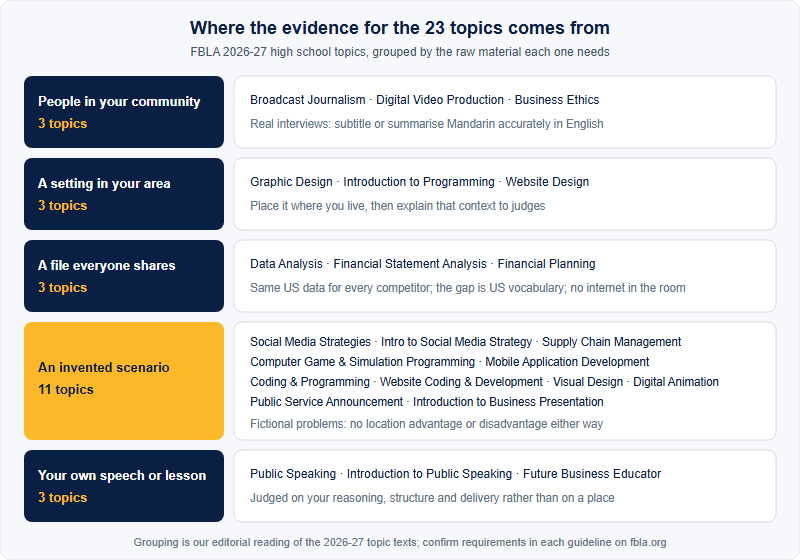
People in your community. Broadcast Journalism, Digital Video Production and Business Ethics need real interviews. The Broadcast Journalism and Digital Video Production topics name no country, so a Shenzhen bakery or a Shanghai community clinic is material a judge has not seen twenty times; Business Ethics gives every team the same case in its guideline, so there only the three required interviews come from your area. The cost is translation: Mandarin interviews need accurate English subtitles or a faithful summary, and judges need a sentence of context. Confirm with your adviser that your round accepts subjects outside the US before you film.
A setting in your area. Graphic Design’s hotel, Introduction to Programming’s local business and Website Design’s community resources can all be placed where you live without fieldwork. Treat the location as a design choice you explain, not an assumption the judge shares.
A file everyone shares. Data Analysis, Financial Statement Analysis and Financial Planning give everyone the same US data, filing or household. Nobody gets a local edge; for students in China the gap is vocabulary, such as the Smith family’s 401(k), IRA and 529 plan or Costco’s US statement titles. All three run without internet in the room, so every chart must travel offline.
An invented scenario, or your own argument. The remaining fourteen topics are a fictional business problem or a speech or lesson you author. Location gives no edge either way, which makes them the fairest ground for a student competing from outside the US.
One China-specific warning. For the two pre-judged video events, FBLA’s best-practice note suggests Google Drive or OneDrive shared with anyone who has the link, or YouTube or Vimeo set to Unlisted, and a video judges cannot open scores zero. Before the deadline, ask someone outside mainland China and outside your school network to open the link. A link that only works inside China, or asks for a login, risks the whole pre-judged score. Our international students guide covers the wider mechanics of competing from a China campus.
Three traps in this year’s topic set
1. Supply Chain Management has two briefs. The topic is last-mile delivery at a fast-growing online retailer, yet the event-specific list in the same guideline still describes launching a limited-edition product line, choosing ethical suppliers, pricing for a donation margin and forecasting youth demand. The three 20-point planning rows fit either brief. Build to the topic, since topic alignment is on the adherence checklist, and ask your adviser to confirm with FBLA which bullets apply. Do not guess, and do not merge the two.
2. The two social media events want opposite platform strategies. Social Media Strategies scores at least three posts across multiple platforms. Introduction to Social Media Strategy wants a campaign on a single platform with three original ads. A Grade 10 student planning to move up next season should expect to rebuild the campaign structure rather than reuse it.
3. Length caps cost points quietly. The Public Service Announcement video tops out at 60 seconds and Broadcast Journalism’s pre-recorded story at 2 minutes, a cap also on that event’s adherence checklist. The pre-judged sheets for Digital Video Production and Digital Animation carry a 5-point row that is simply over or under 2 minutes, and over scores 0. Edit to a few seconds under the cap.
Decode your own topic in 20 minutes, then score your readiness
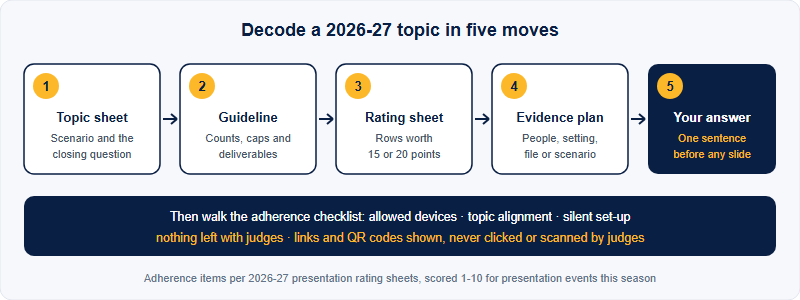
- Restate the scenario in one sentence: who the client is and what decision or artefact they need.
- Copy every number the guideline attaches: interviews, visuals, posts, recommendations, pages, seconds, devices.
- Circle the rating-sheet rows worth 15 or 20 points. That is where most of your hours should go.
- Label your evidence source (community people, a local setting, a shared file or an invented scenario) and note what you must obtain, and by when.
- Answer the topic’s closing question in one sentence. If you cannot yet, you have a subject but not a thesis.
- Walk the adherence checklist: allowed devices, topic alignment, silence during set-up, nothing left with judges, and links or QR codes shown but never clicked or scanned by judges.
Then score yourself: 2 points if the statement is fully true today, 1 if it is partly true, 0 if not.
| # | Readiness statement | Score (0-2) |
|---|---|---|
| 1 | I have read my event’s full 2026-27 guideline, not just the topic sheet. | |
| 2 | I can answer the topic’s closing question in one sentence. | |
| 3 | Every “at least” and “no more than” number is written into my plan. | |
| 4 | My evidence is secured: interviews booked, data or filing saved offline, or scenario assumptions written down. | |
| 5 | I know which rows carry 15 or 20 points, and my plan spends time on them first. | |
| 6 | My format risks are handled: video link tested from outside China, offline copies for rooms without internet, device count checked. |
10-12: build now; the remaining risk is execution. 6-9: fix every zero before you design a single slide, starting with statement 1. 0-5: pause and check whether this event suits your season at all; our competitive events guide compares the formats side by side.
Questions about the 2026-27 topics
When did FBLA publish the 2026-27 topics?
The high school topics document is dated August 2026 and sits with the 2026-27 guidelines on fbla.org. Check the date on any copy you download.
Does every FBLA event have a topic?
No. Twenty-three high school events carry a 2026-27 topic. Tests, role plays and events such as Business Plan, Career Portfolio, Event Planning, Sales Presentation and Job Interview do not; Impromptu Speaking’s topic is given on-site.
Can I reuse last season’s presentation?
Reuse the skills, not the deck. Presentation rating sheets check that your presentation aligns with the assigned topic, so an old topic costs points.
Can students in China use a local business for community topics?
The topic texts name no country. Confirm with your adviser that your round accepts it, and give judges clear context in English.
Published by the FBLA editorial desk, operated by Hanlin Education for China-based international-school students. Official rules are set by the competition and change yearly — confirm current details on fbla.org. Errors are corrected within 7 working days.