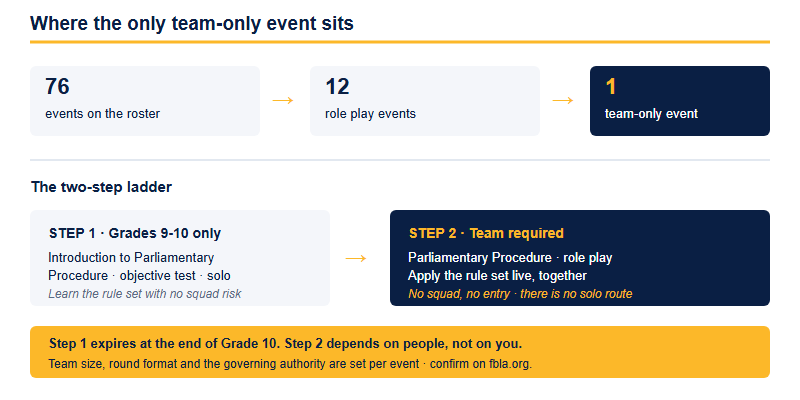
Of the 76 competitive events on the FBLA high school roster for 2026-27, exactly one is labelled team-only: Parliamentary Procedure. Every other event you can enter alone or choose to enter alone. That single structural fact should drive your decision more than any interest in the subject — because without a committed squad, this event is not available to you at all.
One event in seventy-six has no solo door
The roster sorts into objective tests, presentation events, role plays, chapter events and one production event. Most events carry an “Individual” or “Individual or Team” label, meaning you decide the entry shape. Parliamentary Procedure sits in the role play category carrying the label Team — the only one in the roster that does.
That makes it structurally unlike everything else described in the competitive events guide. In an individual event, your preparation is a private variable you control. Here, your preparation is a group’s shared property. If two teammates drift in February, your season does not get harder — it ends. Students routinely underweight this, choose the event on interest, and discover in March that the squad exists on paper only.
There is also a second, quieter door into the same subject. The 9th and 10th grade band includes Introduction to Parliamentary Procedure, an objective test, individual entry, restricted to those two grades. That gives the subject an unusual shape: a solo, low-commitment test to learn the rule set as a junior student, then a team role play once you have people.
| Introduction to Parliamentary Procedure | Parliamentary Procedure | |
|---|---|---|
| Category | Objective test | Role play |
| Entry | Individual | Team — the only team-only event in the roster |
| Who may enter | 9th and 10th grade only | Open per the current guideline — confirm on fbla.org |
| What it rewards | Knowing the rule set cold | Applying the rule set live, together, under observation |
| Failure mode | Vague recall of motion properties | A squad that never rehearsed as a squad |
| Dependency on other people | None | Total |
The Introduction event expires. It is available in grades 9 and 10 and then it is gone, which makes it one of the small set of events with a genuine deadline attached to your age rather than the calendar. A Grade 9 student interested in this track has a clean two-year runway; a Grade 11 student does not have the option at all and must go straight to the team event.
The motions reference you actually have to own
Parliamentary procedure is a rule system for running a deliberative meeting: how business is introduced, debated, changed and decided. In US practice the standard reference is Robert’s Rules of Order, and the properties below are the general conventions of that system.
Two cautions before you memorise anything. First, parliamentary authorities differ in detail and editions are revised, so treat this as a study scaffold and verify against the authority named in your event’s current guideline on fbla.org. Second, the table teaches the shape of the system — for a competitive round you need the fuller set, not eleven rows.
| Motion | What it does | Second? | Debatable? | Amendable? | Vote needed |
|---|---|---|---|---|---|
| Main motion | Introduces new business | Yes | Yes | Yes | Majority |
| Amend | Changes the wording of a pending motion | Yes | Yes | Yes | Majority |
| Refer to committee | Hands the question to a smaller group | Yes | Yes | Yes | Majority |
| Postpone to a certain time | Delays the question to a stated point | Yes | Yes | Yes | Majority |
| Limit or extend debate | Changes how long debate may run | Yes | No | Yes | Two-thirds |
| Previous question | Closes debate and forces the vote | Yes | No | No | Two-thirds |
| Lay on the table | Sets the question aside temporarily | Yes | No | No | Majority |
| Recess | Pauses the meeting briefly | Yes | No | Yes | Majority |
| Adjourn | Ends the meeting | Yes | No | No | Majority |
| Point of order | Says a rule is being broken | No | No | No | Chair rules; no vote |
| Suspend the rules | Sets aside a rule for a specific purpose | Yes | No | No | Two-thirds |
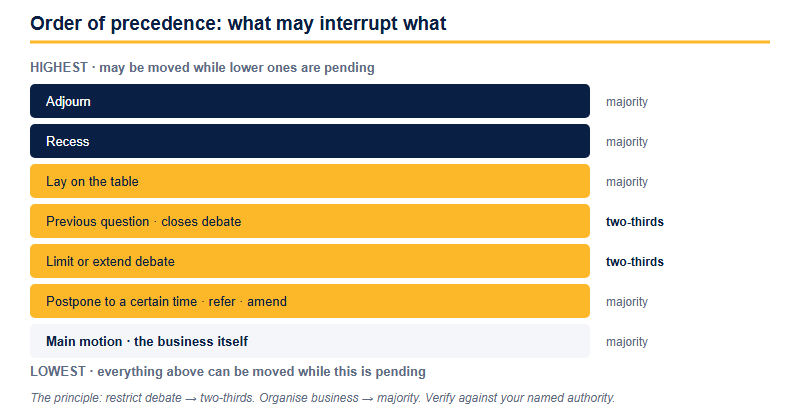
The pattern to internalise is not the rows but the logic joining them: most motions that curtail a member’s right to debate need a two-thirds vote, while motions that merely organise business need a majority — lay on the table is the exception to watch, since it sets a question aside on a majority. Once you see that, closing debate at two-thirds and referring to committee at a majority stop being two facts to memorise and become one principle you can reason from when a round throws something unfamiliar at you. That reasoning ability is what separates a squad that has memorised a table from a squad that can run a meeting.
The squad go/no-go check
Run this before anyone starts memorising anything. Score one point per statement that is true today — not true in an optimistic version of next term.
- We have the number of committed members the current guideline requires, plus at least one reserve.
- Every one of them has said yes to a weekly rehearsal, out loud, knowing the date.
- None of them is already carrying a presentation event with a heavy build window this season.
- Our adviser has agreed to sit in on rehearsals, or we have another adult who will.
- We have a room and a recurring time slot that survives exam weeks.
- At least two of us are willing to chair — the role nobody volunteers for and everybody needs.
- We can all be in the same room, in person, most weeks.
- Our Grade 12 members will still be present and engaged in the spring term.
7-8 points — go. You have the rarest ingredient in this event, which is not talent but attendance. Start with the rule set and move to full mock meetings early; the rules are learnable alone, but the coordination only develops in rehearsal.
5-6 points — conditional. Fix the missing conditions first, in writing, before registering anyone. Most commonly it is the room and the recurring slot, and that is solvable in a week.
Under 5 — no-go this season, and that is a finding rather than a failure. Grade 9 and 10 students should take Introduction to Parliamentary Procedure instead: it is solo, it teaches the same rule set, and it costs the chapter nothing in coordination. Build the squad through the year and enter the team event next season with people who already know the material. Older students without a squad are better served by an individual event; the events guide lays out the alternatives.
Why this event fits some China chapters and defeats others
There is a real and under-discussed argument for this track at an international school in China. In our own coaching experience, the events that most disadvantage a strong non-native speaker are the ones scored on idiomatic fluency and US cultural reference — the impromptu formats, where an unfamiliar prompt has to be filled with natural-sounding English in seconds. Parliamentary procedure is close to the opposite. The content is a finite, written, published rule system. The language is formulaic by design: motions are made in set phrases, the chair responds in set phrases, and precision matters more than idiom. A student who is a disciplined learner and an anxious improviser is often much stronger here than in a speaking event.
The counterweight is equally real, and it is the reason we do not recommend this event broadly. It requires the scarcest resource a young chapter has: several students showing up to the same room, repeatedly, for months, for an event none of them can complete alone. A chapter that cannot yet sustain a weekly meeting will not sustain this. That is why the go/no-go check above is about attendance rather than ability — ability is the part you can fix.
Two practical notes for competing from outside the US. Rehearsing in person matters more here than in almost any other event, because the thing being trained is a group’s timing rather than an individual’s knowledge; if your squad is split across campuses, weight that heavily in your go/no-go. And the round is run by people who use this system natively, so build in rehearsal time specifically for hearing and responding at speed rather than only reading the rules. The international students guide covers the wider mechanics of competing from a China campus.
On what a result does for an application, keep the framing accurate. A placement in a team-only event is read alongside everything else in your file — an admissions reader checks an award against the transcript, the activity list and the essays. This particular event corroborates a specific claim well: if you describe yourself as someone who can run a meeting, hold a group to a process, or take a formal leadership role, a result here is evidence for it, and it lines up naturally with a chapter officer role or a leadership essay. It does much less work sitting alone in a file that says nothing else about you. Make the rest of the file true and the result confirms it.
Questions about the parliamentary procedure track
How many students does the team event need?
Team size is set in the current event guideline and can change between seasons. Confirm the number on fbla.org before recruiting.
Can I enter Parliamentary Procedure on my own?
No. It is labelled team-only on the roster — the only such event in 76. Without a squad, choose a different event.
Is the Introduction event open to Grade 11 students?
No. Introduction to Parliamentary Procedure is restricted to grades 9 and 10, so the option expires after Grade 10.
Which parliamentary authority does the round use?
The guideline names the governing authority and editions are revised. Check your event page on fbla.org rather than assuming.
Published by the FBLA editorial desk, operated by Hanlin Education for China-based international-school students. Official rules are set by the competition and change yearly — confirm current details on fbla.org. Errors are corrected within 7 working days of notice.