The national FBLA deadlines you will meet this season are stamped in US Eastern Time, and Beijing runs 12 or 13 hours ahead of it depending on the month. On top of the clock sit conditions that have nothing to do with how well you compete — membership, registration and conference housing — and any one of them can make a result not count. This is the pre-clearance check.
The conditions that have nothing to do with your performance
Students prepare for the part of the season that is scored. The part that disqualifies you is administrative, sits in the eligibility block of your event guideline, and is usually owned by somebody other than you.
We read the 2026-27 Data Science & AI guideline in full as a worked example of how an eligibility block is written. It states that national membership dues must be paid to the division by 11:59 p.m. Eastern Time on March 1, that competitors must be officially registered for the National Leadership Conference, and that competitors must stay within the official FBLA housing block. It also states that each state may submit up to four entries per event.
Those values come from one event’s guideline and are printed per event. Do not assume they carry across to yours — open your own event’s page on fbla.org and read its eligibility block yourself. What does carry across is the shape of the problem: there is a membership condition, a registration condition, a conference-conduct condition and an entry quota, and each has a different owner.
| Condition | Who actually owns it | When it bites | What happens if it fails |
|---|---|---|---|
| National membership dues paid to the division | Your chapter adviser submits; your family usually pays. You almost never control the submission itself. | A stated date and time in Eastern Time — 11:59 p.m. ET on March 1 in the guideline we read | You are not an eligible competitor, regardless of how you performed at any earlier level |
| Official registration for the conference | Adviser or chapter, on a separate process from membership | A separate deadline from dues — being a paid member does not register you | Not registered, not competing |
| Staying within the official conference housing block | Whoever books the hotel — very often a parent trying to save money | At booking time, months before travel | An eligibility condition breached by a booking decision, not by anything you did in the room |
| Entry quota per event | Your affiliate or state association, not you | At the point entries are submitted upward | You can qualify on merit and still not receive a slot if the quota is full |
| Grade eligibility for your specific event | You, at registration | Before you register, every single season | Wrong event for your grade band — a wasted season with no route to appeal |
The housing condition deserves a paragraph on its own, because it is the one that catches China-based families hardest. The instinct when flying a student to a US conference is to book the cheapest acceptable hotel nearby — that is normal, sensible family budgeting everywhere else in life. Here it can sit against an eligibility condition. Read the housing requirement before anyone opens a booking site, not after, and treat the conference housing line as a fixed cost rather than a variable one when you build the trip budget.
Your deadlines are not on your clock
US Eastern Time is UTC−5 in winter and UTC−4 during daylight saving. China Standard Time is UTC+8 all year and observes no daylight saving at all. So the gap between the two is 13 hours for most of the competitive season and 12 hours from mid-March onward.
That produces the single most useful table in this article. A deadline stamped late in the US evening lands the following day in China — which is a trap in both directions. Students who assume “March 1” means the end of March 1 in Beijing are guessing: an early-morning Eastern stamp expires while it is still 1 March in Beijing, and a late-evening one does not expire until the next afternoon; students who discover the extra hours treat them as slack and file at the very edge.
| Deadline stamp (Eastern) | Beijing time, winter (ET = UTC−5) | Beijing time, US daylight saving (ET = UTC−4) |
|---|---|---|
| 11:59 p.m. ET | 12:59 p.m. the next day | 11:59 a.m. the next day |
| 5:00 p.m. ET | 6:00 a.m. the next day | 5:00 a.m. the next day |
| 12:00 noon ET | 1:00 a.m. the next day | 12:00 midnight, start of next day |
| 9:00 a.m. ET | 10:00 p.m. the same day | 9:00 p.m. the same day |
| 8:00 a.m. ET | 9:00 p.m. the same day | 8:00 p.m. the same day |
Worked through with the example value: a deadline of 11:59 p.m. Eastern on 1 March falls while the US is still on standard time, so it expires at 12:59 p.m. Beijing time on 2 March — lunchtime the following day, in the middle of a school day. That is a genuinely different planning problem from “before I go to bed on the first”.
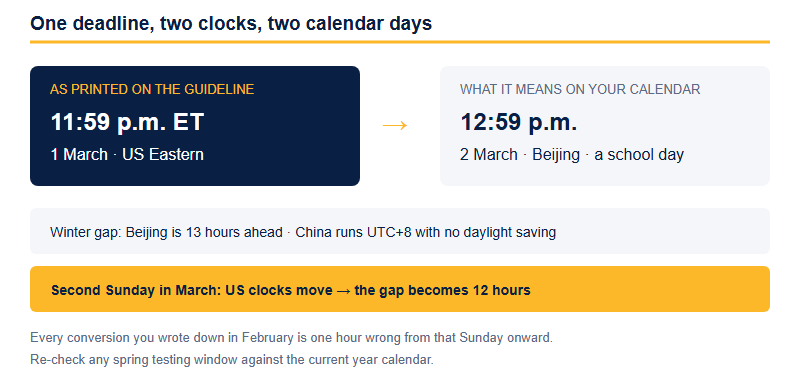
The March hinge: one Sunday moves everything you wrote down
US daylight saving begins on the second Sunday in March and ends on the first Sunday in November. China does not shift at all. The practical consequence for a competitor in Shanghai or Shenzhen is narrow but sharp:
- Before the second Sunday in March, Beijing is 13 hours ahead of Eastern Time.
- From that Sunday until early November, Beijing is 12 hours ahead.
- A membership deadline dated 1 March therefore falls in the 13-hour period, while spring testing windows and any conference dates published for later in the season fall in the 12-hour period.
So the season straddles the switch. If you build a conversion sheet in January and reuse it in April, every entry on it is off by an hour — and an hour is exactly the margin people leave themselves. Build the sheet twice, or annotate each row with which side of March it belongs to. Confirm the current year’s daylight saving dates rather than trusting this paragraph, since the rule is a calendar convention rather than an FBLA rule.
The pre-clearance sequence
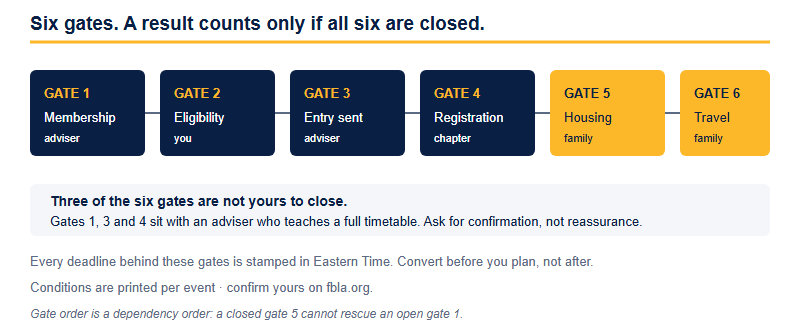
Work this backwards from the conference rather than forwards from today. Each step below is a gate: if it is not closed, the steps after it are wasted effort.
| Gate | What you verify | Who you have to chase | Evidence you keep |
|---|---|---|---|
| 1. Membership | Dues actually received by the division, not merely paid to your school | Adviser | A written confirmation naming you, dated before the deadline |
| 2. Event eligibility | Your grade band matches the event you intend to enter this season | Yourself, against the current guideline | The guideline PDF, downloaded and dated |
| 3. Entry submitted | Your name is on the entry list that goes upward, not on a draft list at school | Adviser | Confirmation that the entry was submitted, not just prepared |
| 4. Conference registration | Registration completed as a separate action from membership | Adviser or chapter | Registration confirmation |
| 5. Housing | Booking sits inside the official conference housing requirement | Whoever holds the credit card | Booking confirmation showing the qualifying property |
| 6. Travel documents | Passport validity and any visa appointment lead time | Family | Appointment confirmation — start early, lead times vary |
The uncomfortable structural fact in that table is that three of the six gates are not yours. Your adviser is a teacher with a full workload, and FBLA administration is rarely their main job. The behaviour that works is not nagging — it is giving them something trivially easy to action: a single message naming the exact task, the exact deadline in their time zone, and the exact information they need from you, with nothing left to look up. Ask for confirmation that the task is done rather than asking whether they remember it.
Three failures that are specific to competing from China
The dues chain has an extra link. In a US chapter, a student pays the adviser and the adviser submits. From a China campus there is often an additional step — a school finance office, an international payment, or a parent transferring funds — and each link adds days. The deadline applies to when dues reach the division, not when your family paid the school. Ask your adviser to confirm receipt upstream, and start early enough that a failed payment can be retried.
The quota is invisible to you. The guideline we read states a cap of four entries per event per state. Whatever route you compete through, some quota governs how many entries move upward, and it is administered above your head. You can be excellent and still not receive a slot, which is an argument for choosing a thinly contested event and for understanding how qualification to nationals actually works before you build expectations.
Testing windows land at hostile local hours. A window that opens at 8:00 a.m. Eastern opens at 9:00 p.m. in Beijing during the winter months. That is survivable but it is not neutral: you are competing at the end of your school day against students who are starting theirs. Where you have any choice of slot, take the one that falls at a time when you are actually awake and sharp, and rehearse at that hour beforehand rather than discovering the effect on the day. Our own coaching experience with China-based cohorts is that a first timed rehearsal scheduled at the real local hour is worth more than two extra content sessions.
None of this is a reason to be pessimistic about competing from outside the US — students do it every year, and the administrative load is front-loaded rather than continuous. It is a reason to close the six gates in September and October rather than in the week the deadline bites. The international students guide covers the surrounding mechanics, and the competitive events guide shows how the event you are clearing yourself for fits the wider roster.
Questions about deadlines, clocks and eligibility
Is Beijing 12 or 13 hours ahead of Eastern Time?
Thirteen hours in winter, twelve while the US is on daylight saving from the second Sunday in March. China never shifts.
When exactly does an 11:59 p.m. Eastern deadline expire in China?
At 12:59 p.m. the next day in winter, or 11:59 a.m. the next day during US daylight saving. Work to the earlier of the two.
Can our family book any hotel for the conference?
Guidelines can require staying within the official housing block. Read your event’s eligibility block on fbla.org before booking anything.
My dues were paid to my school on time. Am I safe?
Not necessarily — the deadline concerns dues reaching the division. Ask your adviser to confirm receipt upstream in writing.
Published by the FBLA editorial desk, operated by Hanlin Education for China-based international-school students. Official rules are set by the competition and change yearly — confirm current details on fbla.org. Errors are corrected within 7 working days of notice.