Something will go wrong. A file will not open, a judge will interrupt, your mind will empty on slide three. What separates competitors is not whether it happens but what they do in the next twenty seconds — because published FBLA rating sheets score row by row, so one bad minute only costs the rows it actually touches, unless you let it spread. This is the recovery playbook.
Why recovery is worth more points than perfection
Published FBLA high school rating sheets are built as a grid. Each criterion is marked at one of four levels — “Not Demonstrated,” “Below Expectations,” “Meets Expectations,” “Exceeds Expectations” — the mark goes into a Points Earned column, and each row carries its own point value. Penalties sit in their own block at the bottom; published sheets have carried lines such as “5 points for late arrival to the assigned presentation time” and a dress code deduction. The precise criteria, point values and penalties are set event by event and rewritten each cycle, so pull your own sheet from fbla.org.
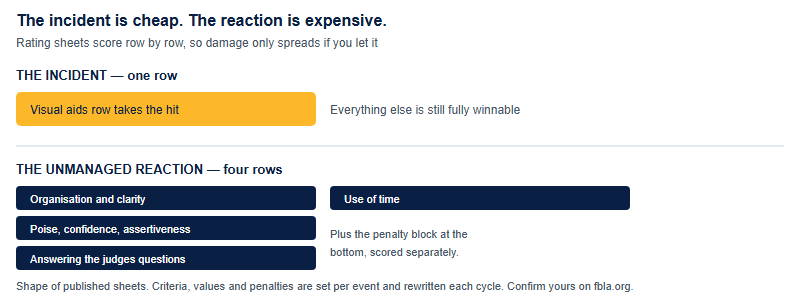
That architecture has a consequence most competitors never think through. An incident damages the row it lands on. A reaction damages every row still to come. A slide that fails is a small problem confined to visual aids. A competitor who spends the following ninety seconds apologising, hurrying and losing their thread has instead spent points on organisation, poise, and their answers to questions — rows that were still fully winnable a minute earlier.
One boundary before the playbook. This page covers recoverable incidents — things that go wrong and can be handled in the room. It does not cover eligibility, integrity or entry problems, which are governed by the guidelines rather than by your composure and are a separate matter entirely. If something in that category surfaces, raise it with event staff rather than improvising, and confirm the position on fbla.org.
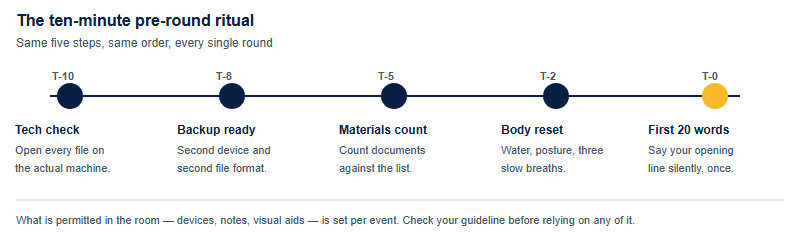
The ten-minute pre-round ritual that prevents half of them
Of the fourteen modes below, roughly half are prevented outright by a fixed routine in the ten minutes before you go in. Fixed is the operative word: the point of a ritual is that it runs identically when you are nervous.
The fourteen failure modes and the scripted recovery
Read the script column aloud a few times before your competition. The purpose of a script is not to sound robotic; it is that under adrenaline you will not invent good language, so it has to already exist.
| # | What goes wrong | What it typically costs | The next 20 seconds |
|---|---|---|---|
| 1 | Your file will not open on the venue machine | Setup time, then composure if you unravel | Name it once, switch, keep moving: “I will use my backup copy — one moment.” Do not narrate the troubleshooting. |
| 2 | Display or adapter gives no signal | The visual aids row, and nothing else if you adapt | Go on without it: “I will describe this rather than show it.” Then deliver as if you always intended to. |
| 3 | A required document is missing from your materials | Potentially the penalty block, not just a row | Tell event staff immediately, before the round — never raise it first with judges. Whether a substitute is allowed is a guidelines question, not yours to assume. |
| 4 | The schedule shifts and you are called early | Rhythm, and every row it drags down | Do not re-run everything. Say your opening line once, check your materials count, walk in. |
| 5 | You blank mid-presentation | Only organisation, if it is short | Stop. Breathe once. Jump to your next structural landmark: “The key point here is…” Never say “sorry, I forgot.” |
| 6 | You realise you skipped a section | Content coverage on that section alone | Do not rewind unless it is load-bearing. Fold it in before you close: “Before I finish, one point I should add on…” |
| 7 | A slide shows a wrong number or a typo | Less than you fear, if you own it | Correct it once, plainly: “That figure should read X.” Accuracy awareness reads as competence; pretending it is not there does not. |
| 8 | You are running over time | Time-related criteria, and any penalty your event defines | Do not speed-read. Cut to the landing: “To close — the recommendation is X, because Y.” |
| 9 | You finish far too early | Depth and coverage rows | Do not pad. Offer depth and hand back control: “That completes the presentation; I am glad to expand on the implementation plan.” |
| 10 | A judge interrupts mid-flow | Usually nothing — interruption is often interest | Stop immediately, answer fully, then bridge: “To pick up where I was…” Never talk over a judge. |
| 11 | A teammate freezes or contradicts you | Team coordination rows; more if you argue | Hand them a bounded question rather than taking over: “You built the cost model — can you take the numbers?” If contradicted, do not litigate it: “We examined it both ways; the version in our report is X.” |
| 12 | You do not understand the question | Nothing, if you ask. A whole row, if you guess | Clarify once, precisely: “Could you rephrase — do you mean X, or Y?” Answering a different question is the lowest-scoring outcome available. |
| 13 | A judge challenges a number you cannot defend | Evidence rows, plus credibility if you bluff | Concede cleanly and rescue the argument: “You are right that it is an estimate; the recommendation holds because…” |
| 14 | A question falls outside your scope | Nothing, if you bound it honestly | Name the boundary, then give what you do have: “That is outside what we tested. What we can say is…” |
Modes 12 and 13 deserve emphasis for anyone competing in a second language. Asking a judge to rephrase is ordinary professional behaviour, not an admission of weakness, and it is dramatically cheaper than answering a question you misheard. The wider context problem — judges who have no reference point for your school or your market — is covered in our guide for international students competing in FBLA.
The recovery grammar: four moves, in this order
Every script in that table is the same four moves underneath. Learn the moves and you can generate a recovery for something not on the list.
- Pause. One full second of silence. It feels like ten to you and like nothing to the judges, and it stops the panic-acceleration that ruins the following minute.
- Name it once. Six words maximum, no apology stacking. “One moment, I will use my backup.” A single calm acknowledgement reads as control; three apologies read as collapse.
- Bridge. A fixed phrase that returns you to the structure — “The key point here is…”, “To return to where I was…”. Have exactly one bridge phrase and use it for everything.
- Resume at a landmark, not at the break. Do not try to rejoin the sentence you lost. Restart at the nearest section heading, which you know cold.
Two habits to unlearn, both common and both expensive. The first is the apology loop — “sorry, sorry, one second, sorry” — which converts a five-second technical problem into a visible thirty-second loss of composure. Say it once. The second is narrating your own troubleshooting: judges do not need to hear that the adapter worked this morning. Silence while you fix something is far stronger than commentary.
Practise the recovery, not just the presentation. In your last two rehearsals before a competition, have someone deliberately break something — kill the slides at minute three, interrupt with a question, or tell you to finish two minutes early. A competitor who has rehearsed a failure once behaves completely differently from one who has only rehearsed success.
What to check before you rely on any of this
Recovery is about what you control; the rules are not. Time limits, what technology and materials are permitted, whether questions are a timed segment, dress expectations and the penalty structure are all set event by event, and FBLA has stated the 2026-2027 Competitive Events Guidelines, including topics, go live at the beginning of September. FBLA also notes these documents may see small changes through the year, so check the date in the footer of whichever file you downloaded — the version you prepared from in September is not automatically the version in force in the spring.
Three specifics worth confirming in your own guideline rather than assuming: what happens if you exceed the time limit, whether you may bring notes or a backup device into the room, and what the dress requirement is, since published sheets have carried a dress code deduction in the penalty block. If you are still choosing between formats, our guide to the competitive events sets out what each one asks of you, and how to qualify for NLC explains the levels you would move through.
Questions students ask about competition day
Should I apologise when something goes wrong?
Once, in six words or fewer, then move on. Repeated apologies cost far more than the original problem did.
Is it acceptable to ask a judge to repeat a question?
Yes, and it is far cheaper than answering the wrong question. Ask once and be specific about what you need clarified.
What if my technology fails completely?
Deliver without it and describe what the visual would have shown. What equipment is permitted is set per event — confirm on fbla.org.
Do judges penalise nerves?
Sheets score observable delivery such as organisation and poise, not how anxious you feel. Recovery behaviour is what shows.
Published by the FBLA editorial desk, operated by Hanlin Education for China-based international-school students. Official rules are set by the competition and change yearly — confirm current details on fbla.org. Any error here is corrected within 7 working days.