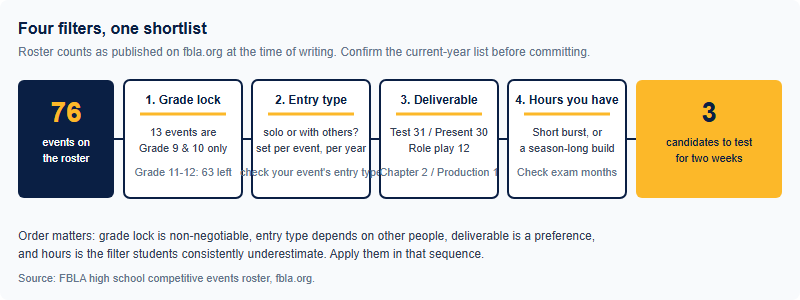
Do not pick an FBLA event by subject. Pick it by four constraints you already know about yourself: your grade, whether you have reliable teammates, what kind of thing you are willing to produce, and how many hours you actually have. Run those four filters against the roster of 76 and you get a shortlist of three. This page is that instrument.
Why “choose by interest” fails and “choose by constraint” works
Every August, students open the events list, see a name that matches their intended major, and enter it. Then in February they discover the event needs three teammates who never show up, or a live presentation in English they had not budgeted hours for, or that they picked something available only to Grades 9 and 10 and cannot re-enter it as a junior.
The subject is the easy part. What determines whether you finish the season is the delivery mechanism — sitting a timed objective test alone is a fundamentally different commitment from producing a written entry plus a live defence with a team. FBLA sorts its roster along exactly those mechanical lines, which is convenient: the official categories are already a constraint map, if you read them that way.
On the roster published on fbla.org at the time of writing, the high school division shows 76 events split into five categories: 31 Objective Tests, 30 Presentation Events, 12 Role Play Events, 2 Chapter Events and 1 Production Event. Those five categories are your first and most useful filter, because they describe what you will physically be doing, not what you will be reading about.
The matcher: find the row that describes you
Read down the left column until you find the sentence you would actually say out loud about yourself. Then take the category on that row and pull candidates from the current roster. Do not skip to the examples — the point is the category, because event names change from year to year and categories do not.
| If this is you | Your category | What you actually hand in | Examples on the current roster |
|---|---|---|---|
| “My English reading is strong but I freeze speaking to adults” | Objective Tests (31) | A timed test, sat alone. No judge in the room evaluating your speech. | Accounting, Economics, Cybersecurity, Business Law, Securities & Investments |
| “I want the biggest signal and I will do the work all year” | Presentation Events (30) | A substantial produced entry plus a live presentation to judges. | Business Plan, Data Analysis, Sales Presentation, Social Media Strategies |
| “I think fast under pressure but hate long written projects” | Role Play Events (12) | A case handed to you on site, short prep, then a performance. | Marketing, Entrepreneurship, Business Management, International Business |
| “My skill is software, not talking about business” | Production (1) or the tech end of Presentation | Output produced against the clock, or a built artefact you demo. | Computer Applications; Coding & Programming, Website Design |
| “I am the one who organises everyone else in my chapter” | Chapter Events (2) | Documentation of real chapter work carried out over the year. | Community Service Project, Local Chapter Annual Business Report |
| “I am in Grade 9 or 10 and want a real shot this year” | The 13 grade-restricted events | Same formats, smaller field — you meet only Grade 9-10 entrants. | Introduction to Business Concepts, Introduction to Programming |
| “I have one dependable friend and we work well together” | Events whose guideline allows either an individual or a team entry | Same entry, shared load — but a single shared score. | Business Ethics, Graphic Design, Financial Planning, Event Planning |
One honest caveat before you act on the examples column: FBLA rewrites its competitive events every year, and the 2026-27 guidelines, including topics, release at the beginning of September per fbla.org. Events get added, retired and renamed. Use the category logic to decide, then confirm on fbla.org that your specific event still exists in the new guidelines before you invest a single hour in it.
The expiring inventory: 13 events that vanish after Grade 10
This is the part of the roster most students discover a year too late. Thirteen events on the 2025-26 list carried a “9th & 10th Grade Only” restriction, leaving 63 for older students. If you are in Grade 9 or 10 now, you are holding inventory that expires. Confirm the 2026-27 count on fbla.org once the new list is published.
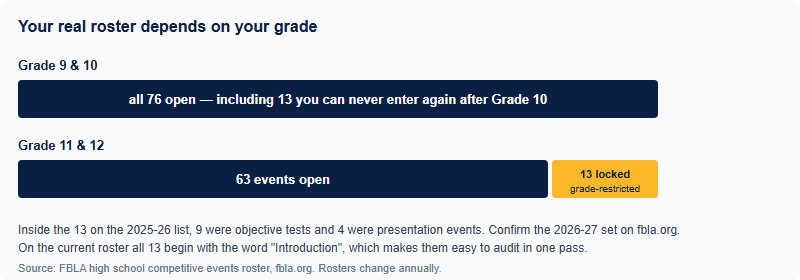
The strategic read for a Grade 9 or 10 student is not “these are the easy ones.” It is that the field in a grade-restricted event contains only other Grade 9 and 10 students, whereas an open event puts you against seniors with three more years of accounting, coding or public speaking behind them. That is a materially different field, and it is available to you for a strictly limited window.
The read for a Grade 11 student is the mirror image: you no longer have a beginner lane, so your event choice has to be justified by something else — accumulated skill, a genuine artefact, or a subject you can go deeper on than a first-year competitor can. If you are new to FBLA in Grade 11, read the China chapter guide for international students for how the entry route works before you worry about which event.
The entry-type math to check before you commit
The category tells you what you do. The entry type tells you who you depend on, and it is the filter students skip. Entry type is set per event in the annual guidelines, and roughly half the roster has historically allowed either an individual or a team entry. Check the entry type for your own event on fbla.org rather than assuming it.
Three practical consequences follow.
- “Individual or team” is a choice you make, not a requirement. Roughly half the roster lets you enter alone. If your chapter is small or unreliable, you are not shut out of the strong events — you simply carry the whole load yourself.
- A small number of events require a team entry. If you cannot field a team, check which events on your year’s list are team-entry only before you rule anything in or out.
- A team entry produces one score for everyone. Choosing “team” is a bet on your partners’ follow-through, not just on the subject. Make it deliberately, and make it early enough that a replacement is still possible.
If you are weighing this properly, the fuller treatment of how each format changes your preparation sits in the complete competitive events guide.
The fourth filter: hours, honestly counted
The last filter is the one students get wrong, because they estimate the work by how interesting the event sounds rather than by its shape. The categories differ less in total hours than in how those hours are distributed, and distribution is what collides with your school calendar.
- Objective tests are compressible. The work is study, it can be broken into thirty-minute blocks, and it can be paused for two weeks during mocks and resumed without loss. If your term is unpredictable, this shape forgives you.
- Presentation events are not compressible. They require a produced artefact, which means long uninterrupted blocks, and they have a hard tail — the presentation must be rehearsed close to the conference, when exam pressure is often highest. Choosing one is choosing to defend a weekly slot from September onwards.
- Role plays front-load almost nothing and back-load everything. Preparation is repeated practice rather than production, so the calendar risk is different: the danger is not running out of time, it is never actually rehearsing out loud because nothing forces you to.
- Chapter events run on other people’s schedules. The documented work happens across the year and depends on your chapter actually doing things. You cannot compress it in April.
Do the count against your real year, not an average one. Mark your heaviest four weeks — mocks, internal assessments, coursework deadlines — then ask whether the event you are considering can survive them. An objective test can. A presentation event with a February deliverable and an April rehearsal window probably cannot, unless you build the artefact in the autumn while it is still cheap to do so.
Run the shortlist down to one: the two-week test
Do not deliberate your way to a final answer — test your way there. Take the three candidates the filters produced and, over two weeks in September once the new guidelines are published, do the following for each.
- Read the actual guideline document end to end — not the event name, the guideline. If you cannot finish reading it with interest, you will not finish preparing for it.
- Do a 45-minute sample of the real work. For an objective test, sit forty questions on the topic. For a presentation event, draft one page of the entry. For a role play, take any short business case and talk through it for seven minutes on a timer.
- Record two numbers: how long it took, and how you felt at minute 40. Interest at minute 40 predicts your February self far better than enthusiasm at minute 5.
- Check the calendar collision. Map the event’s heaviest month against your IB, AP or A-Level dates. An event that peaks in your worst exam month is the wrong event regardless of fit.
Whichever candidate survives all four checks is your event. Then confirm the entry route with your adviser and read how qualification to nationals actually works, because the path from chapter to the national conference carries requirements independent of which event you chose.
Frequently asked questions
How many events can I enter in one year?
Entry limits are set in the annual guidelines and by your state or region, not by preference. Confirm the current cap with your adviser and on fbla.org.
Are the Grade 9-10 events easier?
Not necessarily easier in content, but the field contains only Grade 9 and 10 students. That changes who you are ranked against, which is a different advantage.
Can I switch events after September?
Usually yes early on, but switching after your chapter submits entries may not be possible. Treat your adviser’s internal deadline as the real one.
Will my event still exist in 2026-27?
Not guaranteed. FBLA states the 2026-27 guidelines release at the beginning of September; verify your event on fbla.org before starting work.
Published by the FBLA editorial desk, operated by Hanlin Education for China-based international-school students. Official rules, event rosters, eligibility and rating sheets are set by the competition and change every year — confirm current details on fbla.org before acting on anything here. Errors are corrected within 7 working days of being reported.