A China-based FBLA entry usually fails for an unglamorous reason: the student built an argument on evidence the judge could not follow, verify or picture. The market is real, the numbers may be right, and the point still does not land. Three repairs fix most of it — orient before you argue, convert every local unit, and cite sources a stranger can check.
The gap is about context, not credibility
Start by discarding the wrong version of this problem. This is not about judges being biased against non-US markets, and it is not about your English. It is about a structural asymmetry: you cannot know in advance who will judge you, what industries they have worked in, or which markets they have any exposure to. A judge who has spent twenty years in retail management in the United States is entirely qualified to evaluate your reasoning about a retail concept — and may still have never used a Chinese platform, seen a Chinese price point, or encountered the school system you are describing.
What follows from that is a single working rule: a judge can only award points for reasoning they can follow. If your evidence requires background knowledge you have not supplied, the reasoning built on it is invisible, however good it is. The same is true in reverse for a US student presenting a hyper-local regional case to a judge from elsewhere. You are not being asked to abandon your market. You are being asked to carry the reader across.
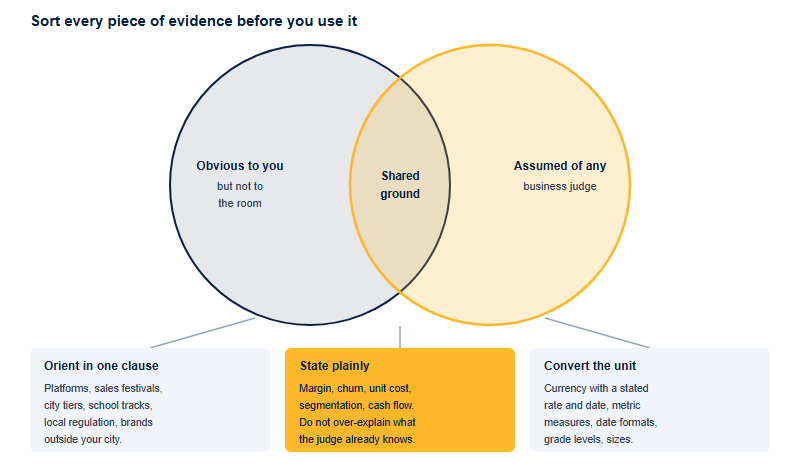
Sorted that way, the failure modes become consistent enough to name, and there are only three of them:
- Unexplained context. A platform, festival, policy or brand is introduced as though universally known. The judge spends the next thirty seconds working out what it is instead of following your argument, and never catches up. This is the most expensive failure because it does its damage silently — nobody interrupts a presentation to ask what a term means.
- Untranslated scale. A number appears in a unit the judge cannot feel. Prices in yuan, distances in kilometres, floor space in square metres, populations quoted without comparison. Each one is a small stall. A “large” market is not persuasive if the reader cannot tell whether large means a city or a province.
- Unverifiable sourcing. The claim is attributed vaguely, or to a source that exists only in Chinese with no date, or to a screenshot. Even a judge inclined to believe you cannot score a claim they have no way of checking, and a strong claim with weak sourcing invites the one question you least want in a Q&A.
All three are repairable at the sentence level. None of them requires changing your idea, your market or your data — which is what makes this the highest-return editing pass you can run before a deadline.
Repair one: the orientation clause
The fix for unexplained context is a single embedded clause, placed the first time a local item appears, and never repeated afterwards. The template:
[Local thing] — [what category of thing it is], [closest analogue the judge plausibly knows], [scale, with a source] — [then your actual point].
The discipline is that the orientation must cost you no more than one clause. Students who discover this technique often over-correct into a paragraph of explanation, which burns time and signals that you think the judge needs teaching. One clause, then move.
| Written as most students write it | What the judge cannot do with it | Repaired |
|---|---|---|
| We will market the product on Xiaohongshu during 618. | Identify either noun; cannot judge whether the channel fits the product | We will market on Xiaohongshu — a social-commerce app where users post product reviews and buy in the same place — during the 618 mid-year sales festival, a major mid-year online discount period [scale, with a named and dated source]. |
| Our target customers are students in tier-2 cities. | Picture the segment; “tier-2” is unfamiliar shorthand | Our target customers are students in tier-2 cities — large provincial cities of several million people, below Beijing and Shanghai in average income [add a named, dated source for the tier definition and for any comparison you draw]. |
| Set-up cost is 48,000 RMB. | Judge the scale of the commitment | Set-up cost is 48,000 RMB, about [USD figure] at the rate on [date] — roughly one month of revenue at our projected volume. |
| Students preparing for the gaokao have no free time in senior year. | Know how binding this constraint is | Students preparing for the gaokao — China's single national university entrance examination, which determines placement almost entirely on one score — have very little discretionary time in their final year. |
| A well-known local brand already does this. | Assess the competitor at all | [Brand] already does this; it operates [number] stores across [region] according to [named source, dated], which makes it the incumbent rather than a fringe player. |
Two habits keep this honest. Bracketed placeholders in the right-hand column are deliberate: fill them from a source you can name, and if you cannot find one, delete the claim rather than estimating in the direction that helps you. And choose analogues carefully — “the Chinese Instagram” style comparison is fast but frequently wrong, and a judge who knows the analogue well will notice. Prefer describing the mechanism (“users post reviews and buy in the same place”) over asserting equivalence.
Repair two: convert every unit, and say what you converted
Currency is the one that matters most, because money is usually load-bearing in a business argument. Give the local figure and a converted figure, and state the rate and the date you used. That last part is not pedantry: it converts a number that looks made up into a number with a method behind it, and it protects you when someone checks a rate that has since moved. Never silently present a converted figure as though it were native.
Beyond currency, run a mechanical sweep before submission:
- Measurements. Metric is fine on its own in most contexts; add an imperial equivalent where the figure carries the argument, such as retail floor space or delivery distance.
- Dates. Write months as words. 7/8 is ambiguous across conventions; 8 July is not.
- Grade and school levels. “Senior 2” or “Year 11” should be given with the US grade equivalent, since your audience will map it to grade 9 through 12.
- Population and market size. Attach a comparison. “A city of 8 million — larger than any US city except New York” does work that “8 million” alone does not.
- Names. Give a company or institution its full name once, then a consistent short form. Switching between a Chinese name, an English name and an abbreviation for the same entity reads as three different organisations.
Repair three: sources a stranger can check
Sourcing is where China-based entries are most often penalised for reasons that have nothing to do with quality of research. A statistic from a genuinely authoritative Chinese source can still be unusable if it arrives without a name, a date, or any route by which a reader could confirm it.
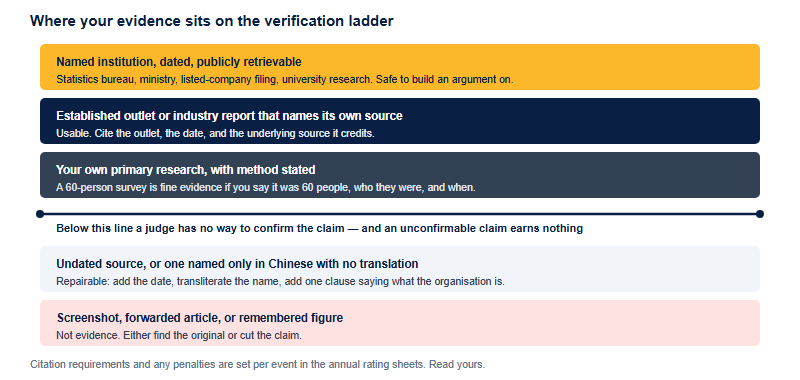
The rung students underrate is the middle one — their own primary research. A survey of sixty classmates, described honestly as a survey of sixty classmates, is legitimate evidence and is often more persuasive than a borrowed national statistic, because it is yours and you can defend every part of it. What sinks primary research is dressing it up: presenting sixty responses as though they represented a market, or omitting the method so a judge cannot tell how much weight to give it.
When to use a China case at all, and how this plays by format
The strategic question sits underneath all of this: should your entry be built on a Chinese market at all, or should you use a market your judge already knows? Neither answer is automatically right, and the honest test is whether the local setting is doing work.
Use the local market when it gives you something a generic case cannot: genuine access to customers you can survey, a competitor you can observe, an operational detail you have actually seen, a problem you can test a solution against. That access is a real advantage and it produces the specificity judges respond to. Use a broader or better-known market when your local knowledge is thin and the setting is essentially decoration — a Chinese city name attached to an argument that would read identically anywhere adds explanation cost for no return.
How the repairs land depends on the format your event uses, and the formats are visible on the annual events poster and confirmed in the guidelines, which FBLA states will be available by September 1, 2026 for the 2026-27 season. If you have not yet chosen an event, our complete guide to the competitive events is the place to start.
- Written or pre-judged entries. You get the easiest version: run a dedicated editing pass whose only job is context, units and sources. Read it as a stranger, marking every proper noun and every number you did not explain.
- Presentations. Orientation has to be spoken, not left in a slide footnote, and it competes with your time limit. Budget for it: a presentation with three local terms needs three short clauses built into the script, rehearsed so they do not sound like asides.
- Live response and interview formats. You cannot pre-write the orientation, so practise it. Rehearse explaining your three most-used local references in ten seconds each until it is automatic.
Finally, the logistics that sit around all of this — participation routes, deadlines and how an overseas chapter enters — are worth confirming early rather than late. Our guide for international students covers the mechanics, and our guide to qualifying for the National Leadership Conference covers the route upward. The 2026 conference in San Antonio has already taken place; the season now beginning runs toward the 2027 event, whose details should be confirmed on fbla.org rather than assumed from last year.
Frequently asked questions
Should I avoid Chinese examples in an FBLA entry?
No. Use them when your local access gives you real specificity — surveys, observed competitors, tested operations — and explain each local reference in one clause.
How do I cite a Chinese-language source?
Give the organisation’s name in English or transliteration, one clause saying what it is, the publication date, and where the figure appeared.
Do I have to convert prices from RMB to US dollars?
Give both, and state the rate and date you used. A converted figure presented without its rate looks unsourced.
Is a survey of my own classmates acceptable evidence?
Yes, if you state the sample size, who was surveyed and when, and do not present it as representing a wider market.
Published by the FBLA editorial desk, operated by Hanlin Education for China-based international-school students. Official rules, event rosters, eligibility and rating sheets are set by the competition and change every year — confirm current details on fbla.org before acting on anything here. Errors are corrected within 7 working days of being reported.