The Business Achievement Awards (BAA) are FBLA’s individual achievement track for high school members: four levels you complete on your own schedule, from a first level FBLA describes as roughly one to two hours to a capstone project FBLA puts at 80+ hours. Unlike competitive events, nothing about the first three levels requires a conference, a flight, or a US visa — which is exactly why it is under-used by students in China.
What the BAA is — and what it is not
Almost everything written about FBLA, including most of this site, is about competitive events: you pick an event, you prepare, you qualify, you compete, someone ranks you. The BAA runs on a different logic. It is an individual achievement award programme open to active, paid high school FBLA members, and it is scored against a fixed set of requirements rather than against other students. You are not competing for a placement; you are completing a level.
That difference has four consequences worth understanding before you decide whether to spend time on it:
- It is not zero-sum. Everyone who completes the requirements earns the level. A strong year for other chapters does not push you out.
- It is asynchronous. The work is yours to schedule, which means it can absorb the weeks when a competitive-event calendar is dead and your school calendar is not.
- It is membership-gated. You must be an active, paid high school member. If your chapter membership lapses or was never completed properly, the BAA is closed to you regardless of how good your project is.
- It does not replace competing. A BAA level is a completion credential, not a national placement. Universities and readers of your application will treat them differently, and you should too.
The four levels, and the honest time cost of each
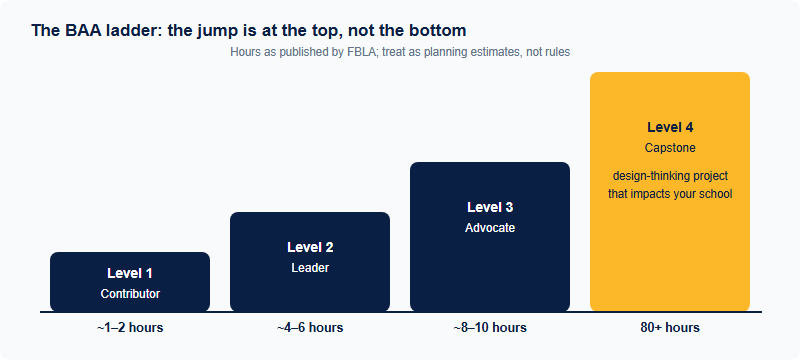
FBLA publishes four levels with sharply escalating time commitments. The published descriptions and hour ranges below come from FBLA’s own programme materials; requirements are restated each year, so confirm the current version on fbla.org before you start.
| Level | Name | Focus, as FBLA describes it | Published time commitment | What you finish with |
|---|---|---|---|---|
| One | Contributor | Introduction to the foundations of FBLA and how to take advantage of what membership offers | About 1–2 hours | Orientation. Useful mostly as a gate to Level Two. |
| Two | Leader | Fundamentals of leadership and exploring your personal leadership style | About 4–6 hours | Vocabulary and a self-assessment you can genuinely use when you run for a chapter office. |
| Three | Advocate | Deeper work in a chosen business content area — FBLA has listed modules such as Understanding Business Ethics and a data-science exploration on financial wellness | About 8–10 hours | Subject content that overlaps directly with objective-test event syllabi. |
| Four | Capstone | Design, complete and reflect on a project that solves a real-world problem, using design-thinking methodology to build something that affects your school | 80+ hours | A documented project with evidence — the only level that produces something an outsider would call a portfolio piece. |
Why this fits a China-based student unusually well
Every structural disadvantage international students face in FBLA — distance, time zones, travel cost, the difficulty of qualifying through a US conference chain — applies to competitive events and mostly does not apply to the first three BAA levels. That asymmetry is the argument.
Consider what a normal competitive-events season demands of a student in Shanghai or Shenzhen: a qualifying route that has to be arranged months ahead (see how to qualify for the National Leadership Conference), then a late-June trip that collides with end-of-year school commitments and costs a meaningful amount of money. The BAA’s first three levels demand an internet connection and about fifteen hours in total.
Three practical implications:
- It gives a first-year member something real to finish. Grade 9 and 10 students in China frequently join a chapter, discover the qualifying path is longer than expected, and drift. Levels One to Three are completable inside a single term, and finishing something early is what keeps students in a club for four years.
- Level Three doubles as event revision. If the content area you choose overlaps with the objective-test event you intend to enter — business ethics, financial topics — the hours count twice.
- The Capstone is the only FBLA product that is genuinely yours. A test score is a number. A documented project that changed something at your school is a story you can tell in an interview, in a personal statement, and to a chapter you later lead.
One caveat that matters for students outside the US: the BAA sits inside FBLA’s member systems, and access depends on your membership being correctly registered and paid. If you are unsure how your school’s chapter or your individual membership is structured, sort that out on our FBLA registration and membership page before you spend an evening looking for a login.
The Capstone: an 80+ hour project with a door into NLC
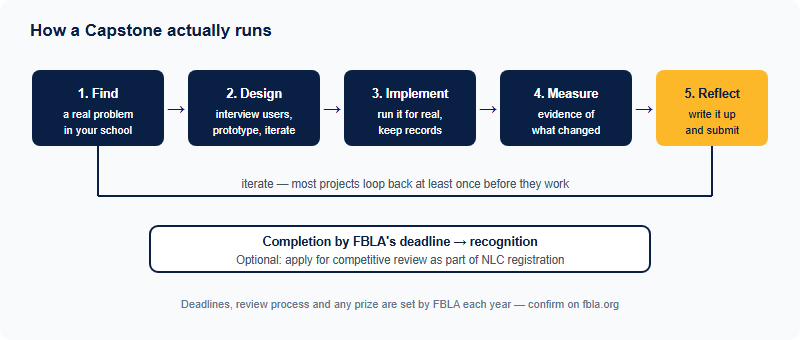
The Capstone is where the BAA stops being a checkbox. FBLA describes it as designing, completing and reflecting on a project that solves a real-world problem, built with design-thinking methodology and aimed at impacting your school. FBLA’s own figure is 80+ hours — a floor, not a target — which in practice means a term and a half of consistent weekly work, not a holiday sprint.
It also has a competitive exit. FBLA has offered a competitive review of completed Capstone projects, with the application to compete folded into National Leadership Conference registration, and has advertised a cash grand prize for that review in recent cycles. Treat both the review process and any prize figure as year-specific and confirm them on fbla.org before you plan around them.
Fitting the BAA into one school year — and what it is honestly worth
The binding constraint is the completion deadline. FBLA sets a completion date each year for BAA work to be recognised at that summer’s National Leadership Conference. For 2026–27 FBLA has published 1 May 2027 as the BAA and Excellence Award submission deadline for NLC recognition — a month earlier than the 2025–26 cycle’s 1 June. Confirm it on fbla.org, and note where it lands: right at the start of the IB, AP and A-Level examination block, not after it. That is what makes it dangerous — the deadline arrives in the week your revision peaks.
A workable sequence for a student in a China international school:
- September: confirm membership is active and paid, then clear Level One in a single evening.
- October to November: Level Two, one hour a week. Do it before chapter officer elections if your chapter runs them — the leadership-style work is directly useful.
- November: Level Three, choosing a content area that overlaps your intended competitive event.
- Early December: decide whether you are doing the Capstone. If yes, choose the problem immediately — the 80+ hours are only realistic if the build starts in December.
- December to March: Capstone build. Five to six hours a week at the very least. Keep a dated log of what you did; you will need it for the reflection and it is exactly what a competitive review looks for.
- End of March: stop building. Write up through April, in study-leave gaps rather than in revision weeks.
- By mid-April: submit, clearing the 1 May 2027 deadline by a fortnight and leaving room for time-zone and upload problems.
An honest read on what it is worth. Do not oversell the BAA to yourself. Levels One to Three are participation-and-completion credentials: real, verifiable, but not selective, and an admissions reader who knows FBLA will read them as evidence of engagement rather than of distinction. Nobody is admitted anywhere because they completed Level Two.
The Capstone is different in kind. An 80+ hour, evidenced project that measurably changed something at your school is the sort of thing that survives translation into any application system — it is a story with a problem, a method, an intervention and a result. Its value comes from the project, not from the badge. A weak Capstone completed for the badge is worth very little; a strong one would have been worth doing even if FBLA had never attached an award to it.
The sensible position for most China-based students: treat Levels One to Three as cheap, useful scaffolding that keeps you engaged while your competitive-event season is still forming, and treat the Capstone as a serious commitment you make only if you have a problem you actually care about solving.
Frequently asked questions
Who can do the FBLA Business Achievement Awards?
FBLA describes the BAA as open to active, paid high school student members. Membership status is the gate — confirm your chapter registration on fbla.org.
Do I have to attend a conference to earn a BAA level?
The levels are individual work completed on your own schedule. Recognition is tied to FBLA’s published completion deadline — 1 May 2027 for the 2026–27 cycle — not to attendance. Confirm on fbla.org.
How long does the Capstone really take?
FBLA puts the Capstone at 80+ hours of design-thinking work on a project that impacts your school. Treat five to six hours a week across a term as the minimum rate, not a holiday sprint.
Can a Capstone project be entered as a competition?
FBLA has offered a competitive review for completed Capstone projects, applied for during NLC registration. Confirm the current process and any prize on fbla.org.
Published by the FBLA editorial desk, operated by Hanlin Education for China-based international-school students. Official rules are set by the competition and change yearly — confirm current details on fbla.org. Errors reported to the editorial desk are corrected within 7 working days.