The weeks between the National Leadership Conference in June and the fall membership window are the least glamorous part of the FBLA calendar — and the most underused. NLC 2026 in San Antonio has wrapped, and the 2026-27 season has not formally begun. This playbook lays out a concrete July-to-September plan for China-based international-school students: what to audit, what to build, and what to have decided before your chapter's fall sign-up opens.
Why the off-season is where medals are actually made
Most students treat FBLA as a school-year activity: join in the fall, pick an event when the adviser asks, start studying when a deadline appears. The problem is structural. By the time the season is moving, you are juggling coursework, other activities and — for grade 11 and 12 students — standardized testing and applications. The hours you can give FBLA in October are contested hours. The hours you can give it in July are not.
The off-season also matters because the highest-leverage FBLA decisions are front-loaded. Which event you enter, whether you compete solo or with a team, and how your chapter organizes its year are all effectively settled by early autumn. Students who arrive at sign-up with those questions already answered get first pick of teammates and a two-to-three-month head start on preparation. Students who arrive undecided inherit whatever is left.
One honest caveat before the plan: FBLA publishes updated competitive-event lists, rating sheets and eligibility rules each year, and details can change between seasons. Everything below is about how to prepare; for any specific rule, deadline or event definition for 2026-27, confirm the current documents on fbla.org once they are released.
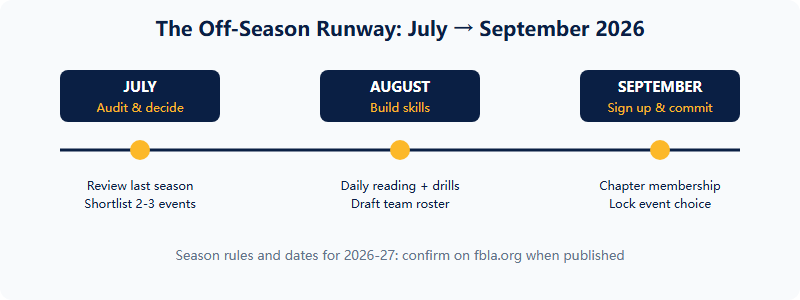
July: run a post-season audit and shortlist your events
July's job is diagnosis, not effort. Whether you competed last season or are entirely new, start by answering three questions in writing.
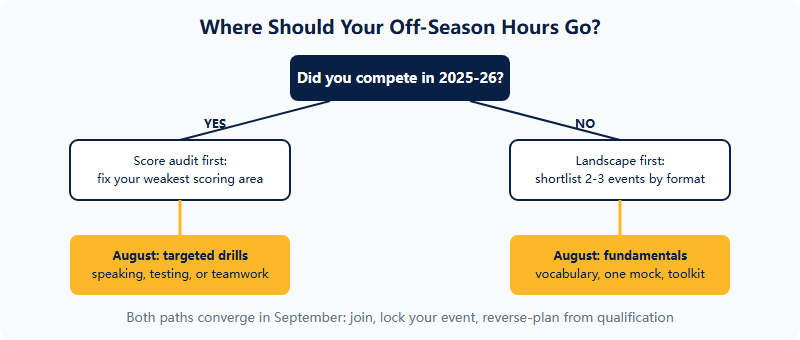
- What actually happened last season? If you competed, pull up your scores or placements and read them the way a coach would: where did you lose points — content knowledge, delivery, time management, or teamwork? If you did not compete, your audit is simpler: what stopped you, and is that obstacle still real?
- What is your realistic weekly budget for the coming year? A grade 12 student with November application deadlines has a very different FBLA year from a grade 9 student. Write down an honest hours-per-week number for October through March before you choose an event that quietly demands double that.
- Which two or three events fit both your goals and your budget? Do not settle on one event yet — the 2026-27 event list may carry changes, and your chapter's team situation is still unknown. A shortlist of two or three keeps you flexible. Our complete guide to FBLA competitive events breaks down the full catalogue by format so you can shortlist intelligently.
For students at China international schools, July is also the month to confirm your participation route. Chapter structures, membership processes and the way international students access FBLA competition differ from the standard US pathway, and sorting this out in July avoids an October scramble. The China chapter guide for international students covers how that route works in practice.
August: build the boring skills that every event rewards
August is for capability, not memorization. You do not yet know the exact 2026-27 event definitions, so drilling event-specific guidelines now has limited value. What never changes is the underlying skill stack. Four investments pay off in almost any event format:
- Business vocabulary and reading fluency. Objective tests, case prompts and judges' questions all assume comfortable command of business English. Twenty minutes a day with business news — reading actively, noting terms like margin, working capital, market segmentation — compounds dramatically over six weeks. For non-native speakers this is the single highest-return habit in the entire calendar.
- Structured speaking. If your shortlist includes any presentation, speech or interactive event, practice answering a simple prompt in a 60-second point-reason-example structure, three times a week, recorded on your phone. You are not rehearsing an event; you are lowering the baseline cost of speaking under pressure.
- A spreadsheet and slide toolkit. Many events reward clean visuals and basic financial literacy. Being fast in spreadsheets and disciplined in slide design is a transferable edge that no one builds mid-season.
- One mock experience. Before August ends, simulate something: a timed practice test from publicly available study materials, or a ten-minute presentation to a parent or friend. The point is emotional calibration — knowing what the pressure feels like before it counts.
August is also when returning members should quietly draft a team plan. If your shortlist includes team events, list the two or three classmates whose skills complement yours and have the conversation now, before sign-up season assigns everyone randomly.
September: convert preparation into commitments
September is when the season becomes real. Chapter membership drives at most schools run in early autumn, and the decisions you prepared in July and August now get executed. Three commitments to make, in order:
- Join early, not eventually. Membership processing, chapter registration and event allocation all have lead times, and late joiners often find team events already full. If you are unsure how membership and dues work at a China international school, confirm the current process with your chapter adviser and check fbla.org for the season's official membership details rather than relying on last year's numbers.
- Lock your event — against the new season's list. When the 2026-27 competitive events list is published, check your shortlisted events against it: names, formats and team-size rules can change year to year. Then commit to one primary event and, if your chapter permits, one secondary.
- Reverse-plan from qualification. Your season is not really aimed at nationals; it is aimed at whatever qualifying gate comes first. Map the path backward — chapter, then the qualifying levels that apply to your route — and put the first real deadline in your calendar. Our breakdown of how students qualify for NLC explains the gates in detail; note that NLC 2027 arrangements (host city and dates) should be confirmed on fbla.org rather than assumed.
| Grade in 2026-27 | July priority | August priority | September priority |
|---|---|---|---|
| Grade 9 (new) | Learn the event landscape; shortlist broad, low-barrier events | English business vocabulary + one mock test | Join early; choose a first event you can finish, not a trophy event |
| Grade 10 | Audit year one; decide whether to level up event difficulty | Deepen one skill (speaking or testing) deliberately | Commit to a primary event + recruit or join a team |
| Grade 11 | Audit with admissions lens; pick events aligned to your intended major | Build toward a leadership or team-anchor role | Lock event + take visible responsibility in the chapter |
| Grade 12 | Honest hours audit against application season | Light-touch maintenance only | Choose a low-overhead event or a mentoring role; protect application time |
The three off-season mistakes we see every year
Mistake one: preparing for last year's event. Students find an old event description in July, build an entire summer around it, and discover in September that the format or guidelines changed. The fix is built into this playbook: July shortlists, August builds transferable skills, and only September — after the new season's materials are out — locks anything event-specific.
Mistake two: confusing research with progress. Reading about events, watching winner videos and comparing options feels productive and costs nothing. By mid-August you should be producing artifacts — recordings, practice-test scores, a draft team roster — not just consuming information.
Mistake three: planning solo when your event is a team event. A summer of individual preparation for a team event still leaves you dependent on teammates you have not chosen. If team formats are on your shortlist, the August roster conversation is not optional; it is the preparation.
FAQ
Is it too early to prepare for FBLA in July?
No — but prepare the right things. Build transferable skills and shortlist events; wait for the official 2026-27 materials on fbla.org before locking event-specific work.
Should I study old event guidelines over the summer?
Use them only to understand formats. Names, guidelines and team rules can change each season, so confirm everything against the new list on fbla.org before committing.
What if my school's chapter has not announced anything yet?
Normal for summer. Contact your adviser in late August, confirm the sign-up window, and use the waiting time for the skill-building steps above.
How many hours a week does off-season prep need?
Three to five focused hours is plenty in July and August. The goal is a head start and calibrated expectations, not summer burnout before the season begins.
Published by the FBLA editorial desk, operated by Hanlin Education for China-based international-school students. Official rules are set by the competition and change yearly — confirm current details on fbla.org. Factual errors are corrected within 7 working days of notice.