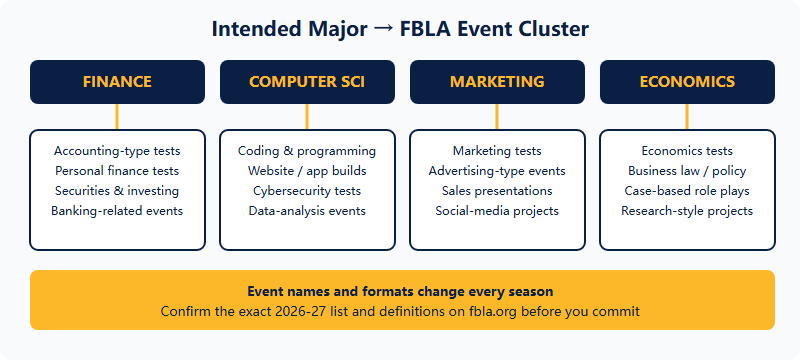
With 76+ competitive events on the FBLA roster, the most useful filter for a China international-school student is not “which event is easiest” but “which event matches the major I intend to apply for.” An event aligned with your intended major turns FBLA from a generic activity line into supporting evidence for your academic story. This guide maps the main event clusters to four common application directions: finance, computer science, marketing, and economics.
Why major-alignment beats difficulty-shopping
Students usually choose FBLA events one of two ways: by perceived ease (“which test can I pass with least study”) or by prestige rumor (“which event do winners do”). Both approaches produce the same weak outcome — an activity that sits on the application disconnected from everything else.
Admissions readers evaluate activities in context. A student applying for finance whose file shows a securities-related FBLA event, a math course load, and an investing club tells one coherent story. A student with the same grades whose FBLA line is an unrelated event chosen for convenience tells no story at all. The competition result matters, but the coherence matters more — and coherence is free. You choose it at sign-up.
Two ground rules before the mapping. First, FBLA updates its competitive-events list every season: event names, formats and team rules change, and some events are added or retired. Treat the clusters below as a stable way of thinking, and confirm the exact 2026-27 event names and definitions on fbla.org when the new list is published. Second, alignment is a signal, not a shortcut — no event choice guarantees any admissions outcome, and we do not claim otherwise. For how FBLA fits into applications more broadly, see our China chapter guide for international students.
Finance track: tests that double as technical vocabulary
If you intend to apply for finance, accounting or a general business degree with a quantitative lean, the objective-test cluster around money topics is your natural home: accounting-type events, personal-finance events, and securities-and-investments-type events have historically appeared on the FBLA roster in some form.
The strategic case is straightforward. These events are mostly knowledge tests, which means preparation is predictable — study, drill, test — and less dependent on English fluency than presentation formats. For a non-native speaker targeting a quantitative major, that is a favorable trade: you compete on preparation depth rather than accent or improvisation. The vocabulary you build (balance-sheet items, asset classes, risk-and-return language) is also literally the vocabulary of your intended degree, so nothing is wasted even if you do not place.
A practical pairing for grade 10-11 students: one finance-cluster objective test as your primary event, plus a team or presentation event as a stretch goal once the test preparation is stable. The complete events guide lists which events run as pure tests versus judged formats so you can build that pairing.
CS track: FBLA's quiet advantage for coders
Computer-science applicants usually look to olympiads and hackathons, and treat FBLA as “the business club.” That misses a real niche. FBLA has long carried technology events — coding-and-programming-type events, website or application development, cybersecurity-style tests, and data-focused formats — where the competitive field is thinner than in dedicated CS competitions.
The angle that matters for applications: FBLA technology events sit at the intersection of building and explaining. Most development-style events require you to present or document what you built, not merely submit code. For a CS applicant, that is exactly the profile edge — evidence you can communicate technical work — that pure algorithm contests do not demonstrate. It also differentiates: thousands of applicants have contest ratings; far fewer can show a judged, presented software project in a business context.
Honest caveat: if your goal is elite CS admissions, FBLA tech events complement rather than replace serious programming credentials. Treat them as your “communication layer,” not your core technical proof.
Marketing and communications track: judged formats are the point
For students aiming at marketing, communications or media-adjacent majors, the calculus reverses. Here the judged, subjective formats — sales-presentation-type events, advertising and social-media-style projects, marketing tests — are not the risky option; they are the evidence. A marketing applicant who has stood in front of judges and sold an idea has a story no test score provides.
These formats demand more English performance, which is exactly why they are worth it for this track: the major itself will demand the same. If live performance in English feels out of reach today, sequence it — start with a marketing objective test in your first season to build vocabulary, then move to a judged format in season two. This staged approach also fits the qualification calendar; see how qualifying for NLC works to plan which season carries which attempt.
Economics track: tests plus cases, and a matrix note
Economics applicants have a two-part fit in FBLA. Economics-type objective tests reward exactly the micro and macro fundamentals your intended major values, while case-based interactive events exercise applied reasoning — take a scenario, structure a recommendation, defend it — which is the skill economics essays and interviews keep testing.
One editorial note for this track: FBLA is a broad business-leadership organization, not a specialist economics competition. If economics is your central story, a dedicated economics competition can carry the technical depth while FBLA carries the leadership-and-application layer. The two are complementary; FBLA's distinctive contribution is the organizational and competitive-breadth signal, not maximal econ rigor.
| Intended major | Primary cluster | Format character | English load | What it signals |
|---|---|---|---|---|
| Finance / Accounting | Money-topic objective tests (accounting, personal finance, securities-type) | Mostly timed tests | Moderate (reading-heavy) | Technical vocabulary + quantitative discipline |
| Computer Science | Tech events (coding, web/app builds, cybersecurity, data) | Build + present or test | Moderate to high | Can build AND explain technical work |
| Marketing / Communications | Judged presentation and campaign-style events | Live performance, judged | High | Persuasion and audience command |
| Economics | Econ tests + case-based interactive events | Tests + live cases | Moderate to high | Applied reasoning on business problems |
How to run the decision in practice
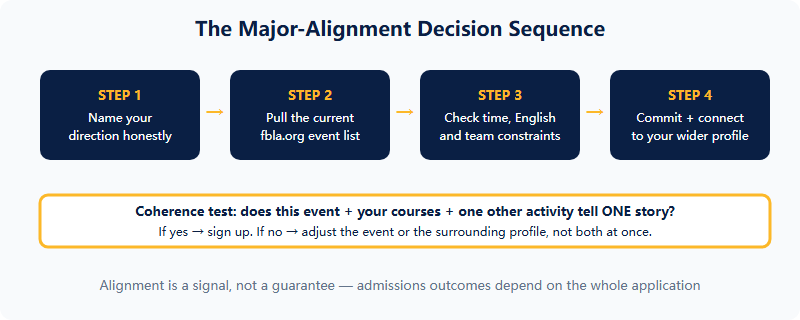
A four-step sequence, best done before your chapter's sign-up window closes:
- Step 1 — name your direction honestly. “Business-ish” is not a direction. If you genuinely do not know your major yet, pick the cluster matching your strongest current subject — alignment with evidence beats alignment with aspiration.
- Step 2 — pull the current event list. When FBLA publishes the 2026-27 competitive events materials, filter your cluster: which events exist this season, in which format, individual or team, and with what deliverables.
- Step 3 — check the constraint triangle. Your event must fit three constraints simultaneously: your weekly time budget, your current English performance level, and your chapter's team situation. An aligned event you cannot resource is worse than a slightly less aligned one you can execute well.
- Step 4 — commit and connect. Once chosen, make the alignment visible in the rest of your profile: course selection, a related club role, or a small independent project in the same domain. One event plus two connected activities reads as a direction; one event alone reads as a Tuesday afternoon.
FAQ
Does choosing a major-aligned FBLA event improve admissions chances?
It strengthens coherence — your activities support your stated direction. No event choice guarantees any outcome; the whole application decides.
What if I change my intended major after choosing an event?
Normal and low-cost. Skills transfer across clusters, and you can switch events next season. Coherence is judged at application time, not at grade 10.
Are the event names in this guide the official 2026-27 names?
No — they are cluster descriptions. FBLA updates the events list each season, so confirm exact names and formats on fbla.org before committing.
Can I compete in events from two different clusters?
Where chapter and event rules allow multiple entries, yes — a test plus a judged event is a common pairing. Check the current entry rules on fbla.org.
Published by the FBLA editorial desk, operated by Hanlin Education for China-based international-school students. Official rules are set by the competition and change yearly — confirm current details on fbla.org. Factual errors are corrected within 7 working days of notice.