FBLA’s speaking events — Public Speaking (a prepared speech on a set theme) and Impromptu Speaking (a topic you draw and prep on a short clock) — are among the most winnable events for non-native English speakers, because judges reward structure, clarity and delivery far more than a flawless accent. There are introductory versions for younger competitors too. Event names, themes and time limits are set yearly, so confirm the current rules on fbla.org.
The two kinds of pure speaking event
Within FBLA’s competitive-events system, speaking events are individual and center on one skill: standing up and talking well about business. They differ from the Role Play and presentation events in the wider catalogue because there is no case to solve with a team and no project to build in advance — it is you, a topic, and a clock. The two core formats work in opposite directions:
- Public Speaking is a prepared speech. You write and rehearse a speech on the year’s announced theme, then deliver it within a time limit, usually without extensive notes. Preparation is everything; the challenge is polish and memory.
- Impromptu Speaking is the reverse. You draw a topic on site, get a short preparation window, and then speak. Preparation is minimal; the challenge is thinking and structuring in real time.
There are also introductory speaking events aimed at 9th–10th graders, which let newer or younger competitors build the same skills at a gentler level. Grade eligibility, themes and exact time limits are published each year in the official Guidelines on fbla.org — treat the summary below as a map and verify the current edition.
| Event | Preparation | What it tests | Best for |
|---|---|---|---|
| Public Speaking | Prepared in advance on a set theme | Writing, polish, memory, delivery | Students who rehearse well |
| Impromptu Speaking | Short on-site prep after drawing a topic | Fast structuring, composure | Quick, calm thinkers |
| Introductory speaking events | Varies (prepared or on-site) | Foundations of public speaking | 9th–10th graders and beginners |
Prepared or impromptu: which one to enter
Because the two events reward opposite strengths, the honest first question is not “which is easier” but “which failure mode can I train away faster.” Both are winnable; they just stress different muscles. Use this to shortlist, then confirm the current formats and eligibility on fbla.org.
| Choose Public Speaking if… | Choose Impromptu if… |
|---|---|
| You write well and rehearse patiently | You think fast and stay calm on the spot |
| You want maximum control over the content | You dislike memorising and prefer to react |
| Your risk is under-rehearsing, which you can fix with time | Your risk is freezing, which you can fix with volume of reps |
| You can commit weeks to polishing one speech | You can practise short, daily prompt drills |
For Public Speaking specifically, the single most important document is the year’s announced theme, which FBLA publishes for the current season. A strong speech is not a generic essay about business; it answers the theme directly, with a clear stance and specific, relevant examples. Before you write a word, read the theme and any prompt language carefully, and check the current rules on fbla.org — themes and note allowances change yearly, so last year’s winning approach is a guide, not a template.
Why non-native speakers can genuinely win these
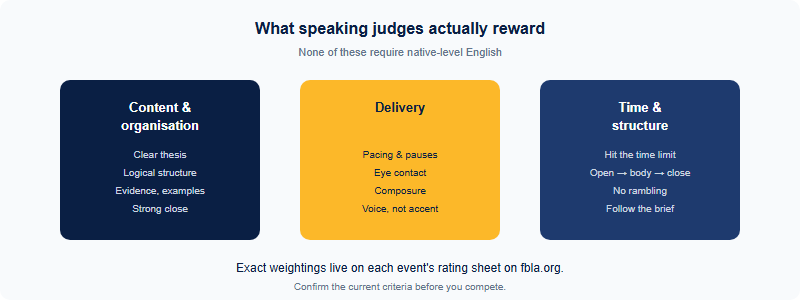
It is a common myth that speaking events belong to native speakers. In practice, judges score against a rating sheet that weights content, organisation and delivery — a clear thesis, a logical structure, evidence, eye contact, pacing and a strong close. None of those require idiom-perfect English. A well-organised speech delivered at a calm pace routinely beats a fast, fluent, but rambling one. Here is the honest picture:
- Structure is language-neutral. A clear opening, three points and a close reads as competence in any accent. This is trainable in weeks.
- Pacing hides accent. Speaking a touch slower and pausing deliberately improves comprehensibility and reads as confidence. Non-native speakers who slow down often score higher than anxious native speakers who rush.
- Judges reward substance. A specific, evidence-backed point about a real business issue lands harder than generic fluency.
- Honest caution: memory pressure is real in Public Speaking. Delivering a prepared speech with limited notes is a distinct skill. Under-rehearsed speeches fall apart regardless of English level.
- Honest caution: Impromptu punishes freezing. The short prep window only feels survivable after many reps. Composure is built, not wished for.
A training method that builds fluency under pressure
You do not become a strong speaker by reading about speaking. You become one through short, frequent, recorded reps. The method below separates the two events, because they demand opposite skills. Scale the timings to whatever your event’s Guidelines actually allow.
For Public Speaking (prepared)
- Draft to a skeleton. Write your speech as a hook, a clear thesis, two or three points with evidence, and a memorable close. Structure first, wording second.
- Cut to the time limit. Most beginners write long. Read aloud with a timer and trim until you land comfortably inside the limit with room to breathe.
- Rehearse from cue words, not a full script. Move to a small set of cue words so you speak to the audience rather than reciting. This is what separates a memorised speech from a delivered one.
- Record and review. Film yourself. Watch once for pacing, once for filler words, once for eye contact. Fix one thing per run.
For Impromptu Speaking (on-site)
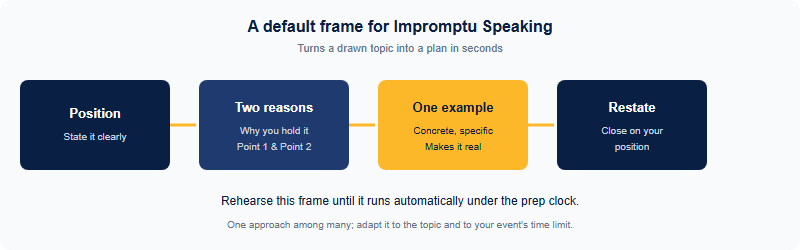
- Adopt a default frame. Have a go-to structure ready — for example, position, two reasons, one example, restated position. A default frame turns a blank mind into a plan in seconds.
- Practise with random prompts. Draw a business topic at random, use only your event’s real prep window, then speak. Do this daily; volume is what tames the panic.
- Train the first ten seconds. Rehearse launching confidently before your brain has the whole speech. Momentum beats a perfect but late start.
- Debrief every rep. After each attempt, note one thing that worked and one to fix. Improvement compounds fast when you are honest.
| Week | Public Speaking track | Impromptu track |
|---|---|---|
| 1 | Draft the speech to a skeleton; time it and cut | Learn a default frame; 3 random prompts, untimed |
| 2 | Move to cue words; record two full runs | 5 prompts at the real prep window; record two |
| 3 | Polish open and close; practise in front of a person | Daily prompt; train the first ten seconds |
| 4 | Full run-throughs under pressure; refine pacing | Mixed hard prompts; debrief every rep |
A first-party observation from coaching China-based competitors: the fastest gains for non-native speakers come from two unglamorous habits — slowing the delivery by about ten percent and cutting filler words. Students often arrive convinced they need a bigger vocabulary. In fact, a slower, cleaner delivery of simpler language scores better, because judges can follow every point. Fluency, in the sense that wins here, is clarity under a clock, not literary English.
Where speaking events fit your season and applications
Speaking ratings advance through the same chapter-to-nationals structure as every FBLA event; NLC 2026 took place in San Antonio, TX, June 29 – July 2, 2026, so the summer is prime time to build the skill before next season’s district and state events. See how to qualify for NLC for that path, and FBLA for international students for the wider China-cohort picture. On applications, public-speaking results signal communication skill and composure — real and valued, but, like any single line, one signal among many rather than a guarantee of any outcome. The larger payoff is a transferable skill you will use in interviews, seminars and pitches for years.
Frequently asked questions
Can I use notes during FBLA Public Speaking?
Rules on notes vary by event and by year. Many speaking events limit or restrict notes to reward genuine delivery. Confirm exactly what is permitted in the current Guidelines on fbla.org.
How much preparation time do you get in Impromptu Speaking?
A short, fixed window after you draw your topic, set per event and conference level. The exact minutes are in the event’s rating sheet on fbla.org — confirm before competing.
Do I need a native-level accent to place?
No. Judges score content, organisation and delivery, not accent. A clear, well-structured, well-paced speech competes strongly regardless of first language.
Which speaking event should a beginner start with?
Younger or newer competitors often start with an introductory speaking event, then move to Public Speaking or Impromptu. Check current grade eligibility on fbla.org.
Published by the FBLA editorial desk, operated by Hanlin Education for China-based international-school students. Official rules are set by the competition and change yearly — confirm current details, event names, themes, formats and time limits on fbla.org. Errors are corrected within 7 working days.