FBLA and DECA are both US-based business Career and Technical Student Organizations, and they overlap — but they reward different strengths. In short: FBLA spans a very broad catalogue of business, finance, and technology events including many written/objective tests; DECA centres on marketing, hospitality, finance, and entrepreneurship, with a heavy emphasis on roleplay case scenarios. Neither is “better.” The right choice depends on your interests, your school’s existing chapter, and how you want to present a business profile to universities. Always confirm current structures on fbla.org and DECA’s official site.
Same family, different temperament
Both organisations are CTSOs: student-led, school-chapter-based, and structured around competitive events that advance from regional to state to national levels. For a student at an international school in China, that shared DNA means the joining mechanics feel similar — you participate through a school chapter with a faculty adviser, not as a solo entrant. We explain that access model in detail in our guide to FBLA for international students.
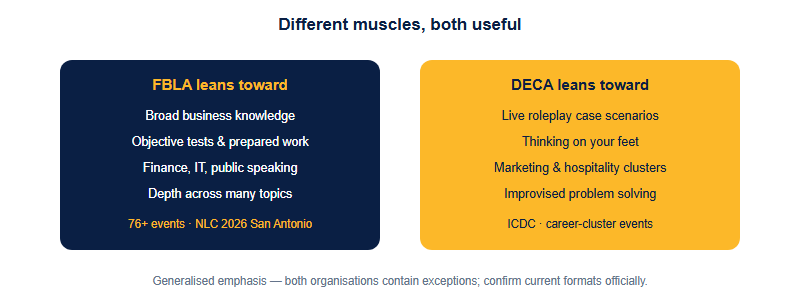
Where they diverge is temperament. FBLA’s identity is breadth: it covers a wide span of business disciplines, and its event list runs the gamut from finance and accounting to information technology, public speaking, and entrepreneurship — including a large number of objective-test events that reward studied knowledge. DECA’s identity is the roleplay: you are handed a business scenario, given limited prep time, and asked to think on your feet in front of a judge playing a client or manager. If you thrive on improvisation and case-style problem solving, that format is the draw. If you prefer to build deep expertise and demonstrate it through prepared work and tests, FBLA’s range fits more naturally.
Side-by-side: what each rewards
This table is a planning aid, not a scoreboard. Specifics (event names, divisions, formats) are reviewed every year by each organisation, so verify anything load-bearing against the official sources before you decide.
| Dimension | FBLA (high school) | DECA (high school) |
|---|---|---|
| Core focus | Broad business: finance, accounting, IT, management, public speaking, entrepreneurship | Marketing, business management, finance, hospitality, entrepreneurship |
| Signature format | Wide mix: objective tests, presentation events, role plays, production/prejudged events | Roleplay case scenarios (with an exam component) plus written projects |
| Event breadth | Very broad catalogue (76+ events) | Substantial, organised around career clusters |
| Best for the student who… | Wants depth across many business topics and likes prepared/tested work | Loves thinking on their feet in live, improvised case roleplays |
| Top national event | National Leadership Conference (NLC) — 2026 in San Antonio | International Career Development Conference (ICDC) |
| How you join | School chapter + faculty adviser | School chapter + faculty adviser |
One honest caveat from the editorial desk: this is a high-level orientation. Event lineups shift, and both organisations periodically add, retire, or restructure events. Confirm current event lists, formats, and divisions on the official FBLA and DECA sites rather than treating any summary — including this one — as a fixed truth.
How the competitive ladder feels in practice
Both organisations share a tiered structure — you compete at a regional or district level, strong performers advance to the state (or equivalent) level, and the best advance to the national/international stage. But the day-to-day experience of preparing differs in a way that should inform your choice.
In FBLA, because the catalogue is so broad and includes many objective-test events, a meaningful chunk of preparation can look like disciplined studying: working through business, finance, accounting, or IT content and building genuine subject knowledge. That suits students who like to master a body of material and can revise independently — useful when you are in a different time zone from US-based peers. In DECA, the centre of gravity is the live roleplay, so preparation skews toward repeated case practice: reading scenarios, applying frameworks, and rehearsing out loud against a clock. That suits students who learn by doing and want to sharpen quick, structured thinking.
Neither rhythm is superior — but knowing which one you will actually keep up for a full year matters more than any abstract prestige comparison. A student who dreads case improv will quietly stop practising for DECA; a student who finds objective tests tedious may lose momentum in FBLA. Pick the preparation you can sustain, because consistency over a season is what produces both results and a real story to tell. Whatever you choose, confirm the current round structure and advancement rules on the official site, since these are set by each organisation and can change year to year.
The China international-school reality check
A US-based comparison only goes so far. Three factors weigh more heavily for a student based in China:
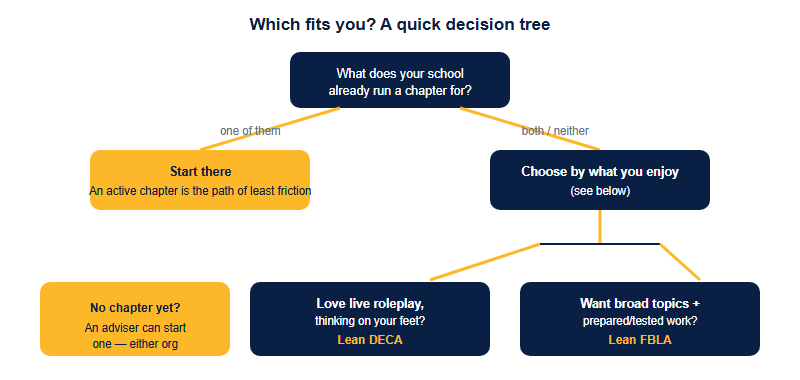
- What your school already runs. If your campus has an active FBLA or DECA chapter with a committed adviser, that is usually where to start — an existing chapter removes the biggest logistical barrier. Founding the other organisation from zero is possible, but it is a project, not a Tuesday afternoon.
- Travel and calendar. Both organisations’ marquee events are in the United States. For a family in China, that means visas, flights, and a summer commitment. Factor the real-world cost and timing in early, and confirm the current dates and host cities on each official site — never assume last year’s calendar repeats.
- Eligibility and access for international participants. Participation pathways for students outside the US can differ by organisation and by year. Do not infer DECA’s rules from FBLA’s, or vice versa. Verify each on its official source. For FBLA specifically, our international-students guide walks through the access model, and the FBLA China program operated by Hanlin can clarify how chapters are structured locally.
- Language and content load. Both organisations compete in English, and both demand business vocabulary you may not meet in a standard high-school curriculum. FBLA’s objective-test events lean on read-and-recall knowledge; DECA’s roleplays lean on speaking fluently under pressure. Be honest about which is the bigger lift for you right now, and treat building that skill as part of the commitment rather than an afterthought.
A small but practical tip: talk to students one or two years ahead of you at your own school who have done FBLA or DECA. Their first-hand account of the real workload, the travel, and what surprised them is worth more than any glossy summary — and it is specific to how your campus runs its chapter, which is exactly the context that a generic US article can never give you.
How admissions readers see them
Both FBLA and DECA are well-recognised US business activities, and a serious, multi-year commitment to either can be a credible signal of business interest and leadership. But be honest with yourself about what the signal actually is. Neither membership nor a trophy is an admissions guarantee — universities read for sustained engagement, genuine contribution, and growth over time, not a logo on a list.
What strengthens the signal is the same in both organisations: holding a chapter leadership role, advancing through competitive rounds because you did the work, and being able to talk specifically about what you built and learned. A student who founded a chapter, mentored newer members, and reached a state or national stage tells a far stronger story than one who paid dues and attended a meeting or two. If FBLA is your route, our guide to qualifying for the National Leadership Conference shows how the competitive ladder works.
When doing both actually makes sense
Students sometimes ask whether they should run FBLA and DECA simultaneously. The answer is “occasionally, and carefully.” Both can coexist because their event formats are complementary — FBLA’s prepared/tested events and DECA’s live roleplays build different muscles. A student genuinely committed to business might use DECA to sharpen on-the-spot case reasoning and FBLA to develop depth across finance, IT, or entrepreneurship.
The risk is dilution. Two CTSOs, each with its own meetings, prep, deadlines, and travel, can stretch a student thin and produce two shallow records instead of one strong one. The rule of thumb: depth beats breadth. If you can hold a real role and compete seriously in both, doing both can be a rich profile. If something has to give, a deep, well-led commitment to one organisation almost always reads better than a thin presence in two. Decide based on your bandwidth, not on a fear of missing out.
Frequently asked questions
Is FBLA or DECA better for college admissions?
Neither is inherently better. Both are recognised US business CTSOs; depth, leadership, and sustained commitment matter more than which logo. No activity guarantees admission.
What is the main format difference?
FBLA spans many formats including objective tests and prepared presentations; DECA centres on live roleplay case scenarios. Confirm current event formats on each official site.
Can a student in China do both FBLA and DECA?
Sometimes. They are complementary, but two CTSOs demand real time. Depth usually beats breadth — do both only if you can commit seriously to each.
How do I join either one in an international school?
Through a school chapter with a faculty adviser. If your school has no chapter, an adviser can start one. Verify the current process on the official site.
Published by the FBLA editorial desk, operated by Hanlin Education for China-based international-school students. Official rules are set by the competition and change yearly — confirm current event lists, formats, divisions, and eligibility on fbla.org and DECA's official site. Errors are corrected within 7 working days.