FBLA’s presentation and roleplay events are won in the room — on structure, timing, and how you handle a judge’s questions — not only on what you know. For a China international-school student presenting in English, the edge comes from a repeatable prep method: learn the exact format of your event, build a reusable answer skeleton, rehearse against a timer, and drill the live Q&A. This guide gives you that method. Always confirm your event’s current format and rating sheet on fbla.org.
Two live formats, two different games
Inside FBLA’s competitive events catalogue, the events that put you face-to-face with a judge fall into two broad camps, and they demand different preparation.
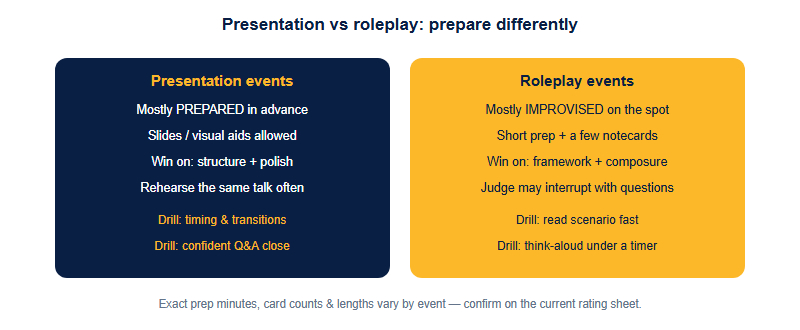
- Presentation events are largely prepared. You build a presentation in advance — often on a set topic — and deliver it live, frequently with slides or visual aids. Events of this kind allow presentations to be delivered using a limited number of personal devices, and visual aids and physical materials may be used. The game here is polish: a tight structure, clean visuals, and rehearsed delivery.
- Roleplay (interactive) events are largely improvised. You receive a business scenario, get a short window to prepare, and then perform — typically with a couple of notecards — while a judge plays a client or manager and may ask questions mid-performance. The game here is composure: reading the scenario fast, applying a framework, and responding under pressure.
One concrete logistics point that students should plan around: in roleplay events, competitors are generally provided a small number of notecards to use during preparation and the performance, and those cards are collected afterwards. The exact number of cards, the prep-time minutes, and the presentation length are set per event and reviewed annually — so read the current guidelines and rating sheet for your specific event rather than relying on a friend’s memory from last year.
Step 1 – Reverse-engineer the rating sheet
The most common mistake is preparing for the event you imagine instead of the event FBLA actually scores. Every competitive event has published guidelines and a rating sheet that tell you, in plain terms, what judges reward — the performance indicators, the point weights, and the time limits. Before you rehearse anything, pull your event’s current materials and turn the rating sheet into a checklist.
Ask three questions of the sheet:
- Where are the points? If “analysis of the problem” carries more weight than “appearance,” you now know where to spend rehearsal time.
- What are the hard limits? Time caps, device limits, and notecard rules are non-negotiable. Going over time or breaking an equipment rule is the most avoidable way to lose.
- What does a top performance look like? The wording of the highest scoring band is, effectively, your target. Memorise its verbs.
This single habit separates students who plateau from students who climb. Our companion guide on how to qualify for NLC makes the same point about reading the official criteria before you compete — it applies doubly to live events where a judge is scoring you against a sheet in real time.
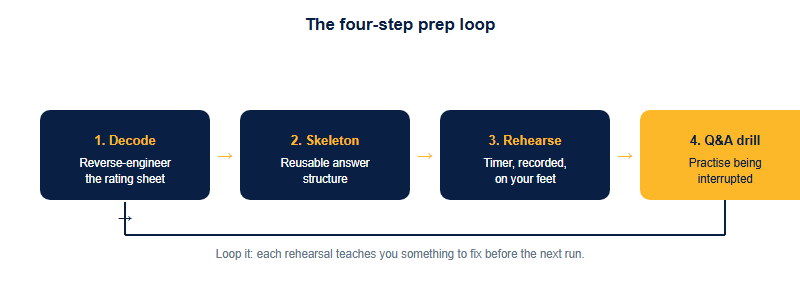
Step 2 – Build a reusable answer skeleton
You cannot script a roleplay you have not seen, but you can walk in with a structure that fits almost any business scenario. A skeleton frees your working memory to focus on content and delivery instead of “what do I say next.” A simple, format-agnostic skeleton:
| Stage | What you do | One-line example phrasing |
|---|---|---|
| 1. Frame | Restate the situation and the decision to be made | “The core issue here is whether we…” |
| 2. Options | Lay out 2-3 realistic paths | “We have three options to weigh…” |
| 3. Criteria | Say how you’ll judge them (cost, risk, customer, brand) | “I’ll evaluate these on cost and customer impact…” |
| 4. Recommend | Commit to one and justify it | “My recommendation is … because…” |
| 5. Next steps | Make it actionable; invite questions | “To implement, the first step would be…” |
For a prepared presentation event, the same logic applies but you build the skeleton into your slides in advance: a clear problem statement, your approach, the substance, and a confident recommendation or summary. In both cases, the structure is your safety net. When nerves hit — and in English, under a clock, they will — the skeleton keeps you moving forward instead of freezing.
Step 3 – Rehearse against the clock, out loud, on your feet
Silent reading is not rehearsal. Judges experience your delivery, so your practice has to look like the real thing. Three rules from the editorial desk, written specifically for students preparing in a second language:
- Use a visible timer every single run. Time discipline is a free source of points and a free way to lose them. Practise hitting your structure inside the cap with a few seconds to spare.
- Record yourself and watch it back. You will catch filler words, a rushed pace, and a flat ending you would never notice from the inside. For non-native speakers, this is the fastest way to smooth pronunciation and pacing on the handful of terms that actually matter.
- Stand up and present to a real person. An adviser, a parent, or a teammate playing “judge” changes everything — eye contact, gestures, and the small panic of a live question are skills you can only build with an audience.
A practical drill for non-native English speakers: build a short, personal pronunciation list of the 15-20 business terms most likely to appear in your event (for marketing: “segmentation,” “value proposition,” “ROI”; for finance: “liquidity,” “amortisation,” “diversify”). Rehearse them until they are automatic. You do not need accent-free English — you need to say your key terms clearly and confidently, because hesitation on a core word reads as uncertainty to a judge.
Step 4 – Win the Q&A (where many students quietly lose)
In roleplay events the judge may ask questions during your performance, and many presentation events end with judge questions. This is where prepared students separate from rehearsed-but-rigid ones. Handling questions well is a learnable skill:
- Pause before answering. A two-second pause looks thoughtful, not slow. It also buys you time to organise an answer in English.
- Answer the question that was asked. Restate it briefly if you need a moment, then respond directly. Dodging is obvious and costs trust.
- Bridge back to your recommendation. A strong answer ends by reconnecting to your main point: “… which is exactly why I’d still recommend option B.”
- If you don’t know, stay composed. “That’s a great question — here’s how I’d find out” beats bluffing. Judges reward poise and honesty over a confident wrong answer.
Rehearse Q&A deliberately. Have your practice “judge” interrupt mid-presentation and lob unexpected questions. The first few times will be uncomfortable; that discomfort is the entire point. By the time you are in front of a real judge, being interrupted feels familiar instead of threatening.
A two-week run-up that actually works
If you have roughly two weeks before a competition, here is a realistic schedule. Adjust to your event and your life; the point is consistency, not heroics.
| Window | Focus | Output |
|---|---|---|
| Days 1-3 | Read official guidelines + rating sheet; build your skeleton; draft pronunciation list | A one-page checklist and structure you trust |
| Days 4-9 | Daily timed run, recorded; review footage; fix one weakness per day | Steady delivery inside the time cap |
| Days 10-12 | Live runs with a practice “judge”; deliberate Q&A interruptions | Composure under questions |
| Days 13-14 | Two clean full run-throughs; light review; rest your voice | Confidence, not cramming |
Notice what this is not: it is not memorising a script the night before. Live FBLA events punish brittle, over-memorised performances and reward students who understand their structure well enough to adapt. Build the structure early, rehearse it until it is second nature, and spend your final days getting comfortable — not panicking. For the wider picture of how these events fit a business profile, see our overview of FBLA for international students.
Frequently asked questions
How long do I get to prepare in a roleplay event?
Prep time varies by event and is reviewed yearly. Check your specific event’s current guidelines on fbla.org rather than assuming a fixed number.
Can I use notes during the performance?
Roleplay events typically provide a small number of notecards, collected afterwards. Presentation events allow visual aids within limits. Confirm the exact rules for your event.
Does my English have to be perfect to compete?
No. Judges reward clear structure, composure, and confident delivery. Drill your key business terms so hesitation on core words doesn’t read as uncertainty.
What matters most to judges?
The published rating sheet tells you exactly. Read it first, find where the points are, and rehearse toward the top scoring band — and respect every time and equipment limit.
Published by the FBLA editorial desk, operated by Hanlin Education for China-based international-school students. Official rules, event formats, prep times, notecard limits, and rating sheets are set by the competition and change yearly — confirm current details on fbla.org. Errors are corrected within 7 working days.