If you are choosing between Business Management and Business Ethics for the 2026-27 FBLA competitive season, the short answer is this: both combine more than one assessment method and both include an objective test, but the second component of each event is completely different. Business Management pairs the objective test with a role play. Business Ethics pairs the objective test with a written report and a presentation. If you want a live, improvised performance with no pre-submitted document, look closely at Business Management. If you want to build, revise and defend a written argument, look closely at Business Ethics. That structural difference, not the topic label, is what should drive your decision.
The format descriptions below are drawn from the FBLA High School Competitive Events list checked on 26 October 2026. FBLA also warns that guideline documents can change during the year and asks users to verify the footer date on any event PDF or page, so treat this comparison as a starting point for the 2026-27 season and re-verify specifics before your entry is locked.
Two Hybrid Events, Two Different Preparation Problems
In this comparison, “hybrid” describes an event that combines more than one assessment method. It does not tell you the weighting of those methods, and it does not tell you how difficult one event is relative to another. That is why students who only read the labels can end up surprised on competition day: two events that mix an objective test with a performance component can demand opposite preparation habits.
The practical consequence is that you are not really choosing between two business topics. You are choosing between two production schedules. One schedule is built around a test plus a live simulation, where everything that matters happens on competition day. The other is built around a test plus a submitted document plus an oral defence, where a portion of the work has to be finished before you ever enter the room. Students and advisors who treat those as similar workflow problems almost always underestimate one of them.
Official Format Differences: Test + Role Play vs Test + Written Report + Presentation
The FBLA High School Competitive Events list distinguishes the two events as follows:
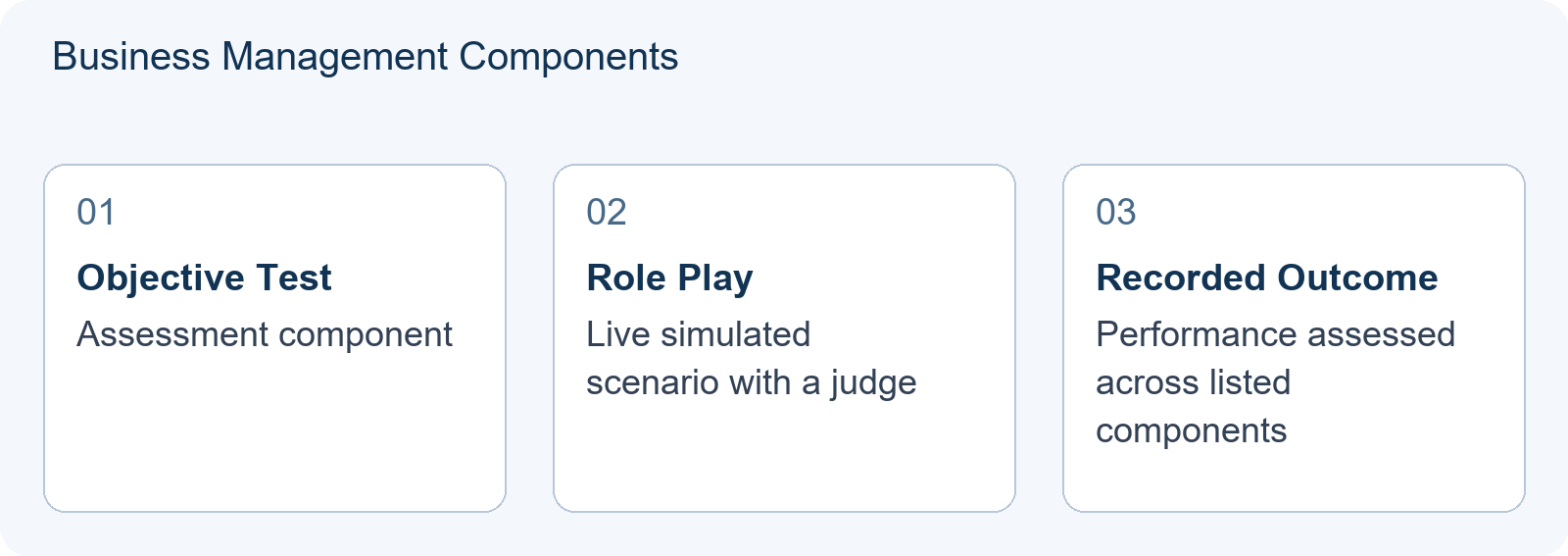
- Business Management: combines an objective test and a role play.
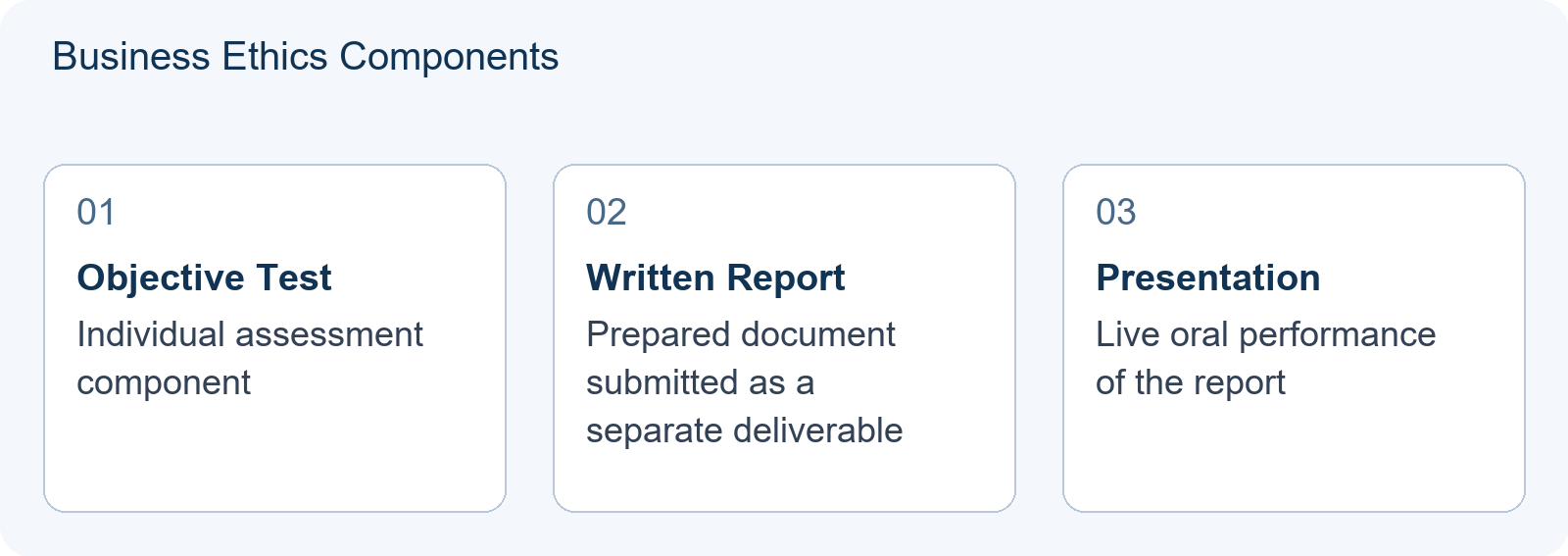
- Business Ethics: includes an individual objective test, a written report and a presentation.
That is the whole format picture you can rely on for both events heading into 2026-27. What is not published by that list is how the components are weighted, what the rubric rows are called, and whether any progression rule links the test to the performance stage. Those details sit in the individual event guideline documents that FBLA warns may change mid-year. So the safe planning assumption is: prepare every listed component at full strength and do not build a strategy on assumed percentages.
| Component | Business Management | Business Ethics |
|---|---|---|
| Objective Test | Yes | Yes (individual) |
| Written Submission | Not listed | Written report |
| Live Performance | Role play | Presentation |
| Preparation Focus | Test drills + simulation practice | Test drills + writing + public speaking |
The table makes the preparation calendar divergence obvious. In Business Management there is no document to finish, so a chapter can compress practice into the weeks immediately before competition and still arrive with a full repertoire of role play drills. In Business Ethics, the written report creates a hard milestone that sits weeks ahead of the presentation. Students frequently underestimate this: if they delay the report, the presentation is built on a draft rather than a complete argument, and the oral defence loses its spine.
Worked Comparison: A Student Strong in Written Evidence
Consider a hypothetical student, “Alex,” who is analytical, patient with research, and comfortable building an argument over several drafts. Alex finds improvised performance stressful and tends to freeze when a judge introduces an unexpected variable mid-scenario. For Alex, Business Ethics is the stronger structural fit. The written report is the deliverable Alex can control: the position can be researched, drafted, critiqued and rewritten without a clock running. The presentation that follows is an oral defence of that same pre-built position, so Alex is arguing from a base of prepared material rather than inventing a response on the spot.
That does not mean Business Ethics is easy for Alex. The presentation is still a live performance, and Alex still has to speak fluently about the report without hiding behind notes. The difference is that the content is fixed in advance. In the role play format of Business Management, by contrast, the scenario itself can shift, so Alex would be performing a skill Alex has not yet built. Choosing Ethics does not remove the speaking requirement, but it lets Alex direct energy into the writing and rehearsal that plays to strength.
Worked Comparison: A Student Strong in Live Decision-Making
Now consider a hypothetical student, “Jordan,” who is quick on their feet, enjoys negotiating, and has strong interpersonal instincts. Jordan writes competently but slowly, and has historically lost points on structure and citation discipline in long-form assignments. For Jordan, Business Management aligns with strengths. The role play rewards presence, reasoning under pressure, and the ability to pivot when the scenario changes. None of that requires Jordan to produce a polished paper, and none of it requires Jordan to sit through multiple revision cycles away from a live audience.
The objective test still applies to Jordan, and it should not be treated as a formality. It is a real assessment component. But it is a format Jordan has practised in many subjects: multiple-choice recognition under time pressure. That is a different skill from writing a formal report, and for Jordan it is the more familiar one. Choosing Business Management removes the writing deliverable Jordan is weakest at, without removing the discipline of the test.
Practical Diagnostic: Which Deliverable Do You Want to Be Judged On?
To make the choice without guessing, work through three questions and write down your honest answers.
1. Static artifact or dynamic action? Would you rather be judged on a document you authored over days, or a live performance you control minute by minute? If the first, Business Ethics fits; if the second, Business Management fits.
2. How much runway do you actually have? Business Ethics includes a written report, which means preparation cannot all be pushed into the final two weeks. If your calendar from September to January is already crowded with another event’s prep, the report milestone may slip. Business Management has no equivalent pre-submitted document in the format description, so its preparation is more flexible in timing.
3. What is your tolerance for ambiguity? A role play can present an incomplete scenario where you must supply assumptions aloud. A written report lets you define scope and structure yourself. If you dislike ambiguity, the report gives you more room to manage it; if you dislike rigid formatting rules, the role play gives you more room to improvise.
Score yourself on each question, then choose the format whose demands you are more willing to meet. This is a planning aid, not an official FBLA rule about who should enter which event.
How the Objective Test Fits Into Both Paths
Because both events share an objective test component, students often assume the test is the whole story and the second half is decoration. The format descriptions make clear the opposite: in Business Ethics the test is one of three components, and in Business Management it is one of two. A plan that treats test preparation as sufficient for either event will leave the performance stage underprepared.
The safe way to handle the shared test component in 2026-27 is to build a single study block that covers the underlying management and ethics vocabulary, then split the follow-on practice by event. Business Management students move from the study block into role play drills with a partner acting as judge. Business Ethics students move from the study block into a drafting schedule that produces the written report with enough lead time for the presentation to be rehearsed from a finished text. If you want a structured way to plan the test side, the mechanics in our FBLA 2026-27 Test Blueprints: Where the 100 Questions Come From in Every Objective Test, With a Study-Hour Allocator are useful as a study-hour allocator regardless of which of these two events you pick.
What You Cannot Know From the Official Event List Alone
The most important limitation to accept before you commit is that the format description is not the score sheet. The FBLA event list confirms what components exist; it does not confirm how they are weighted, what the rubric rows say, or whether the scoring treats each component as independent. Any claim that one component is worth exactly some percentage, or that a specific mark on the objective test automatically qualifies you for the performance stage, is not supported by the event list itself.
That has two practical consequences. First, ignore blog posts, coaching pitches or older students who quote last year’s weighting as though it were permanent; FBLA warns that guideline documents can change during the year, and the footer date is the check. Second, plan as though every listed component carries real weight. If you over-prepare the test and ignore the performance stage, the risk is not that you used the wrong weights; it is that you used no weights at all.
How to Use This Comparison in 2026-27
Use the format difference to shortlist, not to finalise. The next step is to pull the current individual guideline document for whichever event you are leaning toward, check the footer date, and confirm the components still match the event list you read here. If you are already registered and reconsidering, our Reviewing Your FBLA Event Choices in Late October: Keep, Switch or Drop Before Entry Deadlines (2026-27) walks through how to keep, switch or drop before entry deadlines. If you are starting a chapter and assigning event responsibilities for the first time, our Running a New FBLA Chapter: A First-Year Event and Practice Plan After Approval (2026-27) covers first-year event and practice planning, which is the relevant context when your list mixes a submitted-report event with an all-on-site event.
Done well, this comparison saves you weeks. Done badly, it can leave you with a preparation plan that does not match the deliverables you actually face. Match the format to your strengths first, then match the topic to your interests second.
General event background is available at Event background.
Frequently Asked Questions
Is Business Ethics harder than Business Management?
Not in a way the official event list settles. Business Ethics adds a written report and a presentation alongside the objective test, while Business Management pairs the test with a role play. Difficulty depends on whether your strengths lie in prepared writing and oral defence or in live improvised performance.
Does Business Ethics require a written report as well as the objective test?
Yes. The FBLA High School Competitive Events list, checked 26 October 2026, describes Business Ethics as including an individual objective test, a written report and a presentation. That is a three-component format, which is why the report cannot be treated as optional preparation.
Can I switch from Business Management to Business Ethics after registering?
Switching events depends on your chapter’s registration timeline and the slots available to you, not on the two formats being interchangeable. Ask your local advisor and check the current official FBLA guidance for the 2026-27 season, since guideline documents can change during the year.